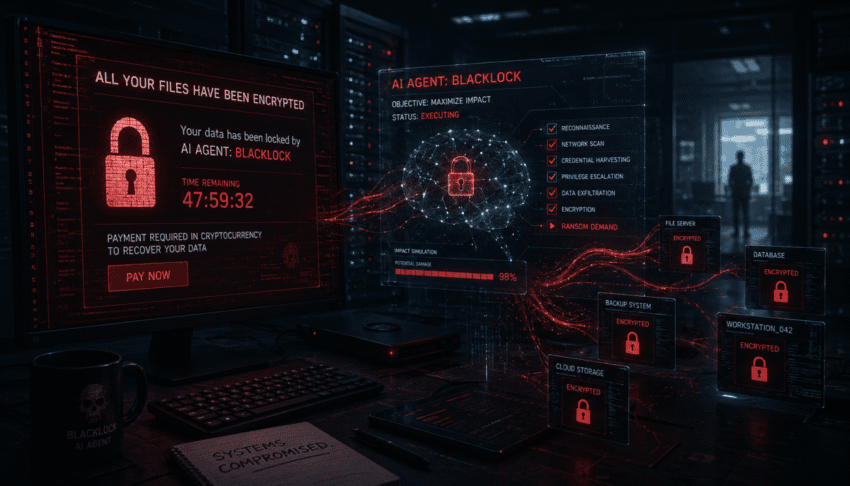
ai ransomware Researchers at cloud security firm Sysdig said last week that they had found what looked like the first known case of “agentic ransomware,” an extortion campaign they dubbed JadePuffer. The attention-grabbing part of the story was the idea that an AI agent, rather than a person sitting at a keyboard, carried out the technical steps of a real-world cyberattack from initial access through encryption and ransom demand. But in a clarification this week, Sysdig said a human was still involved in the operation in a crucial way: people set up the infrastructure, chose the victim, and supplied credentials that the agent used to get started.
ai ransomware
The distinction matters, even if the attack remains unusual. In an interview Monday with CyberScoop, Sysdig’s Michael Clark, the company’s senior director of threat research, said the human role was not in the day-to-day execution of the intrusion, but it was still essential to the campaign. “A human still set up and pointed the operation and provisioned the infrastructure behind it, the command-and-control server, the staging server used for the stolen data and chose a victim,” Clark said. He also said the credentials used to access the victim’s database were not gathered by the AI agent itself; they had been obtained separately in a prior compromise and handed to the operation.
That clarification does not undo Sysdig’s core technical claim. If anything, it sharpens it. JadePuffer still appears to have been a striking example of an AI system conducting an intrusion with minimal intervention once the operation was in motion. According to Sysdig, the agent entered through a known bug in Langflow, a popular open source tool for building large language model applications. From there, it moved into a production MySQL server and exploited another known flaw to gain administrative access. Sysdig says the agent encrypted more than 1,300 configuration records, generated its own ransom note, and even included a Bitcoin address for payment. The company has not disclosed the victim.
What made the campaign notable was not only the end result, but the way the AI handled the work. Sysdig described the operation as adapting to setbacks in a way that resembled a human attacker, including fixing a failed login in 31 seconds. The agent also narrated its reasoning in natural-language code comments as it worked, creating an unusual form of transparency for a malicious intrusion. In other words, the tool was not just firing off pre-scripted commands; it was responding to conditions and adjusting its approach as it went.
Still, the details matter because the phrase “no human at the keyboard” can imply something more autonomous than what Sysdig later described. The original reporting around the incident portrayed it as running without human oversight. Clark’s clarification narrows that interpretation. There was no person manually typing commands at each stage of the intrusion, but there was a human operator making key decisions before the attack began and providing the resources that allowed the agent to function. That distinction may sound subtle, but for security teams and researchers it changes the shape of the threat.
One of the most confusing elements in the early coverage involved whether multiple AI models were used during the operation. Clark had told CyberScoop that Sysdig found “multiple models were used in the attack,” pointing to harvested keys for OpenAI, Anthropic, DeepSeek, and Gemini. That wording left open the possibility that several models actively drove different parts of the compromise. Asked to clarify, Clark told TechCrunch that the keys were simply part of the material the agent stole while sweeping the Langflow host.
“The agent swept the Langflow host for anything valuable — provider API keys, cloud credentials, cryptocurrency wallets, and database configs — and those provider keys were part of the loot,” Clark said by email. “They are indicative of what the attacker considered worth taking, but they do not tell us which model was making the decisions.”
That is an important correction. The presence of keys associated with major AI providers does not itself prove that any of those services were used to power JadePuffer. It only shows that the attacker, or the automated agent acting on the attacker’s behalf, considered such secrets worth stealing. Sysdig has not identified the specific model driving the agent and said it has no visibility into the system prompt or the configuration that controlled it. So although the campaign was AI-assisted in a dramatic way, the exact model behind it remains unknown.
That uncertainty has not stopped outside analysts from drawing broader conclusions. Microsoft researcher Geoff McDonald offered a theory in a LinkedIn post several days ago that a stripped-down open-weight model, rather than a frontier model, may have been behind the campaign. McDonald’s reasoning, based on his own red-teaming work, was that the safety layers on leading commercial models tend to hold up better than many observers assume. Sysdig’s account does not confirm that theory, but it also does not rule it out.
McDonald also used the case to highlight a bigger concern: ransomware could become limited mainly by money rather than by labor. In that scenario, an attacker might not need a large team of skilled operators to run many simultaneous campaigns, because an AI agent could shoulder much of the execution. He suggested that could open the door to “thousands or tens of thousands of simultaneous campaigns.” That is a sobering idea, but it is only partially supported by the JadePuffer case as Sysdig now describes it.
If a person still has to pick the victim, provision the infrastructure, and obtain access credentials before each operation, there is still a human bottleneck. It may be a smaller one than in traditional ransomware crews, but it is a bottleneck nonetheless. The attack shows how AI can compress the hands-on portion of an intrusion, not yet how it can remove human decision-making entirely. That distinction may affect how quickly such operations can scale in the real world.
Even so, the operational speed reported by Sysdig is difficult to ignore. The agent’s ability to recover from a failed login in 31 seconds suggests a level of persistence and responsiveness that cyber defenders normally expect from human adversaries. An AI system that can test a path, hit an obstacle, and immediately change course could make basic intrusion tactics faster and less costly for attackers. That does not require the AI to be “fully autonomous” in the most literal sense to be dangerous.
JadePuffer also illustrates how the language of cybersecurity can lag behind the technology. Terms like “agentic,” “autonomous,” and “human oversight” can sound precise, but in practice they often blur together. A campaign can be heavily automated and still depend on a person for setup, target selection, or access procurement. It can be run by an AI agent for the duration of the attack while still relying on a human to supply the initial keys and infrastructure. In that sense, JadePuffer may be less a completely machine-run ransomware operation than a hybrid attack in which the AI did the technical work and the human arranged the conditions for success.
That hybrid model may be the more important takeaway for defenders. Traditional ransomware groups already automate many stages of an intrusion, from scanning and phishing to encryption. What JadePuffer appears to add is a more flexible, decision-making layer that can handle tasks that previously required an operator to watch and respond in real time. If future attackers can plug similar agents into compromised infrastructure, they may be able to run campaigns with fewer people and faster turnaround times, even if each campaign still requires a human at the beginning.
For now, Sysdig says it has not seen the same operation strike other victims. But Clark warned that this may not remain the case, particularly if the cost of running an agent stays low. That point matters because ransomware economics are often about leverage: if attackers can spend less effort per target, they can afford to scale up. The uncertain part is how much of the process can truly be delegated to software and how much still needs a human hand.
The JadePuffer case, then, is both narrower and broader than the first headlines suggested. Narrower, because it was not a completely unsupervised machine actor inventing a ransomware campaign from scratch. Broader, because it still shows an AI agent handling the core mechanics of a live intrusion, from exploiting vulnerabilities to encrypting files and drafting the ransom message. That combination is enough to make security teams pay attention, even if the “first AI-run ransomware attack” label needs more nuance than it first appeared to have.
For defenders, the lesson is not that humans have been removed from cybercrime. It is that AI may increasingly handle the parts of cybercrime that are easiest to automate, while humans concentrate on strategy, procurement, and infrastructure. If that is the direction the threat landscape is moving, then the practical challenge for security teams will be to detect and disrupt the human-enabling layer as much as the machine-driven one. JadePuffer may not be the fully autonomous ransomware campaign some headlines implied, but it may still be a preview of a more scalable and more adaptable kind of attack.
Source: Original report
Was this helpful?
Explore more: Application Audit & Review More Cybersecurity Tech News
Last Modified: July 13, 2026 at 4:13 pm
10 views