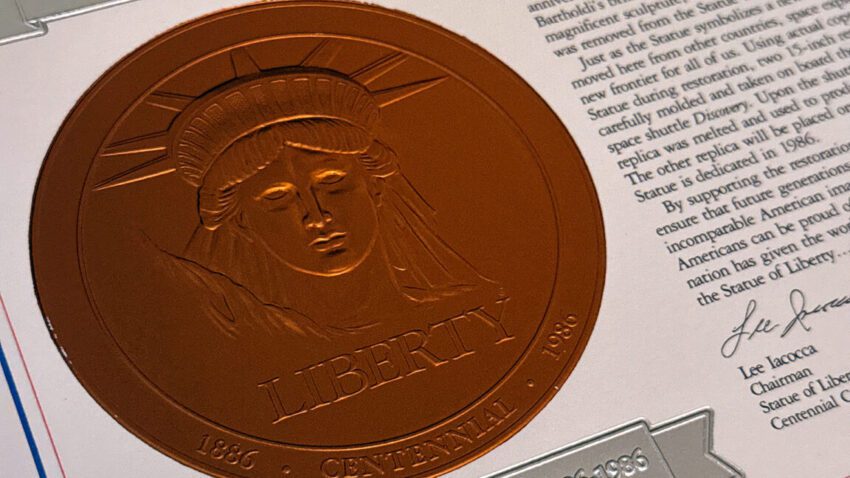
uss constitution spike When the space shuttle Discovery carried tiny copper “Lady Liberties,” a reprint of Thomas Jefferson’s parliamentary manual, and a replica of George Washington’s Headquarters Flag, it was participating in a long tradition: sending pieces of American history into orbit. But if the question is which object from the United States has traveled the farthest back in time before being launched into space, the answer appears to be a modest copper spike from the USS Constitution—an original ship component dating to 1787 and flown aboard Atlantis in 1995.
uss constitution spike
Spaceflight has carried more than astronauts
The history of human spaceflight is often told through crews, rockets, and missions. Yet spacecraft have also functioned as time capsules, carrying small items chosen for their symbolic value. Some are commemorative souvenirs, others are historical artifacts, and many are replicas made specifically because the originals are too fragile, too important, or too irreplaceable to risk in space.
That makes the question of the “oldest American object ever launched into space” a surprisingly nuanced one. In the Ars Technica report, the term “Americana” is used to mean memorabilia that dates back to the Revolutionary War era and the signing of the Declaration of Independence in 1776. Under that definition, the field includes objects tied to the founding of the country, early national symbols, and artifacts associated with the first major institutions of the United States.
There are older objects that have gone to space, but they fall outside that scope. One example cited in the report is a 1611 Jamestown “luggage tag” from the first permanent English settlement, which flew aboard Atlantis in 2007. That item is historically significant, but it is not Americana in the narrower sense used here.
The Statue of Liberty went to orbit in miniature
The headline-grabbing story that opened the article involves the Statue of Liberty, which has technically been launched into space—not once, but twice in miniature form. During the April 1985 STS-51D mission, Discovery lifted off on its fourth flight carrying two 15-inch-tall replicas of the monument. Both were made of copper removed from the full-size statue during restoration work that was still underway at the time.
Those small statues had a second life after the weeklong mission. One was placed on display, while the other was melted down to create copper seals that were sold to the public by the Statue of Liberty Ellis Island Centennial Commission. The copper itself dated to the monument’s original construction between 1875 and 1884. The statue, a gift from France, was originally intended to commemorate the United States’ centennial in 1876.
It is an evocative example of how spaceflight can extend the symbolic life of a national icon. But it is also a reminder that “oldest object” debates often hinge on whether one counts original material, a replica, or a ceremonial offshoot created from historic stock.
John Glenn’s historical flight kit
John Glenn’s 1998 return to space aboard Discovery added another layer to the story. Glenn, one of the original Mercury astronauts and later a US senator, was 77 years old at the time, making him the oldest person to fly into space. For that mission, he selected two items connected to early American history.
One was a 1993 reprint of Thomas Jefferson’s 1801 book, Manual of Parliamentary Practice. The U.S. Senate Curator’s Office explained in a 2023 article that, after consultation with staff in the Office of Senate Curator, the Senate Historical Office, and Senate Library, Glenn selected the book for the STS-95 Official Flight Kit. The office described the volume as a practical choice because of its small size and weight, and also as a meaningful text in Senate history.
Jefferson wrote the manual in 1801 while serving as vice president, which also made him the head of the Senate. The work influenced both houses of Congress in matters of order and decorum, giving the book significance beyond its modest physical size. But the copy flown by Glenn was a 1993 reprint, not an original first edition.
Glenn also flew a replica of George Washington’s Headquarters Flag, a 13-star banner associated with the battlefield identification of the general. The report notes that the flag was believed to be inspired by the details on Washington’s uniform in 1777. Glenn’s flight with the flag took place in the lead-up to the bicentennial commemorations of Washington’s death in 1799.
Again, however, the original artifact remained safely in a museum. The flag Glenn took was made specifically for the 1998 mission, underscoring the frequent need for replicas in these heritage flights.
Other flags and historical symbols in space
The tradition continued beyond Glenn’s mission. Another historic flag replica spent time aboard the International Space Station from November 2014 through June 2015. NASA astronaut Terry Virts was provided the 15-star flag by Fort McHenry in Maryland. That flag had been flown over the historic site for Flag Day during the bicentennial year of the Battle of Baltimore.
The original flag linked to Fort McHenry was the one seen by Francis Scott Key to “yet wave,” inspiring the poem that became the US anthem, The Star-Spangled Banner, in 1814. The article uses this example to show how space programs have carried not just scientific equipment but also emblems tied to national memory and identity.
Even so, flags present a recurring challenge in this kind of historical accounting. The items that fly are often reproductions, ceremonial versions, or commemorative substitutes. They are meaningful, but not always original artifacts from the era they reference.
The Golden Spike and the age of commemorative replicas
Another example in the report comes from the Golden Spike that marked the completion of the First Transcontinental Railroad. In May 1869, a 17.6-karat gold spike was used ceremonially at Promontory Summit in the then-Utah Territory. Today the site is a National Historical Park near where Northrop Grumman builds and tests solid rocket motors for launch vehicles.
Ninety-six years later, a replica of the Golden Spike flew on Atlantis with the STS-38 crew. Like the Jefferson book and the Washington flag, this was a historical symbol made suitable for space by being reproduced rather than by sending the original.
The fact that replicas are so common is important. Many of the best-known objects associated with American history are too delicate, too valuable, or too institutionally important to risk. That leaves historians and mission planners with a choice: send a copy that conveys the story, or keep the original safe on Earth.
The likely oldest original Americana to reach space
That brings the story back to the USS Constitution, the ship popularly known as “Old Ironsides.” The report identifies a copper spike from the frigate as the oldest known piece of Americana to have actually flown into space.
The artifact in question was an original component of the ship’s hull. A plaque accompanying the item states: “In honor of the 200th anniversary of the commissioning of the USS Constitution, ‘Old Ironsides,’ this copper spike, an original component of the hull of the USS Constitution, [was] flown on the United States space shuttle.”
According to the article, the spike was removed from the ship in 1992 and dates back to 1797. It flew aboard Atlantis during the entire STS-71 mission, which ran from June 27 through July 7, 1995. That mission was historically significant because it marked the first rendezvous and docking between a NASA shuttle and the former Russian space station Mir.
As a physical artifact, the spike is notable not only for its age but also for its originality. Unlike the miniature Statue of Liberty, the Jefferson reprint, the Washington flag replica, and the Golden Spike replica, this item was an authentic component of an iconic early American vessel.
Why the USS Constitution matters in this debate
The USS Constitution itself occupies a special place in American history. Launched in 1797, it remains one of the most recognizable symbols of the early U.S. Navy. Its copper and wooden materials connect it directly to the nation’s first decades. An original spike from the hull therefore carries a stronger claim to being “the oldest” than later commemorative reproductions, even if other objects may be older in absolute historical terms.
The report also notes another Constitution-related artifact: a fragment of wood of similar age that was launched into orbit with the Hubble Space Telescope on STS-31. That piece had been on loan at the US Naval Academy Museum in Annapolis, Maryland. The article does not present it as the oldest object, but it reinforces the idea that the ship has been a recurring source of historic items for spaceflight.
A question with a careful answer
So what is the oldest American object ever launched into space? Based on the reporting, the best-supported answer is the copper spike from the USS Constitution, an original ship component dating to 1797 that flew on Atlantis in 1995. It appears to be the oldest original piece of Americana known to have left Earth.
The careful wording matters. The answer depends on how one defines “American,” whether replicas count, and whether the object must be original rather than a modern reproduction of an older artifact. The article itself makes those distinctions clear by comparing originals, copies, and items made from historic material.
That distinction also helps explain why the answer is not the Statue of Liberty, despite the dramatic image of a national monument reaching orbit. Nor is it Jefferson’s manual or Washington’s flag, both of which were flown as reproductions. The USS Constitution spike stands out because it is both old and original.
Spaceflight as preservation and performance
The broader story is not just a trivia question. It reflects a recurring pattern in American space history: missions often carry objects that help connect technical achievement with public memory. A flight can commemorate a bicentennial, honor a national symbol, or mark a milestone in the country’s historical narrative.
At the same time, these objects have to survive launch loads, microgravity, and return, which is why originals are frequently ruled out. The result is a curated blend of authenticity and symbolism. A replica can still represent a real story, while an original can make a mission feel like a direct encounter with history.
That is why the USS Constitution spike is so compelling. It is small, easy to overlook, and not nearly as famous as the ship itself. Yet it may be the oldest surviving American-made object ever to travel beyond the atmosphere, making it a tiny but powerful piece of the space age.
Whether future missions will carry older artifacts remains an open question. But for now, the answer to the old Americana puzzle seems to rest on a copper spike from a ship that helped define the early United States—and that later found itself, briefly, in the company of astronauts and spacecraft.
Source: Original report
Was this helpful?
Explore more: More General Technology Tech News Blog
Last Modified: July 13, 2026 at 4:15 pm
22 views