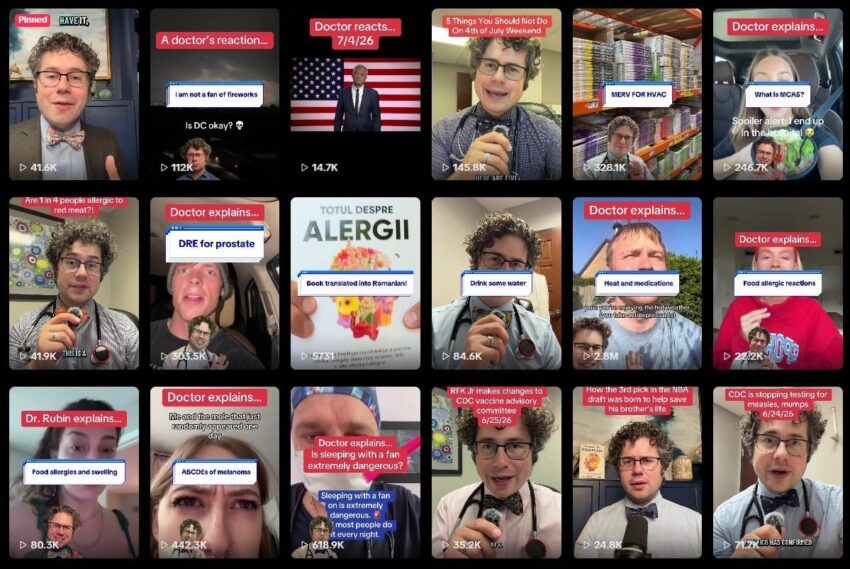
dr rubin Dr. Zachary Rubin spends his days treating children as a pediatric allergist and immunologist, but his online presence has made him a familiar face in a very different kind of clinic: the internet, where he takes on medical and scientific misinformation with a bowtie, a small microphone, and a calm, evidence-based style.
dr rubin
A doctor with two jobs
Rubin is the author of All About Allergies and has built an audience on Instagram, TikTok, and YouTube by addressing health claims that circulate far beyond his exam room. In a recent interview, he described why he chose medicine in the first place and why he now sees public communication as part of the work. He said he has “always been fascinated by how the human body works,” and that medicine appealed to him because it combines “science, problem-solving, and the privilege of helping people during some of the most vulnerable moments of their lives.”
That path was shaped in part by family. Rubin said he was fortunate to see those vulnerable moments early because his father is a pediatrician. He also explained why allergy and immunology became especially compelling to him: the immune system “touches nearly every aspect of health,” and many of the conditions he treats can improve dramatically when patients finally receive the right diagnosis and treatment.
He acknowledged that becoming a physician is “incredibly challenging,” but said it has also been “one of the most rewarding decisions” of his life. That balance between difficulty and purpose seems to inform the way he approaches social media. Rubin has become known for a confident on-camera presence that never tips into condescension, which may be part of why his videos stand out in a crowded field of health creators.
Why he stepped into the online misinformation fight
Rubin’s online work is not a side hobby detached from his clinical life. He said he realized that misinformation “doesn’t stay online; it walks into my exam room every day.” That observation helps explain why he sees social platforms as more than a place to post quick reactions to bad advice. For him, they are a way to reach people before confusion becomes a clinic visit.
He said patients deserve “understandable, evidence-based information before they ever need to see a doctor.” Social media, in his view, lets him scale conversations that would otherwise happen one-on-one in an office. “My goal isn’t to tell people what to think,” he said. “It’s to help them think critically about health claims, understand what the evidence actually shows, and feel empowered to ask better questions.”
That framing is central to Rubin’s style. Rather than trying to win arguments through outrage, he emphasizes understanding. The approach is especially relevant in an environment where attention often goes to the most sensational claim, not the most accurate one. Rubin’s method is to meet people where they are while making the case for evidence, context, and humility.
What science should look like
Asked about the one thing he wishes more people understood about science and medicine, Rubin pointed to uncertainty. He said uncertainty is not a flaw but “one of science’s greatest strengths.” In his view, science is not “a collection of immutable facts.” Instead, it is “a process for getting closer to the truth.”
That process requires people to change their minds when better evidence comes along, and Rubin said good scientists must be willing to do exactly that. He noted that this can appear inconsistent to the public, even though it is actually how progress happens. His rule of thumb is simple: “Confidence should always be proportional to the quality of the evidence.”
This is a useful reminder in an era when health claims are frequently delivered with certainty but little support. Rubin’s point is not that science is indecisive. Rather, science is disciplined about what it can claim and honest about what remains unresolved. That distinction matters when misinformation often uses absolute language to sound authoritative.
The reward and the frustration of countering misinformation
Rubin said the most rewarding part of fighting misinformation online is hearing from someone who says, “I changed my mind.” He called that “incredibly rare today,” and said it shows that respectful conversations can still matter. In a media environment that rewards conflict, a willingness to reconsider a claim can feel almost radical.
At the same time, the work is difficult. Rubin said misinformation spreads faster than nuance. A confident but wrong statement can go viral within minutes, while an explanation of the evidence often takes much longer to produce and is less likely to travel as widely. He also pointed to algorithms that reward outrage, which can make the environment feel stacked against careful communication.
That imbalance, in his view, is exactly why more physicians and scientists need to participate in the conversation. If reliable voices stay silent, he suggested, the gap will be filled by louder and less trustworthy ones. Rubin’s answer reflects a broader challenge facing science communicators: accuracy alone is not enough if it cannot compete in the attention economy.
What the United States gets right — and where it falls short
Rubin was also asked what the United States, heading toward its 250th birthday, is doing well in science and medicine and what it should improve. He said the country has “an extraordinary history of scientific discovery” because it has invested in research, encouraged innovation, and welcomed people with diverse ideas and expertise. He said he hopes those strengths continue.
But he sees room for improvement, especially in scientific literacy. Rubin argued that people should spend more time learning how to evaluate evidence, not just memorize facts. That distinction matters because scientific literacy is not simply about knowing terminology; it is about understanding how claims are supported, challenged, and revised.
He also said scientists and physicians need to become better communicators. If experts do not explain their work clearly and transparently, he warned, “someone else will fill that void.” In his view, trust is not built by pretending to have every answer. It is built through honesty about what is known, what is uncertain, and how researchers are working to find out more.
Why Rubin’s online presence stands out
Rubin’s appeal likely comes from the combination of his clinical credentials and his delivery. He speaks with authority, but his tone is measured. The bowtie and the handheld microphone give him a recognizable visual identity, but his content appears to rely on something more durable than branding: a willingness to translate complex medical information without talking down to people.
That approach matters because misinformation often thrives on emotional certainty. A creator who sounds angry or dismissive can alienate audiences even when the underlying facts are correct. Rubin instead seems to aim for the middle ground between rigor and accessibility. He does not treat viewers as adversaries; he treats them as people who may need better tools to sort evidence from noise.
In medicine, that attitude can have practical consequences. If a patient arrives having seen a viral claim about allergies, immune disorders, or another health concern, the conversation that follows may depend on whether they feel embarrassed, judged, or respected. Rubin’s model suggests that the best response is not simply correction, but context and clarity.
Why his message resonates now
Rubin’s comments also speak to a larger cultural moment in which expertise is frequently challenged and the boundaries between informed advice and viral content can blur. The internet has made it easier than ever for people to encounter health information, but not all of that information is equally trustworthy. In that setting, the role of the clinician can expand beyond diagnosis and treatment to include public education.
Rubin appears to understand that the task is not just to debunk falsehoods one by one. It is to build the habits of mind that help people navigate future claims more effectively. That is why his emphasis on evidence, uncertainty, and asking better questions feels so central. He is not only answering misinformation; he is trying to inoculate audiences against it.
His comments also highlight a tension many doctors now face: the tension between the slow, careful pace of medicine and the instant, high-velocity culture of social media. Clinical work demands nuance, while online systems often reward simplicity. Rubin’s work suggests that it is still possible to bring those two worlds together without sacrificing credibility.
A communicator, not just a creator
It would be easy to think of Rubin as simply another medical content creator. But his interview makes clear that he sees the role as an extension of his responsibility as a physician. By bringing the same evidence-based mindset to social platforms that he brings to patient care, he is trying to reduce the distance between public confusion and professional guidance.
That mission is not glamorous. It requires patience, repetition, and a tolerance for being ignored or misunderstood. It also requires accepting that no single video will fix the larger information ecosystem. Still, Rubin’s experience suggests that even small moments of clarity can matter, especially when they reach someone before misinformation hardens into belief.
In that sense, his work is less about winning online arguments than about making reliable information more available and easier to trust. It is a reminder that science communication is not a luxury or a brand exercise. For physicians like Rubin, it is becoming part of how care is delivered in public.
Source: Original report
Was this helpful?
Explore more: More General Technology Tech News Blog
Last Modified: July 13, 2026 at 4:12 pm
14 views