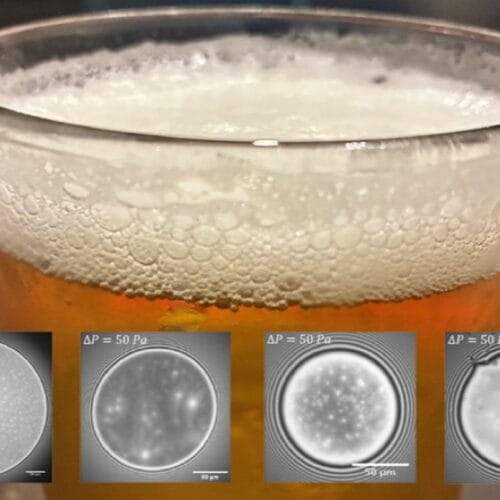
Scientists unlock secret to thick, stable beer foams: A research team from Switzerland has made significant progress in understanding the factors that contribute to the stability and thickness of beer foam, a crucial aspect for beer enthusiasts. After seven years of dedicated research, the team has uncovered the reasons why some beers maintain a thick, lasting head of foam while others do not. Their findings, published in the journal Physics of Fluids, highlight the role of fermentation in foam stability and could have implications beyond brewing.
Key takeaways
- The thickness and stability of beer foam are influenced by the degree of fermentation.
- Foams are formed by air being introduced into a liquid containing surfactants.
- Over time, bubbles coarsen, leading to changes in foam structure.
- Understanding foam stability can have implications for various industries beyond brewing.
For many beer lovers, the presence of a thick head of foam atop their drink is not merely aesthetic; it enhances the overall sensory experience. The foam’s longevity can significantly affect how one perceives the beer’s flavor and aroma. The Swiss researchers aimed to quantify this relationship and identify the underlying mechanisms that contribute to foam stability.
The study emphasizes that the degree of fermentation—whether a beer is singly, doubly, or triply fermented—is a critical determinant of foam stability. Fermentation is the process by which yeast converts sugars into alcohol and carbon dioxide. This process not only influences the beer’s flavor profile but also its physical properties, including the formation and persistence of foam.
In their research, the scientists conducted a series of experiments to analyze how different fermentation levels affect foam characteristics. They discovered that beers with higher fermentation levels tend to produce foam with greater density and stability. This is attributed to the increased presence of proteins and polysaccharides generated during fermentation, which act as surfactants. Surfactants are essential in stabilizing bubbles, as they reduce the surface tension of the liquid, allowing the bubbles to maintain their shape and size for a more extended period.
Foams are a common phenomenon in various aspects of daily life, from culinary applications like whipped cream to industrial products such as insulation and flame retardants. The underlying physics of foam formation involves the introduction of air into a liquid mixture containing surfactants. These surfactants strengthen the walls of the bubbles, preventing them from collapsing. The study of foams has implications that extend beyond the brewing industry, offering insights into various applications where stability and durability of foams are crucial.
The Science of Foam Formation
Understanding the science behind foam formation involves examining the behavior of bubbles. Typically, bubbles form spherical shapes because this configuration minimizes surface area for a given volume, making it the most energy-efficient arrangement. This spherical shape allows bubbles to pack tightly together, creating a foam structure. However, as time progresses, bubbles undergo a process known as coarsening.
Coarsening occurs due to gravitational forces acting on the liquid surrounding the bubbles, which causes the liquid film walls to thin out. As a result, smaller bubbles are gradually absorbed by larger ones, leading to a reduction in the overall number of bubbles. This process can alter the foam’s appearance and stability, making it more prone to collapse over time.
In practical terms, this means that a beer with a high degree of fermentation will not only generate foam more effectively but will also sustain that foam for a longer duration. The researchers’ findings suggest that brewers can manipulate fermentation processes to enhance foam stability, potentially leading to a more enjoyable drinking experience for consumers.
Implications for the Brewing Industry
The implications of this research extend to the brewing industry, where foam stability is often a key quality indicator. Brewers may consider adjusting their fermentation techniques to optimize the foam characteristics of their products. This could involve experimenting with different yeast strains or fermentation durations to achieve the desired balance between flavor and foam stability.
Moreover, the findings may encourage brewers to explore the use of specific ingredients that enhance foam stability. For instance, the incorporation of certain proteins or polysaccharides that act as natural surfactants could be beneficial. By understanding the science behind foam formation, brewers can innovate and differentiate their products in a competitive market.
Additionally, the research underscores the importance of quality control in the brewing process. As consumer preferences continue to evolve, maintaining a consistent and appealing foam quality could be a significant factor in customer satisfaction and brand loyalty. Brewers who can deliver a product with both exceptional flavor and stable foam may find themselves at a competitive advantage.
Broader Applications of Foam Research
While the study focuses on beer foam, the principles of foam stability and formation have broader applications across various industries. In the food industry, the stability of foams is crucial for products like whipped toppings and mousses. The ability to maintain a stable foam can enhance the texture and mouthfeel of these products, making them more appealing to consumers.
In cosmetics, the durability of foams can influence the efficacy of products such as shaving creams and hair styling products. A stable foam can provide a better application experience, improving the overall performance of the product. Understanding how to create and maintain stable foams could lead to innovations that enhance consumer satisfaction.
Additionally, industries that rely on foams for insulation or fire retardation can benefit from insights gained through this research. Understanding how to create more stable foams could lead to advancements in materials science and engineering, ultimately resulting in safer and more effective products. For example, improved foam stability could lead to better insulating materials that are more energy-efficient and environmentally friendly.
Future Research Directions
The findings of this study open up several avenues for future research. One potential direction is to explore the specific types of proteins and polysaccharides that contribute most significantly to foam stability. By identifying these components, researchers could provide brewers with targeted recommendations for ingredient selection.
Another area of interest could involve examining the impact of different brewing techniques on foam stability. For instance, variations in temperature, pressure, and fermentation time could all influence the final product’s foam characteristics. Understanding these factors could enable brewers to fine-tune their processes for optimal results.
Furthermore, researchers may investigate consumer perceptions of foam stability and its impact on overall beer enjoyment. Conducting sensory evaluations and consumer preference studies could provide valuable insights into how foam quality influences purchasing decisions and brand loyalty.
Conclusion
The research conducted by Swiss scientists sheds light on the complex interplay between fermentation and foam stability in beer. By unlocking the secrets to thick and stable beer foams, this study not only enhances our understanding of a beloved beverage but also opens the door for innovation across multiple industries. As brewers and manufacturers continue to explore the implications of these findings, consumers can look forward to experiencing even better foam quality in their favorite products.
Source: https://arstechnica.com/science/2025/08/physics-of-why-belgian-beer-foam-is-so-stable/
Was this helpful?
Explore more: More General Technology Tech News Blog
Last Modified: August 27, 2025 at 4:49 am
14 views