Imagine asking a question online and getting the exact answer instantly, no scrolling, no clicking, no digging through multiple links. That’s the direction search is heading. From voice assistants to AI-powered search results, users today expect fast, accurate, and conversational responses.
This shift is transforming how content is created and discovered. Traditional Search Engine Optimization (SEO) is no longer enough on its own. While SEO helps your content rank, it doesn’t guarantee that your information will be selected as the answer.
This is where Answer Engine Optimization (AEO) comes in.
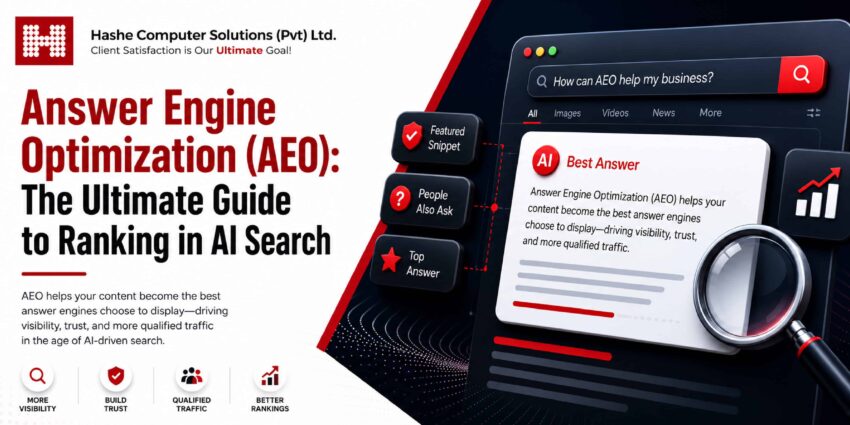
AEO aims to position your content as the most relevant and trustworthy response to user queries, whether it appears in a featured snippet, is spoken by a voice assistant, or is generated by an AI tool. As search engines evolve into answer engines, understanding and applying AEO is becoming essential for anyone who wants to stay visible, competitive, and relevant in the digital space.
In this blog, we’ll explore what AEO is, how it works, and why it’s quickly becoming a must-have strategy in modern digital marketing.
What is Answer Engine Optimization (AEO)?
Answer Engine Optimization (AEO) is a digital content strategy focused on delivering precise, direct, and contextually relevant answers to user queries across search engines, voice assistants, and AI-driven platforms. Unlike traditional optimization methods that prioritize ranking entire web pages, AEO ensures that your specific content is selected and presented as the best possible answer.
At its core, AEO aligns content with how modern users search, through natural language, complete questions, and conversational queries. Instead of targeting isolated keywords, AEO emphasizes user intent, focusing on what the user actually wants to know and delivering a clear, immediate response.
For example, rather than optimizing for a rigid keyword like “AEO meaning,” AEO encourages structuring content to directly answer a natural query such as:
“What is Answer Engine Optimization?”
This approach makes it significantly easier for search engines and AI systems to extract, interpret, and present your content as a definitive answer.
Platforms Powered by AEO
Modern search platforms no longer rank content; they interpret, summarize, and deliver answers. AEO ensures your content is optimized for this shift, helping it appear across:
- Featured Snippets: Prominent answer boxes at the top of search results
- Voice Search Responses: Spoken answers from assistants like Siri, Alexa, and Google Assistant
- AI-Generated Summaries: Synthesized responses in tools like Google AI Overviews and Perplexity
- Knowledge Panels: Instant-answer information boxes displayed on search pages
Structuring Your Content for Success
A key component of AEO is clarity and structure. Search engines prioritize content that is:
- Well-organized with clear, logical headings
- Written in simple, natural, and conversational language
- Broken into concise, easy-to-scan paragraphs or lists
- Enhanced with structured data (schema markup)
When your content is easy to read and extract, it becomes far more likely to be selected as a trusted answer. In simple terms, if SEO helps users find your content, AEO helps search engines use your content.
As search continues to evolve into a more interactive and AI-driven experience, AEO is quickly becoming a foundational strategy for content creators, marketers, and businesses aiming to stay visible, competitive, and authoritative.
SEO vs. AEO: Shifting the Paradigm
To truly understand how digital marketing is evolving, it’s important to view this shift not as a replacement for older methods, but as a fundamental change in user behavior.
For over two decades, search engine optimization (SEO) has been the undisputed king of digital visibility. It operates on a “discovery model.” A user types a fragmented phrase into a search bar, the engine provides a list of potentially relevant links, and the user clicks through to explore. The primary metric of success? Traffic. You want users on your page, clicking your links, and browsing your layout, since success is measured by how many users visit your page and engage with your website.
Answer engine optimization (AEO) completely flips this script. It operates on a “resolution model.”
Instead of guiding users to find information, AEO delivers the information instantly, often without requiring a click. Users get exactly what they need directly within search results, voice responses, or AI-generated summaries. As a result, the success metric shifts from clicks to authority and accuracy; your content becomes the trusted source selected by AI.
Key Technical Differences Between SEO and AEO
While AEO builds on the technical foundation of SEO (such as fast page speed and mobile optimization), the execution strategy differs significantly.
| Feature | Traditional SEO | Answer Engine Optimization (AEO) |
|---|---|---|
| Core Mechanism | Index & rank web pages based on keyword relevance | Extract & synthesize precise answers from content |
| User Query Style | Fragmented keywords (e.g., “best running shoes flat feet”) | Conversational questions (e.g., “Which running shoes are best for flat feet?”) |
| Content Structure | Long-form, comprehensive guides covering entire topics | Structured, modular content with clear Q&A sections |
| Primary Goal | Drive clicks and website traffic | Deliver instant answers and build authority |
| End Result | Users visit your website and explore content | AI displays, summarizes, or speaks your answer |
Coexisting in the Modern Search Landscape
A common misconception is that AEO will replace SEO. In reality, AEO depends on SEO.
AI systems and answer engines rely on high-quality, authoritative web content as their source of truth. If your website lacks strong technical SEO, credibility, or backlinks, it is far less likely to be selected as a trusted answer.
Think of it this way:
- SEO builds your digital presence, ensuring your content is discoverable, credible, and authoritative.
- AEO refines your content, making it clear, concise, and ready to be extracted as an answer.
To succeed in today’s search environment, your strategy must combine both. It is no longer just about ranking on page one; it is about becoming the answer users (and AI) rely on instantly.
Why AEO Matters in 2026 and Beyond
The way people search for information has fundamentally changed, and it continues to evolve rapidly. Users no longer want to browse through multiple links to find answers; they expect immediate, accurate, and conversational responses. This shift is exactly why Answer Engine Optimization (AEO) is becoming a critical component of modern digital strategy.
Here are the key reasons AEO matters now more than ever.
The Rise of Zero-Click Searches
A growing percentage of searches now end without a single click. Users get what they need directly from featured snippets, knowledge panels, or AI-generated summaries.
It means:
- Ranking on page one is no longer enough.
- Visibility alone does not guarantee website traffic.
- Only the most relevant and well-structured content gets selected.
AEO ensures your content is positioned to capture these zero-click opportunities, turning visibility into authority even when a user does not visit your site.
AI-Powered Search Is Redefining Discovery
Search engines are rapidly evolving into answer engines powered by artificial intelligence. Instead of simply listing links, they now interpret user intent, summarize multiple sources, and deliver direct, contextual answers.
Platforms like AI search assistants and generative search experiences prioritize content that is clear, structured, and trustworthy. Without AEO, your content risks being completely overlooked in these AI-driven outputs.
Voice Search Is Changing Query Behavior
With the widespread use of voice assistants, search queries have become more natural and conversational. Users now ask complete, long-tail questions such as:
- “What is Answer Engine Optimization?”
- “Why is AEO important for businesses?”
Voice search usually delivers a single answer rather than a list of options. AEO helps ensure your content is optimized to be that chosen answer.
Increased Competition for “Position Zero”
Featured snippets, often called Position Zero, have become prime digital real estate. Only one or two highly optimized sources are selected to appear in these highly visible spots at the very top of the search page.
AEO drastically improves your chances of securing these placements by structuring your content for easy extraction, providing concise answers, and aligning perfectly with what the user is trying to solve.
Shifting Metrics: From Traffic to Authority
Traditional SEO focuses heavily on clicks and traffic. While these metrics still matter, AEO introduces a new priority: being the trusted source of truth.
Success is increasingly measured by:
- How often your content is selected as an answer
- How visible your brand is in AI-generated responses
- How much authority your content holds in your niche
Even without a click, being featured as the answer builds recognition and trust.
Better User Experience Drives Engagement
AEO aligns perfectly with modern user expectations:
- Fast access to information
- Clear, easy-to-understand answers
- Minimal effort to find what they need
By optimizing for AEO, you’re not just improving search engine performance but also enhancing the overall user experience, which ultimately strengthens brand perception.
Key Elements and Core Pillars of AEO
To succeed with Answer Engine Optimization (AEO), your content must execute a two-step strategy simultaneously:
- Pass the algorithmic evaluation: Align with the quality, clarity, and trust signals that answer engines use to assess content.
- Master structural design: Apply precise formatting techniques so AI crawlers can quickly identify, interpret, and deliver it as an answer.
This section unifies both concepts, combining the high-level philosophy with practical, execution-level tactics to give you a comprehensive framework for creating answer-ready content.
The Core Pillars of (How Answer Engines Evaluate Content)
Before creating a single piece of content, it’s essential to understand how an artificial intelligence engine actually interprets information. Unlike human readers, who may enjoy storytelling or narrative build-up, AI systems evaluate content through the lens of efficiency, clarity, and accuracy.
They don’t “read” in the traditional sense. Instead, they scan, break down, and map information into structured data, identifying key entities, relationships, and meaning. Because of this, most answer engines prioritize content based on three core pillars:
1. Understandability
Can your content be easily read, structured, and interpreted by an AI system?
AI crawlers read text differently from humans. They break it down into entities (nouns, concepts, locations) and the relationships between them to build a structured understanding of information.
If your content is too complex, disorganized, or unclear, the system may struggle to interpret it and could skip it altogether.
Strong understandability depends on:
- Clear hierarchical structure (H2 → H3 headings)
- Clean, grammatically precise sentences
- Logical flow that connects headings with supporting content
2. Directness
Do you resolve the user’s question immediately, or do you make them work for it?
Traditional content strategies often encouraged slow introductions to increase engagement. In AEO, this approach becomes a liability. Answer engines prioritize content that delivers instant clarity.
Generative search experiences favor content that uses the “inverted pyramid” model of journalism: leading with the absolute climax (the answer) and filling in the supporting details afterward.
Using the inverted pyramid model, your content should:
- Lead with the answer
- Provide immediate value within the first few lines
- Expand with supporting details afterward
The faster your content satisfies the query, the more likely it is to be selected and surfaced.
3. Credibility (E-E-A-T)
Can your content be trusted as a reliable and authoritative source?
Since AI engines synthesize and read aloud information under their own brand name (e.g., Google or OpenAI), quoting misinformation carries a massive reputational and legal risk for them. To protect themselves, these platforms rigorously screen for signals of Experience, Expertise, Authoritativeness, and Trustworthiness (E-E-A-T).
They cross-reference your site against strict trust metrics before ever considering your text for a voice response or featured summary.
This typically involves:
- Backing claims with credible data or references
- Demonstrating subject-matter expertise
- Maintaining consistent accuracy across your domain
Content that lacks trust signals is far less likely to be used in featured snippets, voice responses, or AI-generated summaries.
Key Elements of AEO (How to Optimize Your Content?)
Once your content architecture aligns with the core pillars, you must shift your focus to tactical execution. These eight elements serve as the essential controls for turning your content into a precise, answer-ready resource.
1. Question-Focused Content Architecture
To capture conversational traffic, your content must reflect how users naturally phrase their queries. Traditional keyword strategies often focus on fragmented terms, but AEO prioritizes complete, question-based searches.
- Action: Frame your subheadings (H2s and H3s) as full, natural questions.
- Strategy: Use formats like “What is…”, “How do I…”, or “Why does…”.
- Why it works: It aligns your content with how users search via voice and AI-driven platforms.
2. The “Snippet-Sized” Answer Block
Answer engines operate on efficiency and speed; they don’t want to sift through thousands of words to find a simple definition. By adopting a “lead with the answer” approach, you give the crawler exactly what it needs immediately.
Think of this as your elevator pitch to the AI: a short, tightly packed block of information that stands on its own before expanding into deeper context.
- Action: Place a direct answer immediately below your question heading (within 1–2 sentences).
- Strategy: Keep this response concise, ideally between 40–60 words.
- Why it works: This format is ideal for featured snippets and voice assistant responses.
3. Structured and Modular Formatting
Large, unbroken walls of text are difficult for machine learning algorithms to process and interpret accurately. To support efficient parsing, your content should be broken into clean, modular components.
By organizing information into distinct visual groups, you make it easier for an AI system to extract specific sections and present them clearly on a user’s screen.
- Action: Break dense walls of text into clean, scannable data nodes.
- Strategy: Use numbered lists for chronological steps, bullet points for key features, and Markdown tables for comparisons.
- Why it works: It drastically lowers the computational effort required for an AI engine to interpret, extract, and display your data.
4. Back-End Schema Markup Integration
While human visitors interact with the text, colors, and images on your website’s frontend, answer engines rely on structured data to understand context.
Schema markup functions as a translation layer between your words and the algorithm. Adding structured data to your backend eliminates ambiguity, ensuring that the engine clearly understands your page’s intent.
- Action: Add structured data code to your website to speak to search engines in their native language.
- Strategy: Implement FAQ Schema, HowTo Schema, and Article Schema across your pages.
- Why it works: It programmatically labels your text (e.g., “This is the question, this is the answer”), removing all algorithmic guesswork.
5. Strict Search Intent Alignment
An answer engine’s ultimate goal is user satisfaction, which means it will only display content that directly resolves the user’s specific problem. You must look beyond the surface level of a search query and figure out the exact motivation behind it.
True AEO success comes not only from answering the initial prompt but also from predicting and answering the logical follow-up questions the user is bound to think of next.
- Action: Ensure your content completely satisfies the underlying motivation behind a user’s prompt.
- Strategy: Focus heavily on informational intent and anticipate logical, sequential follow-up queries.
- Why it works: When you answer the main question and cover the logical next steps, AI engines will prioritize your page as a trusted, high-value resource.
6. Strong Trust and Authority Signals
Since artificial intelligence platforms face severe backlash when they distribute incorrect information, they are naturally defensive about the sources they use.
You cannot just make broad, unbacked statements and expect an AI to repeat them. To win the trust of an answer engine, you must show your receipts by grounding every claim you make in cold, hard, verifiable proof.
- Action: Intentionally design your pages to broadcast digital trust and validation.
- Strategy: Link out to authoritative external sources, include real-world data points, and feature explicit author bios highlighting real credentials.
- Why it works: It feeds the AI engine the hard proof it needs to feel safe quoting your content without risking misinformation.
7. Natural Language and Conversational Tone
The era of writing mechanical sentences only to please old-school search algorithms is officially over. Modern search systems use incredibly advanced language models designed to evaluate flow, context, and human speech patterns.
To match this shift, your content needs to read like a natural conversation between two people rather than a rigid technical manual packed with forced keyword fragments.
- Action: Write for the ear, not just the eye, by keeping your language fluid and human.
- Strategy: Avoid stiff prose and the old-school habit of stuffing awkward keyword fragments (like “best strategy marketing”). Use grammatically complete phrasing instead.
- Why it works: Because voice-activated search and AI chatbots mimic human dialogue, your content needs to sound natural when read aloud.
8. A Strong Technical SEO Foundation
You can write the most brilliant, perfectly structured answer in your entire industry, but it won’t matter if an answer engine’s crawler can’t access it. AEO is not a replacement for traditional technical SEO; it is a premium layer built right on top of it.
If your website takes too long to load, struggles on mobile screens, or has indexing errors, AI bots will simply move on to a faster, healthier site.
- Action: Maintain a clean, fast, and healthy backend architecture.
- Strategy: Focus on lightning-fast page loading speeds, flawless mobile responsiveness, and unhindered crawler access in your robots.txt file.
- Why it works: AEO cannot fix a broken website; if answer engine bots face tech delays or rendering bugs, they will skip your content entirely.
How to Optimize for AEO: A Step-by-Step Workflow
Knowing the theories behind AEO is great, but how do you actually sit down and apply them to your content? Transitioning your blog or website for answer engines doesn’t require throwing out your existing content; it requires reshaping how that content is planned, written, connected, and maintained.
This step-by-step optimization workflow will take your pages from basic search results to highly extractable AI sources.
Step 1: Conduct Conversational Question Research
To provide the perfect answer, you must first pinpoint the exact questions your audience is asking. Traditional keyword tools are great for finding search volume, but they often struggle to capture the complex, natural language of conversational queries. To find the conversational questions that matter, try these tactics:
- Mine Google’s “People Also Ask” (PAA) Boxes: Search for your target head keyword and document the questions Google already groups together. These are the exact questions the algorithm wants answered.
- Use “AlsoAsked” or “AnswerThePublic”: These tools visualize query networks, showing you the primary question and the subsequent follow-up queries users ask.
- Review AI Prompts Directly: Head to ChatGPT, Perplexity, or Gemini and ask: “What are the top 10 questions a beginner would ask about [your topic]?” to reveal highly specific query variations.
Step 2: Build Your Q&A Content Framework
Once you have your target questions, structure your webpage to resolve them explicitly. Your page should be organized as a logical, sequential path of discovery, taking the reader from basic definitions to advanced steps. To structure your layout effectively, try these tactics:
- Map Questions to Headers: Use your H2 and H3 tags to state the user’s questions verbatim (e.g., Why is organic reach declining on social media?).
- Keep Answers Distinct: Each heading should focus on one specific question and provide a single, direct answer, without overlapping with other sections or drifting into unrelated points. Make sure each heading has a single, clear purpose so the AI scraper doesn’t get confused.
- Group Related Concepts Together: Arrange your question headers in a logical hierarchy so that basic, foundational answers naturally precede complex, technical solutions.
Step 3: Write the “Snippet-Sized” Answer Block
This is where you execute the “inverted pyramid” style. For every question-based header on your page, you must provide a quick, high-density answer immediately below it before expanding on the details. To write a high-performing answer block, try these tactics:
- Keep it Concise: Write a brief and precise summary, ideally keeping it between 40 and 60 words to easily fit featured snippet slots.
- Be Direct and Objective: Lead with a declarative definition (e.g., “Answer Engine Optimization (AEO) is…” rather than “When we think about AEO, we should first think about…”).
- Avoid Fluff and Fillers: Cut out introductory phrases, storytelling, and conversational wind-ups, getting straight to the core solution in the very first sentence.
Step 4: Inject Schema Markup into Your Code
To ensure search engine crawlers do not have to guess what your content represents, you need to state its purpose explicitly in your site’s code. Schema markup acts as a translation guide for search algorithms. To implement structured data on your site, try these tactics:
- Deploy FAQ Schema: For any page featuring a Q&A format, apply FAQ structured data to tell the crawler exactly where the question ends and where the authoritative answer begins.
- Use HowTo Schema: If you are writing a tutorial or procedural guide, apply the HowTo schema so that AI engines can read the steps in chronological order.
- Leverage Article Schema: Ensure your blog posts use Article or NewsArticle schema to verify author details, publication dates, and content publishers.
Step 5: Establish Off-Site Trust and Mentions
AI engines do not just evaluate your website; they look at your brand’s reputation across the entire web. If other credible sites, forums, and directories are not talking about your brand, an AI is unlikely to cite you as an authority. To build digital authority outside your website, try these tactics:
- Secure Brand Mentions on High-Authority Sites: Focus on digital PR, guest posting, and industry interviews to get your brand name mentioned on reputable, niche-relevant websites.
- Be Active in Community Hubs: Answer user questions directly on forums like Reddit and Quora, as AI engines frequently pull answers directly from active discussion sites.
- Keep Niche Directories Consistent: If you run a local business, ensure your Name, Address, and Phone number (NAP) are identical across all maps, directories, and social platforms to prove real-world legitimacy.
Step 6: Optimize for Multi-Modal Extraction
AI engines do not just extract plain paragraphs; they prioritize structured data formats. When you present data visually, you make it incredibly simple for an AI system to lift that specific chunk off your page and display it on a user’s screen. To make your content easy to extract, try these tactics:
- Include Definition Boxes for Key Terms: Highlight core concepts inside stylized panels or blockquotes to visually separate them from the rest of the text.
- Use Comparison Tables for Alternatives: Use clean Markdown tables to organize pros, cons, and features of different products, systems, or ideas.
- Format Processes as Step-by-Step Lists: Present steps in a numbered list to display sequential instructions.
Step 7: Create Internal Answer Networks
Most digital content is written in complete isolation, but AEO heavily rewards connected knowledge systems. Because AI search engines are built to map the semantic connections between topics, they favor websites that demonstrate comprehensive, organized depth. To build a connected ecosystem of knowledge, try these tactics:
- Link Related Questions Across Articles: Ensure your articles naturally cross-reference each other whenever a related question arises.
- Build Topic Clusters: Designate a highly comprehensive “pillar” page for broad topics, and link it directly to narrower, specific “supporting” pages.
- Use Descriptive Anchor Text: Avoid generic hyperlinks like “click here.” Instead, use descriptive anchor text that naturally reflects real-world search questions.
Step 8: Refresh and Revalidate Content Regularly
AEO is highly sensitive to accuracy, relevance, and real-time freshness. Because AI platforms run on factual verification, outdated statistics, dead links, or debunked strategies will quickly get your content dropped as a recommended source. To keep your pages prioritized as trusted resources, try these tactics:
- Update Statistics and Examples: Update older data points with current research and replace outdated case studies with fresh, modern examples.
- Improve Weak Answer Blocks: Identify pages that are dropping in visibility and rewrite their primary answer blocks to be more direct and concise.
- Expand Sections Where Intent Isn’t Fully Satisfied: Review your content and identify logical follow-up questions that remain unanswered. Expand the copy to address these questions.
The Challenges and Future of AEO
While Answer Engine Optimization offers an incredibly powerful framework for modern digital visibility, it is not without its hurdles. Navigating a landscape dominated by artificial intelligence means adapting to rapid technological shifts, dealing with measurement limitations, and planning for a highly automated future.
To keep your digital strategy ahead of the curve, you must understand both the current bottlenecks and where this technology is heading.
The Core Challenges of AEO
Shifting your focus to answer engines introduces unique obstacles that traditional search engine optimization never had to face. To prepare your strategy for these roadblocks, consider the following primary challenges.
- The Zero-Click Search Dilemma: Since answer engines aim to resolve queries directly on the search results page or inside a chat window, website click-through rates (CTR) can decline. Marketers must learn to balance providing instant answers with giving users a compelling reason to click through to their site for deep-dive content.
- Loss of Traditional Attribution and Analytics: Unlike traditional SEO, where tools like Google Analytics track clicks, sessions, and referral sources, AI-driven answer engines operate as closed systems. Measuring when and how your content is surfaced, cited, or used on platforms like ChatGPT or Perplexity is challenging, limiting visibility into performance and attribution.
- Rapidly Shifting Algorithmic Standards: Traditional SEO algorithms change multiple times a year, but LLM (Large Language Model) updates and real-time training loops happen continuously. An answer block that was favored by an engine yesterday can be easily bypassed tomorrow if a competitor introduces a more updated data point or structured table.
- Legal and Ethical Considerations of AI Content Use: There is ongoing tension between publishers and AI companies around copyright, data scraping, and content licensing. While tools like robots.txt can help manage how crawlers access your site, they do not fully control how content is used once it is indexed or incorporated into AI systems. As a result, publishers must stay informed about evolving web standards, platform policies, and legal frameworks to better manage content usage and attribution.
The Future of AEO
As search continues to evolve, AEO is shifting from a specialized tactic to a core standard for how content is structured, discovered, and delivered.
To stay ahead, prepare for these emerging trends:
- From Search Engines to Action-Oriented AI Systems: AI search is evolving beyond summarizing information toward enabling task completion. Instead of simply answering questions, users can increasingly rely on AI systems to perform actions, such as making reservations, booking services, or completing transactions.
For AEO strategies to remain relevant, they should start aligning with structured, machine-readable data and integrations that enable platforms to transition from merely answering queries to actively facilitating outcomes.
- Multi-Modal AI Optimization (Voice, Image, and Video): Search is no longer limited to text. Users are increasingly interacting with AI systems through voice commands, images, and video inputs. As a result, AEO is expanding beyond written content to include optimized image metadata and alt text, video transcripts and structured captions, and natural, conversational phrasing for voice queries.
Content that is accessible across multiple formats will be better positioned to surface in AI-driven results.
- Hyper-Personalized Answer Generation: Traditional search results were largely uniform, but modern AI systems are increasingly capable of adapting responses based on context, user behavior, and situational signals such as location or intent.
While personalization is still evolving, this shift suggests that content strategies should move toward building flexible, context-rich topic clusters that can serve multiple user scenarios rather than a single static query.
- The Rise of Brand Citation in AI Responses: As AI-generated answers reduce the need for clicks, visibility is shifting from website traffic to being referenced within responses. This makes “brand citation” an emerging priority: how often your content or brand is used as a trusted source.
In response, new analytics approaches are beginning to focus on measuring presence within AI outputs, such as tracking share of voice across platforms and identifying where brands are being referenced in generated answers.
Frequently Asked Questions (FAQs) About Answer Engine Optimization (AEO)
1. What is Answer Engine Optimization (AEO)?
Answer Engine Optimization (AEO) is the process of optimizing content so AI-powered search systems, voice assistants, and answer engines can understand, extract, and present it as a direct response to user queries. Unlike traditional content optimization, AEO focuses on making your content the most reliable and accessible answer source.
2. What is the difference between AEO and SEO?
SEO focuses on improving search visibility by helping web pages rank higher in traditional search results and attract clicks. AEO goes a step further by optimizing content for direct answers, AI-generated summaries, voice responses, and conversational search experiences. In simple terms, SEO helps users find your content, while AEO helps AI systems select and deliver it.
3. Will AEO replace traditional SEO?
No. AEO is not a replacement for SEO; it is an evolution of it. Strong technical SEO, authoritative backlinks, and high-quality content remain the foundation that helps AI systems discover and trust your information. AEO builds on these principles by making content easier to interpret and deliver as an answer.
4. How do I optimize my website for AEO?
To optimize for AEO, create content around real user questions, provide direct answers near the beginning of each section, use clear headings, structure information with lists and tables, implement schema markup, and strengthen trust signals through expertise and credible sources.
5. Does AEO matter if users are getting answers without clicking websites?
Yes. While AEO may decrease traditional clicks, it enhances your brand’s recognition as a trusted source in AI-generated responses. Visibility, citations, brand authority, and influence in AI-driven search experiences are becoming important success metrics alongside website traffic.
6. How can I measure AEO success?
Measuring AEO is still evolving, but businesses can track indicators such as brand mentions in AI responses, featured snippet visibility, organic impressions, query coverage, referral traffic from AI platforms, and overall authority within their topic area.
Conclusion: The Future Belongs to Answer-Ready Content
Search is undergoing one of its biggest transformations in decades. We are moving from an era of finding links to a world of receiving direct, intelligent answers. As AI-powered search experiences continue to expand, businesses must create content that is not only discoverable but also structured, authoritative, and easy for answer engines to understand.
AEO does not replace traditional SEO; it builds upon it.
By combining a robust technical SEO foundation with clear, valuable, and answer-focused content, you create the signals that modern AI systems seek. Your website becomes not just searchable, but selectable.
The future of digital visibility belongs to brands that don’t simply compete for rankings, but become the trusted sources users and AI systems rely on for accurate answers.
Searching for premier technology partners to elevate your next project? Hashe Computer Solutions is a distinguished digital services firm delivering elite software development, mobile app development, web development, strategic digital marketing, and AI automation services. Reach out today for high-performance creative web design and results-oriented digital marketing strategies.
Check out our Social Media Pages:
- Facebook: https://www.facebook.com/hasheCS/
- Instagram: @hashe_official
- LinkedIn: https://pk.linkedin.com/company/hashe-computer-solutions
- Twitter: https://twitter.com/hashe
- Youtube: https://www.youtube.com/channel/UCay7eQtwoQ3ehoIesAxHDPw
- Pinterest: https://www.pinterest.com/hashecs/
- Threads: https://www.threads.net/@hashe_official
- Behance: https://www.behance.net/hashecs
Was this helpful?
Last Modified: September 17, 2026 at 7:03 am
125 views