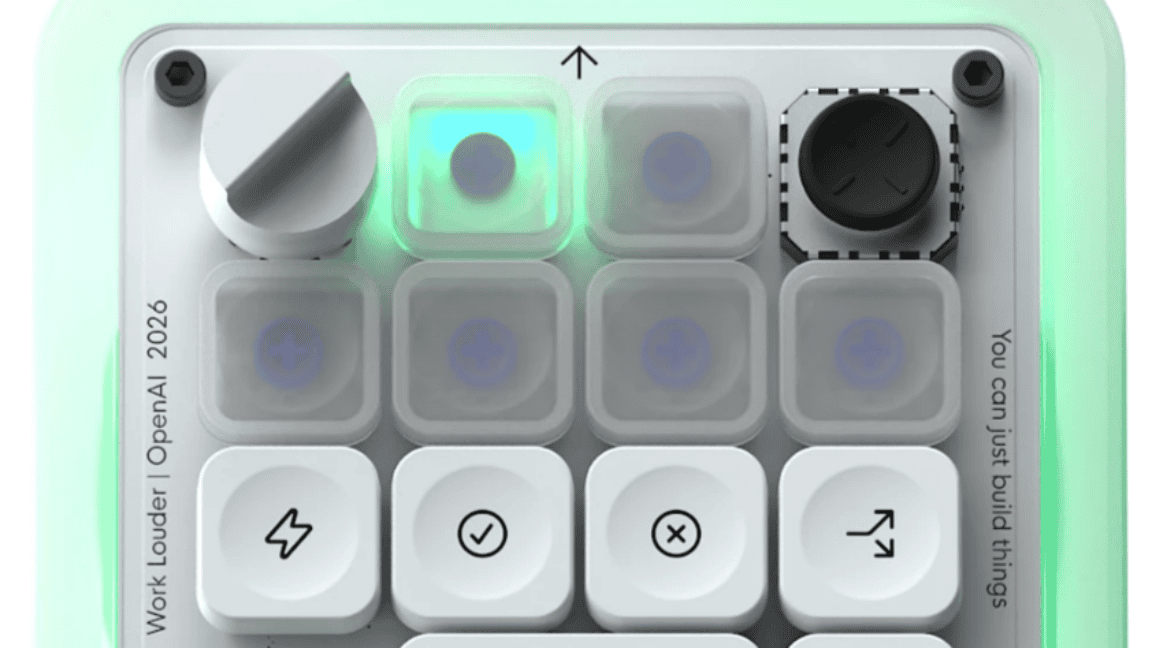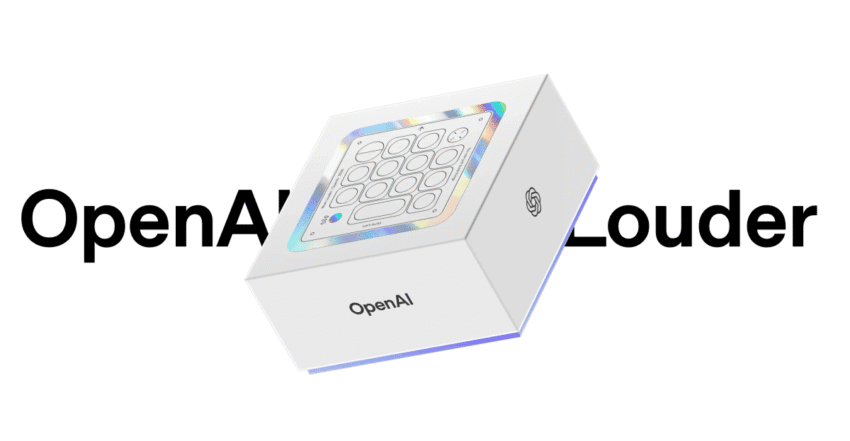
OpenAI has taken a first, highly visible step into hardware with a $230 keyboard built for Codex, even as the company faces a separate legal fight over its broader device ambitions. The Codex Micro, co-designed with specialty keyboard maker Work Louder, is pitched as a desk-ready control panel for people managing AI coding agents, with illuminated status keys, shortcut buttons, a joystick and a dial for adjusting how much “reasoning” an agent uses on a task.
A keyboard built for Codex workflows
According to OpenAI, the Codex Micro is designed to help ChatGPT users manage fleets of AI coding agents, the semi-autonomous bots that can write and execute code with limited human input. Rather than switching between a phone app and a desktop interface, users can treat the keyboard as a “command center for agentic work,” in OpenAI’s wording.
The device includes several purpose-built controls. Light-up “Agent Keys” are meant to display agent status, while customizable “Command Keys” can be assigned to common Codex actions. There is also a joystick for launching workflows more quickly, plus a dial that changes the amount of “reasoning” an agent uses on a task — meaning the time and computing power allocated to that job.
OpenAI says the Micro can be controlled and customized through the ChatGPT desktop app. The company also appears to be leaning into the novelty of the product as much as its utility, describing it as a new way to organize and monitor agentic work while also acknowledging that it is a limited-run collaboration.
Limited-run hardware, not a mass-market launch
In an email to TechCrunch, OpenAI said the Micro is a limited-run collaboration, which signals that this is less a mainstream consumer product than a showcase item. That framing matters. The company is not presenting the keyboard as the beginning of a broad retail hardware push, but rather as a flashy, highly specialized accessory tied to its coding tools.
The price point — $230 — places the device well above ordinary keyboards, but the design makes clear that it is not being sold as a generic input device. Its lighted keys and agent-focused controls are intended to appeal to users already working with OpenAI’s coding products, especially those experimenting with the company’s more autonomous software agents.
OpenAI’s language also suggests the keyboard is meant to be as much a symbol as a tool. It is positioned as a “command center” for a new style of software interaction in which users direct multiple agents rather than manually carrying out each coding task themselves.
OpenAI’s more serious hardware plans are still murky
The Codex Micro is only the most visible part of OpenAI’s hardware story this week. The more consequential update came Tuesday, when Bloomberg reported on a separate, unreleased OpenAI device that appears to be intended as a longer-term project.
That device, according to Bloomberg’s description, is a portable, screenless smart speaker that integrates with ChatGPT and includes “mechanical elements that can move on their own.” Those details point to a product that is substantially different from the Codex Micro: not a desk accessory for coders, but a general-purpose consumer device built around voice and physical motion.
Even so, the description leaves plenty unanswered. A portable product with no screen and moving parts could take several forms, and OpenAI has not publicly explained how those elements would work together. Bloomberg also reported that the item is still in development and subject to change, which means the final version could differ significantly from the current description.
That uncertainty is part of what makes OpenAI’s hardware push so unusual. The company is now simultaneously shipping a small, clearly defined novelty device and teasing a much more ambitious consumer product whose shape is still unclear. The first offers a concrete glimpse of OpenAI hardware; the second suggests the company’s plans go well beyond keyboards.
Apple connection adds another layer of tension
The reported new device also comes with an unexpected backstory: it is said to be designed by former Apple engineers. That detail has drawn extra attention because Apple is currently suing OpenAI for trade theft.
Last week, Apple alleged that OpenAI’s senior leadership pursued a deliberate strategy to extract confidential information from Apple and then used that information in developing its own hardware device. OpenAI has denied wrongdoing.
That lawsuit gives OpenAI’s hardware rollout a particularly delicate backdrop. A company entering a new product category would normally face the usual challenges of design, engineering and manufacturing. OpenAI, however, is doing so while navigating a high-profile dispute with one of the world’s most important hardware companies. The timing makes the hardware story less about a simple product announcement and more about how OpenAI intends to position itself in a crowded and competitive market.
What the Codex Micro says about OpenAI’s strategy
The Codex Micro may be limited in scope, but it is still revealing. It shows OpenAI exploring how AI products might extend beyond software interfaces and into physical devices that shape the way users interact with agents. The keyboard’s controls are specifically designed around agent supervision, task launching and workload tuning — all signs that OpenAI sees coding agents as something users will increasingly manage rather than merely prompt once and wait on.
That is a notable shift in emphasis. Instead of treating AI as a passive chatbot or even a traditional coding assistant, OpenAI is imagining a workflow in which the user orchestrates a set of software agents through dedicated hardware. The keyboard’s “Agent Keys,” “Command Keys,” joystick and reasoning dial all support that model.
At the same time, the limited-run nature of the Micro suggests OpenAI is still experimenting. It is not yet clear whether the company intends to build a family of hardware products around Codex or whether this keyboard is mainly a proof of concept designed to generate interest and gather feedback.
Hardware enters the OpenAI picture
For now, the Codex Micro is the most tangible sign that OpenAI is entering the hardware market, even if only in a small way. It arrives with a clear use case, a defined audience and a price tag of $230. It also arrives alongside a much more mysterious device that could point to OpenAI’s longer-term hardware strategy, if the current reports hold up.
Between the novelty keyboard, the reported screenless smart speaker and the Apple lawsuit, OpenAI’s hardware ambitions are emerging in a complicated way: part product experiment, part strategic signal and part legal flashpoint. The company has not explained where the effort is headed, but it has now made one thing clear enough — OpenAI is no longer talking about hardware as a distant possibility.
Source: Original report
Was this helpful?
Explore more: AI Automation Services More AI & Automation Tech News
Last Modified: July 16, 2026 at 6:38 pm
10 views