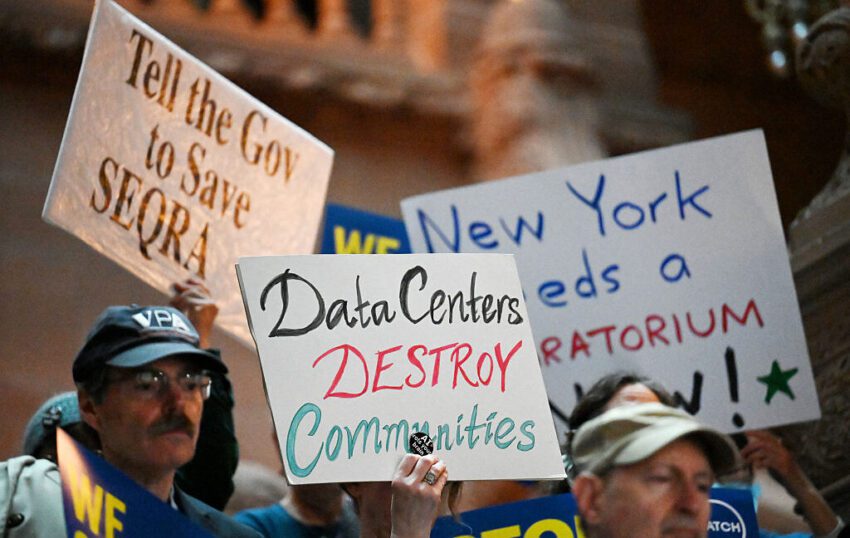
data center ban New York has become the first U.S. state to impose a one-year pause on construction of large new data centers, a move that could reverberate well beyond Albany. Governor Kathy Hochul announced the moratorium on Tuesday, saying the state needs time to establish “consistent standards” for how data centers should be developed and operated.
data center ban
A statewide pause for the biggest projects
According to Reuters, the ban applies to data centers that use 50 megawatts or more. The state will not lift the moratorium until officials complete a review of what responsible data center development should look like in New York, including the environmental effects of building and operating these facilities.
Hochul directed state officials to produce a Generic Environmental Impact Statement, or GEIS, to help determine what those standards should be. Reuters reported that the review is meant to ensure new facilities are held to “consistent standards” before they come online.
The decision lands as concern over data centers is rising across the country. Residents, advocates, and some lawmakers have grown more vocal about potential pollution, higher electricity bills, and pressure on water supplies tied to the rapid expansion of energy-hungry computing infrastructure.
Energy concerns and political pressure
New York’s move follows a broader wave of opposition to large data center projects. Researchers found last month that more than $130 billion in data center projects had been blocked or delayed by protests so far this year, underscoring how often local resistance is now slowing the industry.
The issue has also reached Washington. Sen. Bernie Sanders, I-Vt., and Rep. Alexandria Ocasio-Cortez, D-N.Y., have introduced legislation that could lead to a nationwide ban on new data center construction. Republicans appear unlikely to support such a measure, in part because Donald Trump has argued that moratoriums could weaken U.S. leadership in the AI race.
Even so, officials in both parties are facing pressure to account for residents’ concerns before backing new projects. The political risk is real: data centers promise investment and jobs, but they also raise questions about who pays for grid upgrades, whether communities get the benefits they are promised, and how much strain these facilities put on local resources.
New York’s grid and the backlog of projects
New York has fewer data centers than states such as Virginia and Texas, which have become major hubs for new development. But Reuters noted that the state had a long queue of proposed facilities waiting for approval to connect to the power grid.
That backlog helped set the stage for the moratorium. Some planned projects had already triggered backlash, according to The Washington Post, and New York lawmakers had passed a bill seeking a data center moratorium of their own. Hochul has not yet received that bill for her signature, Reuters reported, but her office described it as “complicated” and said it would take some “time to work through” once it reaches her desk.
In the meantime, Hochul framed the decision as a necessary intervention. She said it was her “responsibility to take action and lead,” warning that “data center development threatens to hike up utility bills, deplete our natural resources, and create uncertainty for New Yorkers.”
In a statement, she added: “New York will lead the way in creating the strongest standards in the nation for data center development, ensuring that when companies succeed because of New York, New Yorkers succeed too.”
Tax breaks may also be on the chopping block
The moratorium may not be the only financial barrier facing the industry in New York. Hochul also indicated on Tuesday that she plans to repeal sales tax exemptions for data centers, a step that could matter well beyond the state. For years, many states have used tax incentives to attract AI and cloud infrastructure projects, but those giveaways are now drawing more scrutiny as voters question whether the public is getting enough in return.
Hochul’s office has argued that old incentives and voluntary commitments are no longer sufficient. In its view, the state needs more information before allowing further growth, particularly when the electricity burden is expected to keep rising.
That position is consistent with Hochul’s earlier approach this year. In February, she announced a plan to make data centers pay their “fair share” for energy grid updates, calling it a “simple standard” intended to ensure that “everyday New Yorkers do not subsidize this energy-intensive industry.” Her office said at the time: “These industries must pay more; if they do not, they must supply their own energy.”
A possible model for other states
New York’s decision is significant not just because of the state’s size, but because it shows a statewide moratorium is politically possible. The move could become a template for other governors and legislatures weighing how to respond to the fast-growing AI buildout.
The Washington Post described the action as “a striking setback for artificial intelligence companies that politicians once courted for investment.” It also noted that Maine’s governor had previously vetoed a similar statewide pause because the earlier proposal did not exempt a favored project already under construction.
Hochul has been careful to say she is not anti-AI. But her administration is signaling that it wants firmer rules before more projects are approved, especially in a state where electricity prices are among the highest in the U.S. The practical effect may be a slower approval pipeline, tougher environmental review, and greater pressure on companies to show how they will avoid shifting costs onto ratepayers.
For the AI industry, the most immediate impact may be symbolic as well as regulatory. If one state can halt large-scale data center construction while it reassesses its standards, other states may feel freer to do the same.
Source: Original report
Was this helpful?
Explore more: DevOps Services More Cloud & DevOps Tech News
Last Modified: July 15, 2026 at 6:37 pm
8 views