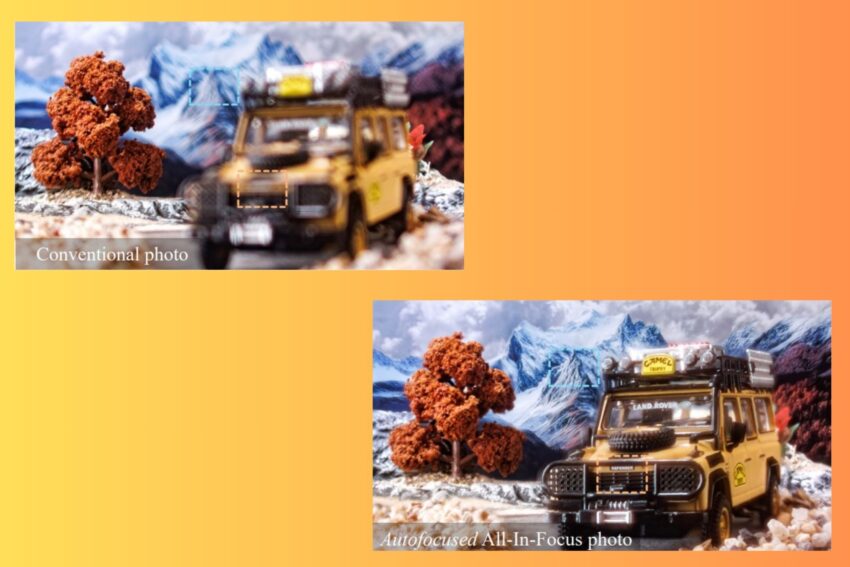
this experimental camera can focus on everything Researchers at Carnegie Mellon University have developed a groundbreaking camera lens technology that can focus on multiple objects at different distances simultaneously.
this experimental camera can focus on everything
Introduction to the Breakthrough
For decades, traditional camera lenses have operated under a fundamental limitation: they can only focus on one specific plane at a time. This constraint mirrors the functionality of the human eye, which also struggles to maintain clarity across varying distances. However, a team of researchers at Carnegie Mellon University (CMU) has made significant strides in lens technology, allowing for a revolutionary approach that can bring every part of a scene into sharp focus. This advancement not only enhances the quality of images captured but also opens new avenues for applications in various fields.
The Mechanics of Traditional Lenses
To understand the significance of this new technology, it is essential to first examine how traditional camera lenses function. Conventional lenses operate by bending light rays to converge at a single focal point. This process allows photographers to capture images with a specific subject in sharp detail while rendering other elements either in front of or behind the focal plane as blurred. This selective focus creates depth and dimension in photographs, a technique that has been widely utilized in photography and cinematography.
Limitations of Conventional Focusing
While the ability to focus on a single plane can produce aesthetically pleasing results, it also comes with notable limitations:
- Loss of Detail: Areas outside the focal plane lose clarity, which can be problematic for applications requiring detailed analysis of all elements within a scene.
- Time-Consuming Adjustments: Photographers often need to adjust their focus manually to capture different elements, which can be time-consuming and may lead to missed opportunities.
- Increased Complexity in Post-Processing: In professional photography, achieving the desired focus often requires extensive post-processing work to correct blurriness in images.
The New Lens Technology
The innovative lens technology developed by CMU researchers addresses these limitations by enabling a camera to focus on multiple objects at varying distances simultaneously. This capability is achieved through a combination of advanced optics and computational techniques, allowing for a more comprehensive capture of scenes.
How It Works
The new lens system employs a unique design that incorporates multiple focal planes. By utilizing a series of micro-lenses and advanced algorithms, the camera can process light from different distances concurrently. This allows the lens to capture finer details across the entire image, regardless of the distance of the objects being photographed.
Technical Innovations
The researchers have integrated several technical innovations into this lens system:
- Micro-Lens Arrays: These arrays consist of numerous tiny lenses that work together to capture light from various angles and distances, enhancing the overall clarity of the image.
- Computational Photography: By employing sophisticated algorithms, the system can analyze the captured light data and reconstruct images in real-time, ensuring that all elements are in focus.
- Adaptive Focus Adjustment: The lens can automatically adjust its focus based on the scene being captured, allowing for seamless transitions between different focal planes.
Applications and Implications
The implications of this new lens technology extend far beyond traditional photography. The ability to focus on multiple objects at different distances simultaneously opens up a range of potential applications across various fields.
Photography and Videography
For photographers and videographers, this technology could revolutionize the way images and videos are captured. The ability to maintain clarity across an entire scene would eliminate the need for constant focus adjustments, allowing for more dynamic and spontaneous shooting. This could be particularly beneficial in fast-paced environments, such as sports photography or wildlife videography, where timing is crucial.
Medical Imaging
In the medical field, enhanced imaging capabilities could lead to significant advancements in diagnostics. For example, the ability to capture detailed images of anatomical structures at varying depths could improve the accuracy of scans and assessments. This technology could be particularly useful in fields such as radiology and surgery, where precise imaging is essential for successful outcomes.
Virtual and Augmented Reality
The integration of this lens technology into virtual and augmented reality systems could significantly enhance user experiences. By allowing for a more natural focus on multiple elements within a virtual environment, users could interact with digital objects in a more intuitive manner. This could lead to advancements in gaming, training simulations, and educational tools.
Robotics and Autonomous Systems
Robots and autonomous systems that rely on visual input could also benefit from this technology. Enhanced focus capabilities would improve object recognition and navigation, allowing for more effective interaction with complex environments. This could have applications in fields ranging from manufacturing to autonomous vehicles.
Challenges and Future Directions
Despite the promising nature of this new lens technology, several challenges remain. The complexity of the system may pose difficulties in manufacturing and integration into existing camera systems. Additionally, the computational demands of processing images from multiple focal planes could require significant advancements in hardware and software.
Research and Development
Ongoing research will be crucial in addressing these challenges. The CMU team is likely to continue refining the technology, exploring ways to streamline the manufacturing process and enhance the performance of the lens system. Collaboration with industry partners may also facilitate the integration of this technology into commercial products.
Potential for Consumer Adoption
As the technology matures, its potential for consumer adoption will depend on several factors, including cost, ease of use, and compatibility with existing devices. If these hurdles can be overcome, it could lead to a new era of photography and imaging technology that fundamentally changes how we capture and perceive the world around us.
Conclusion
The development of a lens system capable of focusing on multiple objects at different distances represents a significant leap forward in imaging technology. By overcoming the limitations of traditional lenses, researchers at Carnegie Mellon University have opened the door to a wide array of applications that could transform various fields. As further research and development continue, the potential for this technology to revolutionize photography, medical imaging, virtual reality, and robotics becomes increasingly tangible.
Source: Original report
Was this helpful?
Explore more: More Hardware & Devices Tech News Blog
Last Modified: December 29, 2025 at 11:40 pm
18 views