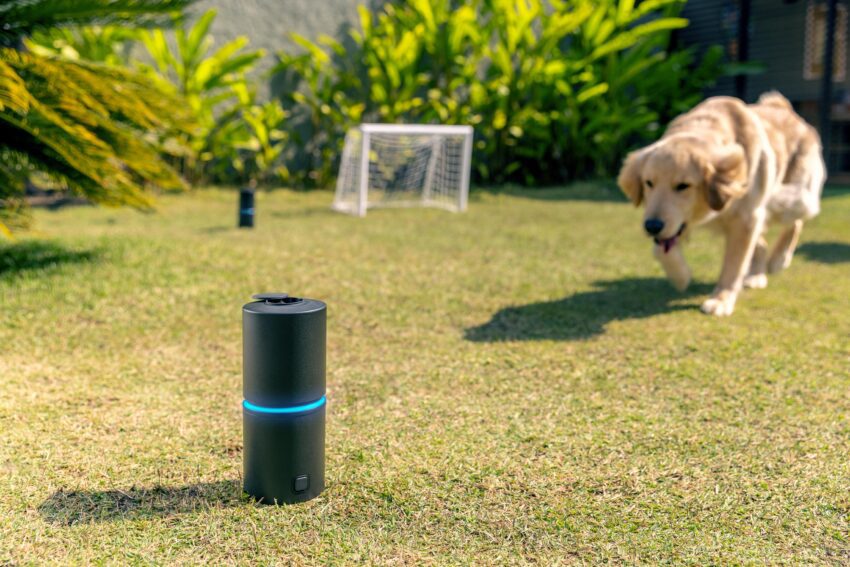
Thermacell is taking its connected mosquito defense system up a notch with Liv 2.0, a new version of its Wi-Fi-enabled outdoor repellent setup that promises broader coverage, redesigned hardware, and even protection against no-see-ums. The catch is that the system is significantly more expensive than the original, and Thermacell is now positioning it as a professional-install product rather than a simple do-it-yourself purchase.
What Thermacell announced
Liv 2.0 is the next generation of Thermacell’s smart mosquito protection system, built around the same basic concept as the original Liv: a central hub linked to wired repellers that contain the company’s metofluthrin-based repellent. Thermacell says the new version uses entirely new hardware, including a new hub and redesigned repellers intended to improve release rates. The company also says the repellent formula is now rated to deter no-see-ums, a small biting insect that can be especially annoying in warm-weather outdoor spaces.
The update is not just about the hardware. Thermacell says it has also re-architected the system’s cloud connectivity. Adam Goess of Thermacell said those changes, along with rising global component costs for an IoT product, helped drive the big jump in price. The company has also added a new branching system that gives installers more flexibility in placement.
Coverage scales up, but so does the bill
Pricing for Liv 2.0 starts at about $1,746 for a system that includes three repellers, a six-pack of repellent refills, and coverage of up to 900 square feet. That is roughly twice the starting price of the original Liv system, which launched at $699 and covered about 945 square feet.
For larger outdoor areas, Thermacell is offering more expensive configurations. A four-repeller system costs $2,150, while a 10-repeller package reaches $4,900. Thermacell says the largest setup covers 3,000 square feet and is intended for commercial use, including restaurants with outdoor seating areas. The quoted prices do not include installation.
The original Liv system is still available as an off-the-shelf product that customers can install themselves, but its starting price has also increased. Thermacell now lists it from $1,500.
How the system works
Like the first-generation product, Liv 2.0 uses replaceable repellent capsules that are heated inside the repellers. Thermacell says each repeller creates about a 20-foot zone of protection, and those zones can be chained together to expand coverage. In the largest configuration, the company says the system can protect up to 3,000 square feet.
Thermacell emphasizes that the system does not use sprays or smoke and produces only a faint scent. The repellent is EPA-registered, and the company says it is safe for pets and children. The general idea is to provide a more controlled and more permanent alternative to portable bug devices or seasonal yard treatments.
That said, the coverage is only as good as the number and placement of repellers. Thermacell’s own setup relies on overlapping protection zones, and gaps between those zones could create weak points. In practice, the company’s recommendation is clear: if you want whole-yard protection, you need enough repellers to cover the entire area.
Connected controls through the Liv+ app
One of the defining features of the Liv system is that it connects directly to home power and can be managed over Wi-Fi. That makes it different from Thermacell’s battery- and butane-powered repellents, which are designed more as standalone devices. Thermacell says Liv offers broader protection than those smaller units and allows users to control the system from inside the house.
With the Liv+ app, users can turn the system on or off, set schedules or timers, and enable voice control through Amazon Alexa and Google Home. The app can also send push notifications reminding users to shut the system off to conserve repellent, and Thermacell says the system can be configured to automatically power down.
There is no subscription fee, and Goess said Thermacell is committed to never putting the app behind a paywall. That detail matters in a market where connected devices increasingly tie basic functions to recurring payments. For Liv, at least for now, the app is part of the package.
A premium product for a stubborn problem
Thermacell is clearly aiming Liv 2.0 at homeowners and businesses that want a more seamless solution than candles, sprays, or portable repellents. The system’s biggest advantage is scale: it is wired into the home, can be controlled remotely, and is designed to cover a much larger area than a typical standalone repeller.
But the price makes the product hard to ignore. Thermacell describes the cost as comparable to hiring a company to spray a yard for a season, which is its argument for the value of a one-time installation. That may make sense for customers who are already spending heavily to keep mosquitoes under control, especially in outdoor living spaces used often throughout the year.
Still, the company is asking buyers to spend thousands of dollars for a solution to a problem that can vary by property size, bug pressure, and how much of the yard needs coverage. The original Liv system was already expensive for a consumer device, and Liv 2.0 pushes that into a clearly higher tier.
What changed from the original Liv
- New hardware: Thermacell says Liv 2.0 uses a new hub and redesigned repellers.
- Expanded pest coverage: The repellent is now rated to deter no-see-ums in addition to mosquitoes.
- Flexible layout: A new branching system allows for more placement options.
- Higher prices: The starter package is about $1,746, compared with the original system’s $699 launch price.
- Professional installation: Liv 2.0 is available now through Thermacell professional installers.
- Large-scale option: A 10-repeller system can cover 3,000 square feet and is aimed at commercial use.
The bigger picture
Liv 2.0 reflects a broader trend in home tech: products that once seemed niche or premium are becoming more sophisticated, more connected, and more expensive. Thermacell is not just selling a bug repeller here; it is selling an installed, app-controlled outdoor protection system with cloud connectivity and voice assistant integration. That adds convenience, but it also raises the stakes on price and upkeep.
For buyers who need serious outdoor bug protection and are willing to pay for professional installation, the new system may be appealing. For everyone else, the original Liv still exists, and simpler Thermacell devices remain available. The choice now depends on how much area needs protecting, how much setup a user wants to handle, and whether the added smart-home features are worth the premium.
Source: Original report
Was this helpful?
Explore more: More Consumer Technology Tech News Blog
Last Modified: July 7, 2026 at 9:27 pm
14 views