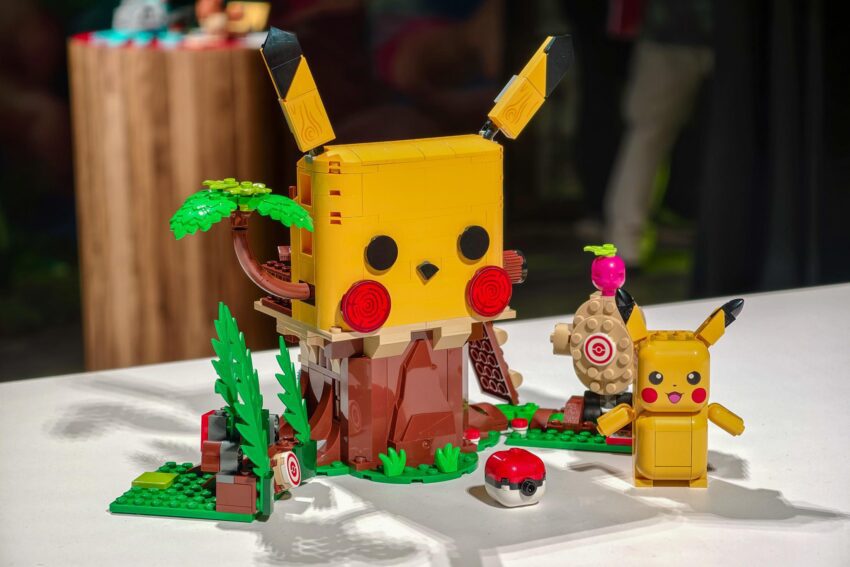
Lego’s second-generation Smart Play sets are finally making good on some of the promise it showed at CES, but not all of it. The new Pokémon lineup adds training and battle mechanics that are noticeably more involved than the company’s first Smart Bricks Star Wars releases, yet one of the most obvious and appealing features remains missing: authentic character sounds. After a few hours with the new sets, the takeaway is clear — Lego’s smart toy platform is getting more capable, but it is still arriving in careful steps rather than a dramatic leap.
12 Pokémon sets are coming August 1st
Lego announced 12 new Smart Play sets today, with preorders open now and retail availability set for August 1st. Only two are “all-in-one” sets that include the Smart Bricks and charger required to use the interactive features. Those are a $69.99 Pikachu set with a treehouse and one Smart Brick, and a $119.99 battle set featuring Charizard and Jolteon that includes two Smart Bricks.
The other 10 sets are described by Lego as “compatible,” which means they include Smart Tags that can trigger certain effects and interactions, but not the Smart Bricks themselves. Prices for those sets range from $14.99 for Jigglypuff to $89.99 for a Cubone-versus-Gengar battle set.
Battle mode is the biggest upgrade
The most substantial addition is combat. If two Smart Brick-equipped Pokémon figures are shaken together, Battle mode starts. From there, the play pattern is intentionally simple: a quick thrust forward triggers a low-damage attack, holding the figure back for a few seconds charges a stronger move, and pulling it back helps dodge incoming damage. The result is a short, physically active fight that ends with flashing lights and victory music.
Federico Begher, Lego’s SVP of product and marketing development, said the design is meant to sit at “the sweet spot” for open-ended play — not too complicated, and not overwhelming. It is not a recreation of the video games’ turn-based system, but there is still some strategy in choosing when to dodge and when to unleash a charged attack.
Type matchups and relative strength matter
Behind the scenes, Lego has also built in a few Pokémon-specific rules. Some characters are stronger than others, so Mewtwo should generally have the edge over Pikachu. Type advantage matters too, meaning Squirtle should usually beat Charmander. Each figure’s Smart Tag also shows its type or types and its Pokédex number.
Different types trigger different sound effects as well. Lego says Pikachu, for example, gets an electricity effect, while Lapras produces a water-themed sound. But those effects are still generic rather than fully character-specific.
Training works, but it is temporary
There is also a training mode. Tap a Pokémon on the training tag and it enters that mode; then, by tapping it against built-in targets, other objects, or even waving it through the air, the Smart Brick’s accelerometer helps level the Pokémon up. That makes it stronger in its next battle.
The catch is that the boost is not permanent. Once the Smart Brick is removed, or if the battery dies, the training effect disappears. That means there is no long-term squad progression to carry forward from session to session.
A Lego representative said that design choice is intentional, based in part on playtesting that suggested kids enjoy repeating the training loop from scratch. Still, the limitation also reflects the capabilities of the Smart Brick itself.
The missing feature is still the most noticeable
For all the progress, the biggest disappointment is also the most obvious: the Pokémon do not say their own names, and they do not make recognizable in-game or anime sounds. That means Lego Pikachu does not actually say “Pikachu,” and the figures do not deliver the iconic audio cues many fans would probably expect.
Instead, the toys rely on generic creature noises and the occasional themed effect. Sam Coates, head of the Smart Play platform, said the limitations come from the brick’s runtime synthesizer, which generates sound in real time using a system similar to MIDI, as well as from limited onboard memory. He also pointed to a second issue: Pokémon names and sounds vary by region, and the bricks are not localized in the way the games are. Squirtle, for instance, is Zenigame in Japan.
That means any sound effects have to work worldwide, regardless of where the toy is sold. In practice, Lego is leaning on broad audio cues rather than name-based voice clips. It is a practical compromise, but also the clearest reminder that the Smart Play system still has technical constraints.
Set sizes range from simple builds to larger battle kits
The 12 sets vary widely in size and complexity, from an 88-piece Jigglypuff kit to an 831-piece Umbreon-and-Garchomp battle set. Most include some moving parts, such as Gengar’s wagging tongue. Some of the bigger sets are rated 10+, while simpler builds are intended for ages 6 and up.
Lego says the sets were extensively playtested and iterated to improve durability, but the format still involves knocking figures around at speed. That makes breakage a real possibility over time. During the demo, an unfortunate collision destroyed the reviewer’s Charmander build, though Lego had a “toy doctor” available for repairs.
A step forward, but not the full vision
Compared with the first Star Wars Smart Brick sets, Pokémon Smart Play is clearly more ambitious. The battles add structure and replayability, and the training mechanic gives the system more to do between showdowns. Even so, Lego has not yet delivered the more advanced interaction features it demonstrated at CES, including behavior that changes based on the precise position of characters, tags, and bricks.
So this launch looks like real progress rather than the final version of the idea. Lego’s smart toy platform is beginning to show what it can do beyond lights and sounds, but it is still moving cautiously — and still leaving some of the most obvious fan expectations on the table.
Source: Original report
Was this helpful?
Explore more: More Hardware & Devices Tech News Blog
Last Modified: July 7, 2026 at 9:41 pm
10 views