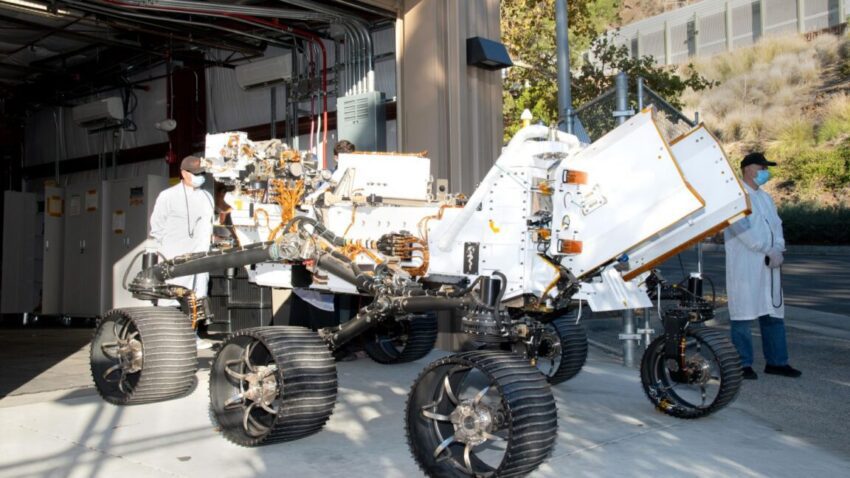
nasa may send a backup nuclear-powered mars NASA is contemplating the deployment of a backup Mars rover, known as “Promise,” to the Moon, aiming to enhance its exploration efforts in the lunar south pole region.
nasa may send a backup nuclear-powered mars
Overview of the Proposal
During a recent update, NASA officials revealed their serious consideration of sending the full-scale engineering model of the Perseverance rover, currently located at the Jet Propulsion Laboratory (JPL) in California, to the Moon. This initiative is part of a broader strategy to expedite lunar exploration, particularly in the south pole region, which is believed to hold significant resources and scientific interest.
The Rover: Promise
The rover in question, nicknamed “Promise,” is not merely a prototype; it serves as a testbed for the Perseverance rover, which successfully landed on Mars in February 2021. Unlike its Martian counterpart, Promise was not originally slated for a launch. However, its unique capabilities and design make it a viable candidate for lunar exploration.
Powering the Mission
One of the most notable features of Promise is its multi-mission radioisotope thermoelectric generator (MMRTG). This power source is crucial for operating in the Moon’s harsh environment, particularly during the extended lunar night, which lasts approximately 14 Earth days. Unlike NASA’s other rovers, which primarily rely on solar power, the MMRTG allows Promise to function independently of sunlight, enabling it to traverse difficult terrain and conduct scientific experiments even in the absence of direct solar energy.
Scientific Objectives
The Moon’s south pole has garnered significant attention from scientists and space agencies worldwide due to its potential resources, including water ice. Water is a critical resource for future lunar missions, as it can be converted into hydrogen and oxygen for rocket fuel or used to support human life. By sending Promise to the Moon, NASA aims to gather valuable data that could inform future missions and establish a sustainable human presence on the lunar surface.
Exploration of the Lunar South Pole
The lunar south pole is particularly intriguing because it is believed to contain permanently shadowed regions that may harbor water ice. This ice could provide insights into the Moon’s geological history and serve as a resource for future lunar exploration. The presence of water ice also raises the possibility of using it to support human habitats, making it a focal point for NASA’s Artemis program, which aims to return humans to the Moon by the mid-2020s.
Implications for Future Missions
Sending Promise to the Moon could have far-reaching implications for NASA’s future exploration plans. The data collected by the rover could help refine the agency’s understanding of the Moon’s geology and resources, ultimately informing the design and execution of future missions. Additionally, the successful operation of a nuclear-powered rover on the Moon could pave the way for similar missions to Mars and beyond, where solar power may not be as reliable.
Technological Advancements
The use of an MMRTG represents a significant technological advancement in space exploration. This power source has been successfully used in previous missions, including the Mars Curiosity rover and the Voyager spacecraft. Its reliability and longevity make it an ideal choice for missions that require sustained power over extended periods, particularly in environments where solar energy is limited.
Stakeholder Reactions
The proposal to send Promise to the Moon has elicited a range of reactions from stakeholders within the space community. NASA Administrator Jared Isaacman emphasized the agency’s commitment to exploring the lunar south pole, stating, “We are thinking very hard right now about sending Promise to the Moon.” This statement underscores the urgency and importance of the mission in the context of NASA’s broader lunar exploration goals.
Community and Scientific Engagement
In addition to internal discussions, NASA has been engaging with the scientific community to gather input on the potential mission. Researchers and scientists have expressed enthusiasm about the prospect of sending a rover to the Moon, particularly one equipped with advanced technology like the MMRTG. The scientific community recognizes the value of obtaining data from the lunar surface, which could lead to new discoveries and enhance our understanding of the Moon’s history and resources.
Challenges and Considerations
While the proposal to send Promise to the Moon is promising, it is not without challenges. The logistics of launching and landing a rover on the Moon require careful planning and coordination. NASA must consider factors such as the timing of the launch, the rover’s trajectory, and the landing site. Additionally, the agency must ensure that the rover is equipped with the necessary instruments and technology to conduct its scientific objectives effectively.
Budget and Funding
Another critical consideration is the budget and funding for the mission. As with any space exploration initiative, securing adequate funding is essential for the successful execution of the project. NASA must navigate budgetary constraints and prioritize its various missions, including the Artemis program and other ongoing projects. The decision to send Promise to the Moon will depend on a comprehensive assessment of the mission’s costs and benefits.
Conclusion
The potential deployment of the Promise rover to the Moon represents a significant step forward in NASA’s exploration efforts. By leveraging advanced technology and focusing on the scientifically rich lunar south pole, NASA aims to gather crucial data that could inform future missions and establish a sustainable human presence on the Moon. As discussions continue and plans are refined, the space community eagerly anticipates the outcomes of this ambitious initiative.
Source: Original report
Was this helpful?
Explore more: More General Technology Tech News Blog
Last Modified: July 1, 2026 at 3:35 am
12 views