iFixit’s latest teardown takes aim at counterfeit Apple gear, after the repair specialists bought fake Apple Watch Ultra 3, AirPods Max 2, and AirPods Pro 3 units in Shenzhen’s Huaqiangbei district and opened them up on camera. The result is a close look at how convincing some of these knockoffs appear on the outside — and how quickly the illusion falls apart once they’re disassembled.
A visit to Huaqiangbei
According to iFixit, Huaqiangbei in Shenzhen, China is a major global hub for repair parts used across electronics sold worldwide. It is also a place where visitors can find counterfeit products that may resemble the real thing closely enough to fool casual buyers, but that do not stand up to closer inspection.
That is the backdrop for iFixit’s video, in which Shahram Mokhtari and the team brought the fake devices back to the studio and tore them down immediately. The findings were unsurprising in one sense — they were counterfeit products, after all — but the internals still revealed a mix of shortcuts, mismatched materials, and missing hardware.
Fake Apple Watch Ultra 3: red tint instead of real apps
Mokhtari’s first red flag came as soon as he started interacting with the fake Apple Watch Ultra 3’s operating system. Rather than opening an app when he tapped on the watch face, the device triggered Night Mode and tinted the interface red.
The imitation also felt off in the hand. Mokhtari noted that the Taptic Engine behaved differently from the real thing, and that most of the sensors on the back were simply painted onto the plastic shell. In the real Apple Watch Ultra line, those elements are built with more premium materials such as ceramic or sapphire, but the knockoff used visual tricks instead.
Once iFixit opened the case, the internal construction looked even less convincing. The fake Watch Ultra 3 contained a 260 mAh battery, which iFixit said was less than half the capacity of the real model’s battery. The cell was basically loose inside the case, with its wires soldered directly to the main board.
Fake AirPods Max 2: the look is close, the hardware is not
The counterfeit AirPods Max 2 also gave itself away in the feel and finish. Mokhtari said the materials, textures, and overall build were noticeably different the moment he picked them up. Instead of an aluminum shell, the knockoffs used plastic, and the cushions were described as more squishy than the real version.
Physical controls did not escape scrutiny either. The buttons felt wrong, according to Mokhtari, and the headphones lacked two major features buyers would expect from Apple’s premium over-ear model: active noise canceling and transparency mode.
Interestingly, the fake headphones did mimic a few software-facing features from the real product. iFixit found that they included ear detection, as well as the native pairing popups and animations that appear during setup with an authentic pair of AirPods Max. That kind of software imitation can make a fake product appear more legitimate at first glance, especially for users who only test it briefly.
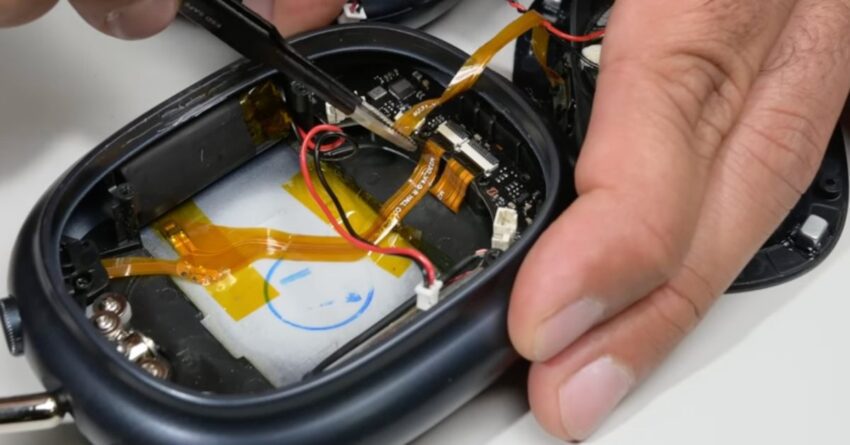
Inside the earcups, however, the story was different. Mokhtari could not identify the battery used in the knockoff, and as the disassembly continued, some poorly soldered cables came loose with little effort. He also spotted several silver cylinders whose apparent purpose was not functional engineering, but simply weight: they helped the headphones feel as heavy as a real pair of AirPods Max 2.
Fake AirPods Pro 3: convincing on the outside, fragile underneath
Of the three products, the fake AirPods Pro 3 were the closest match cosmetically. Mokhtari said they were almost impossible to distinguish from the genuine article, apart from a slight difference in the seams. That kind of exterior accuracy is often what gives counterfeit accessories their appeal, at least until something goes wrong.
In this case, the problems started almost immediately during teardown. When Mokhtari tried to remove the silicone tip, the entire front section of the earbud came off with it, disconnecting a couple of cables and wires in the process. He later found that the tip had actually been glued to the earbuds.
A CT scan revealed even more shortcuts. Mokhtari said the fake AirPods Pro 3 were missing MEMS microphones, and that the drivers looked cheap. The internal structure was basic, relying on soldered copper wire instead of flex cables. Those details are the kind of clues that separate a product designed to imitate an Apple accessory from one built to function like it.
He also said the earbuds were constructed like first-generation AirPods, which allowed the tiny printed circuit board to slide out of the stem. As expected, the internals did not include components such as the ANC microphones or heart rate sensors. Disassembling the charging case turned up similarly rough internals, including yet another unmarked battery.
What the teardown shows
iFixit’s video does not reveal anything particularly flattering about counterfeit electronics, but it does illustrate how these products balance imitation and cost-cutting. The exterior can be close enough to fool a buyer at a glance, while the internals rely on cheap materials, missing components, and assembly methods that would never be found in Apple’s own devices.
That contrast is especially striking in the fake AirPods Pro 3, which come closest visually to the original, and in the fake AirPods Max 2, which borrow enough interface behavior to seem plausible before the materials and acoustics expose them. The fake Apple Watch Ultra 3, meanwhile, shows how little substance can sit behind an authentic-looking shell.
For viewers interested in repairs, materials, and product authenticity, iFixit’s teardown still offers a compact and revealing look at how counterfeit wearables are built — and why close inspection matters.
Source: Original report
Was this helpful?
Explore more: More Hardware & Devices Tech News Blog
Last Modified: July 7, 2026 at 9:30 pm
17 views