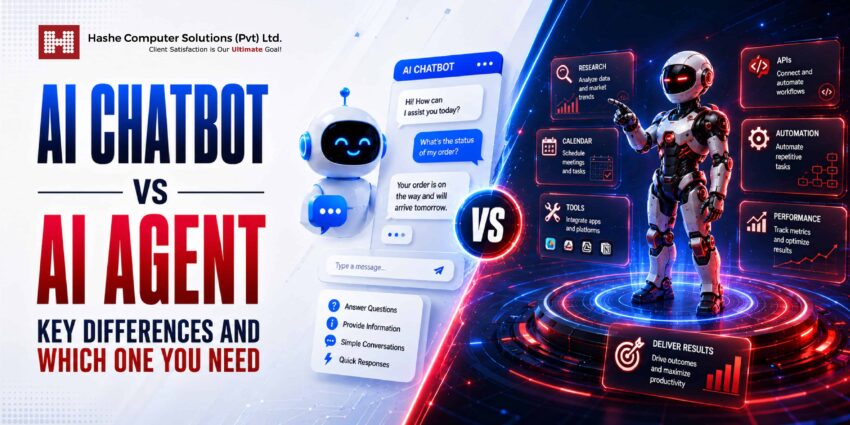
Artificial intelligence is no longer a futuristic concept; it is already reshaping how businesses operate and how users interact with technology. From answering customer queries in seconds to automating complex workflows, AI-powered tools are becoming essential across industries. However, as adoption grows, so does the confusion around key terms, especially when comparing AI agents vs. AI chatbots.
At first glance, they seem similar; both communicate, assist, and streamline daily tasks. Yet under the hood, their capabilities and purposes are vastly different. Understanding these differences isn’t just a matter of terminology; it can directly impact how effectively you choose and deploy AI in your business or project.
In this guide, we will break down the core distinctions between AI agents and AI chatbots in a clear, practical way so you can confidently decide which tool fits your needs.
What is an AI Chatbot?
An AI chatbot is a software application designed to simulate human-like conversations with users through text or voice interfaces. It acts as a virtual assistant that can understand user queries, interpret intent, and deliver relevant responses in real time.
From answering simple questions to guiding users through processes, chatbots have become a core tool for improving customer interaction and operational efficiency.
At a basic level, chatbots rely on predefined rules, such as decision trees or scripted responses, to handle predictable queries. More advanced chatbots, however, use technologies such as Natural Language Processing (NLP) and Machine Learning (ML) to better understand context, recognize variations in language, and provide more accurate, human-like responses.
How AI Chatbots Work
AI chatbots typically follow a structured, linear process:
- Input Recognition: The chatbot receives a user message (text or voice).
- Intent Detection: It analyzes the message using NLP/LLMs to extract intent and key details to understand what the user wants.
- Response Generation: Based on its training or rules, it selects or generates an appropriate reply.
- Output Delivery: The response is delivered instantly through the interface (chat window, app, or voice assistant).
Some advanced chatbots also use context retention, allowing them to remember previous interactions within a conversation and respond more intelligently.
Workflow Overview:
User Input → Intent Recognition → Response Retrieval/Generation → Output Delivery
What are the Types of AI Chatbots?
AI chatbots generally fall into three main categories.
- Rule-Based Chatbots: These chatbots rely on predefined scripts and decision trees. They are highly predictable but limited in handling complex or unexpected queries.
- AI-Powered (Contextual) Chatbots: These use NLP and ML to understand intent and context, making them more flexible and conversational.
- Hybrid Chatbots: A combination of rule-based and AI-driven systems, offering both structure and adaptability.
The following table summarizes the types of AI chatbots and how they work.
| Chatbot Type | How It Operates | Best Used For |
|---|---|---|
| Rule-Based | Follows strict decision trees and predefined scripts. | Simple FAQ buttons and rigid menu flows. |
| AI-Powered (Contextual) | Uses NLP and language models to understand context and intent. | Conversational search, dynamic Q&A, and documentation retrieval. |
| Hybrid | Combines rule-based structures with dynamic AI flexibility. | Guided support flows with fallback conversational assistance. |
Key Features of AI Chatbots
The key features of AI chatbots include:
- 24/7 Availability: AI chatbots are available round the clock, ensuring users can get support anytime without waiting for human agents, making them especially valuable for global businesses operating across different time zones.
- Instant Responses: They provide immediate replies to user queries, significantly reducing wait times. This improves customer satisfaction and helps businesses handle high volumes of requests efficiently.
- Scalability: Chatbots can manage thousands of conversations simultaneously without performance issues. This allows businesses to scale customer support without a proportional increase in costs or personnel.
- Consistent Communication: AI chatbots deliver uniform responses every time, ensuring accuracy and reducing the risk of human error. This consistency helps maintain brand voice and reliability across interactions.
- Easy Integration: They connect easily with websites, mobile apps, and enterprise CRM systems for fluid data exchange. This enables seamless data flow and enhances overall business automation and user experience.
Common Use Cases of AI Chatbots
Across industries, AI chatbots are most effective when handling high-volume, repetitive interactions where speed and accessibility matter most.
- Customer Support and FAQs: AI chatbots are widely used to handle repetitive customer queries such as product information, return policies, shipping details, and account-related questions. This helps businesses provide instant responses without requiring human agents for every interaction, improving both efficiency and customer satisfaction.
- Appointment Booking: Chatbots simplify scheduling by allowing users to book, reschedule, or cancel appointments directly through a chat interface. They can integrate with calendars and booking systems to automatically check availability and confirm time slots in real time.
- Order Tracking: In e-commerce and logistics, chatbots help customers track their orders by providing real-time updates on shipping status, delivery timelines, and location details. This reduces the need for customers to contact support teams for basic order inquiries.
- Basic Troubleshooting: Chatbots assist users in resolving simple technical issues by guiding them through step-by-step solutions. For example, they can help reset passwords, fix login issues, or troubleshoot common app or device problems before escalating to human support if needed.
What are the Limitations of AI Chatbots?
While AI chatbots are very useful for automating conversations and enhancing response times, they still have specific limitations that can impact their performance and user experience.
- Struggle with Complex or Multi-Step Queries: AI chatbots often perform well with simple questions, but they falter when tasks require logical reasoning, multi-system coordination, or deeper problem-solving.
- Limited Decision-Making Ability: Most chatbots operate within static knowledge parameters or predefined rules, meaning they cannot independently evaluate situations or make advanced decisions beyond their programming.
- Dependence on Training Data or Predefined Rules: The quality of a chatbot’s responses is heavily influenced by the data it has been trained on or the rules it follows. If the data is incomplete or outdated, the responses may be inaccurate or irrelevant.
- Difficulty Understanding Ambiguous Language: Chatbots can misinterpret unclear, vague, or context-heavy user inputs, leading to incorrect or generic responses that may not fully address the user’s intent.
What is an AI Agent?
An AI agent is an advanced software system designed to autonomously perform tasks, make decisions, and achieve specific goals with minimal human intervention. Unlike traditional tools that simply respond to user inputs, AI agents analyze situations, plan sequences of actions, and execute multi-step processes, often adapting dynamically as conditions change.
In essence, an AI agent behaves more like a problem-solver than a responder. It doesn’t just wait for instructions; it can take initiative, use available resources, and continuously work toward a defined objective.
Unlike an AI chatbot, which acts primarily as a conversational interface, an AI agent functions like a digital worker. It operates with a high degree of autonomy, using external tools, memory, and reasoning loops to achieve specific outcomes with minimal human supervision.
How AI Agents Work
AI agents go far beyond static, linear processing. Instead, they operate through a dynamic, multi-step Reason–Act–Observe loop, enabling them to plan, execute, and refine actions in real time.
- Goal Decomposition and Planning: The agent starts with a high-level objective (e.g., “Perform competitor price matching and update inventory software”) and breaks it down into smaller, logical sub-tasks.
- Tool Selection and Action: Next, it identifies and uses the appropriate tools or APIs to complete each step, such as running a web scraper, querying a database, or sending an HTTP request.
- Observation and Evaluation: After executing an action, the agent evaluates the outcome. It determines whether the step was successful or if errors occurred.
- Adaptive Execution and Correction: Based on feedback, the agent adjusts its approach in real time, retrying, refining, or selecting alternative actions until the overall goal is achieved.
Workflow Overview:
Goal Input → Task Planning → Tool Execution → Observation → Self-Correction → Final Outcome
What are the Types of AI Agents?
AI agents can be categorized by their operational methods and the complexity of the tasks they handle. Each type serves different use cases depending on the level of autonomy and decision-making required.
- Reactive Agents: Take immediate actions based on present inputs without relying on long-term memory or past execution state.
- Model-Based Agents: They maintain an internal state of their environment to track changing conditions and make informed choices.
- Goal-Based Agents: These AI agents plan sequences of actions specifically designed to achieve a defined objective.
- Utility-Based Agents: They evaluate multiple possible actions and select the optimal one based on a utility function (e.g., cost, time, efficiency).
- Learning Agents: These agents continuously adapt and optimize their decision-making logic over time based on performance feedback.
- Multi-Agent Systems (MAS):
The following table summarizes the types of AI agents and how they work.
| Agent Type | How It Operates | Best Used For |
|---|---|---|
| Reactive Agents | Respond instantly to current inputs without memory or past context. | Real-time monitoring, alerts, and simple rule-based automation |
| Model-Based Agents | Maintain an internal state to track past interactions and environment changes. | Systems requiring context awareness (e.g., chatbots with memory) |
| Goal-Based Agents | Plan and execute actions to achieve a specific objective or end state. | Multi-step workflows like travel booking or DevOps automation |
| Utility-Based Agents | Evaluate multiple options and choose the best outcome using a scoring function. | Resource allocation, pricing optimization, and decision-making systems |
| Learning Agents | Continuously improve performance by learning from data and feedback. | Recommendation systems, personalization engines, and adaptive AI systems |
| Multi-Agent Systems | Multiple specialized agents collaborate or coordinate to solve complex problems. | Enterprise workflows and large-scale, distributed problem-solving |
Key Features of AI Agents
The key features of AI agents include:
- Autonomy: AI agents can function autonomously with minimal human intervention, making decisions and performing tasks independently within established parameters. That said, they function continuously without constant user input, especially in automated workflows and real-time systems.
- Goal-Oriented Behavior: They are designed to focus on achieving specific objectives rather than just responding to individual inputs. All their actions are aligned with a specific end goal, ensuring structured and purposeful task execution.
- Reasoning and Decision-Making: AI agents can analyze information, evaluate multiple options, and choose the most effective course of action, enabling them to handle complex scenarios where simple rule-based responses are not sufficient.
- Tool and API Usage: AI agents can interact with external tools, APIs, and systems to gather data or perform actions required to complete tasks. They are highly versatile, as they can integrate with databases, web services, and enterprise software.
- Memory and Context Awareness: AI agents can retain and use past information to maintain continuity and improve decision-making over time. This helps them understand ongoing tasks and provide more consistent and relevant outputs.
- Learning and Adaptation: They improve their performance by learning from feedback, outcomes, and new data. Over time, they become more accurate, efficient, and better aligned with user expectations.
- Multi-Step Task Execution: AI agents can break down complex goals into smaller steps and execute them sequentially to achieve the outcome. This structured approach helps them manage long, multi-stage workflows effectively without losing track of the overall objective.
Common Use Cases of AI Agents
AI agents are deployed across industries to automate multi-step operations, eliminate manual bottlenecks, and support intelligent decision-making in dynamic environments.
- End-to-End Workflow Automation: AI agents automate complex business operations, such as invoice processing, system updates, and cross-platform synchronization, by connecting multiple enterprise tools and executing sequential tasks autonomously. For example, an agent can extract invoice data, verify it against ERP records, flag discrepancies, and log reconciled entries into accounting software without human intervention.
- Data Analysis & Intelligent Reporting: AI agents can collect, process, and analyze large volumes of data across internal databases and third-party platforms to uncover patterns, generate insights, and produce structured reports. Instead of relying on manual SQL queries or spreadsheets, the agent can monitor live operational data, detect anomalies in real time, and deliver automated summaries directly via Slack or email.
- Customer Support and Resolution: AI agents can handle customer queries, troubleshoot issues, and resolve requests without human intervention. Unlike traditional chatbots that provide static responses, they can take direct actions such as verifying user identity, retrieving purchase history from a CRM, initiating returns in backend systems, and issuing refunds through payment gateways. This leads to faster response times and improved customer satisfaction.
- Research and Information Gathering: AI agents can search across databases, websites, and APIs to gather relevant information on a given topic. They can summarize findings and present structured insights for users. This is especially useful for market research, competitive analysis, and academic work. For instance, an agent can track competitor pricing, monitor press releases at scale, and deliver concise daily briefings to decision-makers.
What are the Limitations of AI Agents?
While AI agents deliver powerful operational automation, they introduce distinct challenges and constraints that organizations must consider before deployment.
- High Complexity in Design and Deployment: AI agents require careful system design, including planning logic, tool integration, and feedback loops. Building and maintaining these systems can be technically challenging and resource-intensive. This often makes them harder to implement compared to simpler automation tools.
- Dependence on High-Quality Data: The performance of AI agents heavily relies on the quality and availability of data. If the input data is incomplete, outdated, or biased, the agent’s decisions may become inaccurate or unreliable. Continuous data validation and monitoring are therefore essential.
- Risk of Error Propagation: As AI agents operate within multi-step workflows, an error in one step can cascade into later stages, potentially leading to incorrect outputs or unintended actions if not adequately monitored. Safeguards and human oversight are often required to mitigate this risk.
- Limited Explainability: Many AI agents, especially those powered by advanced machine learning models, operate as non-deterministic “black boxes.” Tracing why an agent chose a specific tool path can be difficult, presenting compliance challenges in strictly regulated industries.
AI Chatbot vs AI Agent: What are the Key Differences?
Although both technologies leverage artificial intelligence to interact with users and process language, their core capabilities, operational models, and enterprise roles are fundamentally distinct.
Here are the key differences between an AI chatbot and an AI agent,
1. Purpose and Functionality
- AI Chatbots: Designed for conversational engagement, chatbots focus on real-time interactions with users, answering questions, retrieving information, and guiding users through simple workflows. For example, a retail chatbot can respond to “What is your return policy?” by retrieving the relevant information from a knowledge base.
- AI Agents: Built for task execution, AI agents go beyond conversation to complete end-to-end workflows. Instead of explaining a process, they perform it, such as verifying customer identity, checking eligibility in a CRM, generating a return label via a logistics API, and issuing a refund through a payment system.
2. Intelligence and Decision-Making
- AI Chatbots: Chatbots operate using predefined rules, scripted branching logic, or static language model prompts to generate conversational output. Their decision-making is strictly bounded by their training context and knowledge base retrieval mechanisms, meaning they lack independent reasoning when confronted with unexpected edge cases or multi-layered questions.
- AI Agents: Agents possess dynamic reasoning, strategic planning, and self-correction capabilities. They evaluate high-level goals against environmental constraints, formulate sequential action plans, select appropriate tools, and adapt their strategy on the fly. If an API request fails or an unexpected data error occurs mid-workflow, an agent can analyze the system error log, select an alternate route, and continue pursuing the end goal.
3. Proactivity
- AI Chatbots: Reactive by design, chatbots stay entirely dormant until a human user initiates an interaction via a prompt or interface click. They follow an input-and-response pattern, processing one query at a time and returning to a waiting state as soon as the text output is rendered.
- AI Agents: Proactive by design, AI agents can operate independently on scheduled timers, system webhooks, or event-driven triggers without waiting for explicit prompt input. They can monitor live infrastructure telemetry, track database changes, detect metric anomalies, and trigger complex downstream mitigation workflows automatically before a human even notices an issue.
4. Task Complexity
- AI Chatbots: AI chatbots are optimized for simple, predictable, and single-turn tasks with narrow operational scopes. They excel at high-volume, low-complexity interactions such as answering common FAQs, providing account balance check-ins, or collecting basic lead capture details through structured web forms.
- AI Agents: AI agents are architected to navigate complex, multi-step workflows that involve branched decision logic, long-horizon task management, and cross-platform orchestration. An agent can manage intricate operations, such as scraping market research data across dozens of competitor websites, filtering relevant data points, synthesizing findings into a structured briefing, and pushing executive summaries directly to Slack or email.
5. Context Awareness
- AI Chatbots: They usually keep a short-term, session-bound context limited to the current chat buffer. Once a chat window is closed or refreshed, the conversational state is generally reset, meaning the chatbot views each new interaction as a blank slate with little to no long-term operational memory.
- AI Agents: They maintain deep, persistent memory structures across extended operational timeframes. They track ongoing task execution states, retain past user choices, store environmental parameters, and leverage both short-term working memory (for immediate sub-tasks) and long-term storage (for historical context and continuous optimization).
6. Autonomy
- AI Chatbots: Chatbots depend heavily on step-by-step user input and continuous human guidance to progress through a conversation. If the user stops providing prompts or asks a question that is not part of the bot’s pre-configured script, the interaction stalls or gets redirected to a human representative.
- AI Agents: Agents operate with a high degree of operational autonomy. Once given a high-level goal or triggered by a system event, an agent independently determines how to achieve the outcome, breaks the goal into sub-tasks, executes each step, and verifies completion with minimal to no human oversight.
7. Integration and Tool Usage
- AI Chatbots: Feature basic, predefined integrations, typically limited to reading from vector databases (RAG), querying internal knowledge bases, or triggering simple read-only webhooks to fetch static records.
- AI Agents: AI agents use read-and-write APIs, databases, browser automation tools, and code interpreters to interact dynamically with complex software ecosystems. An agent can query an SQL database, write code to analyze data, execute scripts in a sandboxed environment, update enterprise CRM records, and trigger third-party SaaS workflows seamlessly.
8. Learning Capability
- AI Chatbots: They rely primarily on periodic offline updates, manual prompt engineering, or structural model retraining by developers to expand knowledge boundaries or fix conversation drop-off points.
- AI Agents: They feature continuous learning and self-optimization loops. They observe task outcomes, inspect execution feedback from external software tools, evaluate success metrics against original goals, and refine their decision-making pathways to handle future workflows more efficiently and accurately.
A Quick Comparison between AI Chatbots and AI Agents
| Aspect / Feature | AI Chatbot | AI Agent |
|---|---|---|
| Primary Goal | Information retrieval and user interaction | Autonomous task execution and workflow automation |
| Purpose | Conversational support (Q&A, guidance) | Goal completion and end-to-end task execution |
| Action Capability | Informational (read-only responses) | Operational (read/write, executes real actions) |
| Decision-Making | Rule-based or response-driven | Dynamic, reasoning-based, and self-correcting |
| Proactivity | Reactive (responds to prompts) | Proactive (initiates actions and monitors systems) |
| Task Complexity | Simple, single-step tasks | Complex, multi-step workflows |
| Context Awareness | Limited, session-based | Persistent, long-term context |
| Autonomy | Low (requires user input) | High (operates independently) |
| User Effort | High (user must act on responses) | Low (system completes tasks end-to-end) |
| Integration Depth | Predefined, limited integrations | Deep integration with APIs, databases, and tools |
| System Connections | Knowledge bases, FAQs, internal documentation | Enterprise systems, APIs, databases, browser tools, code execution environments |
| Learning Capability | Periodic updates or retraining | Continuous learning and adaptation |
| Deployment Complexity | Low to medium | Medium to high |
| Cost & Compute | Lower (single interaction cycles) | Higher (multi-step reasoning and execution loops) |
AI Chatbot vs AI Agent: What does your Business Need?
Deploying complex autonomous software when a lightweight solution will waste engineering hours and infrastructure budget. On the flip side, relying purely on conversational tools for operational workflows often leads to limited functionality and frustrating user experiences.
Choose an AI Chatbot if:
- Your primary goal is information retrieval or answering standard employee/customer FAQs.
- Your desired workflow is predictable, single-step, or low-risk.
- You want rapid deployment with low infrastructure and token costs.
Choose an AI Agent if:
- You need to automate multi-step business operations (e.g., sales prospecting, lead routing, context gathering, automated DevOps).
- Tasks require reading and writing data across multiple systems (CRMs, databases, APIs)
- The workflow involves dynamic decision-making and contextual reasoning.
Can AI Chatbots and AI Agents Work Together?
Yes, and this is where modern AI systems become significantly more powerful.
Many organizations integrate both technologies into a unified system, with the chatbot managing user interactions while the AI agent performs tasks in the background. The chatbot captures intent and maintains a smooth conversational experience, while the agent plans and completes multi-step actions across systems.
How the Collaboration Works
- The chatbot understands user input and intent.
- It passes structured requests to the AI agent.
- The AI agent executes tasks using tools, APIs, and data sources.
- Results are returned to the chatbot for user-friendly communication.
Example
For a request like “Schedule a meeting”:
- The chatbot gathers details (participants, timing).
- The AI agent checks calendars, resolves conflicts, and books the meeting.
- The chatbot confirms the outcome to the user.
Why This Matters
This hybrid approach combines natural interaction with real execution, making systems both user-friendly and capable of handling complex workflows.
Final Thoughts
The choice between AI chatbots and AI agents isn’t about picking a winner; it’s about deploying the right tool for the right operational objective.
- AI chatbots remain the gold standard for conversational engagement, scalable customer interactions, and instant information delivery.
- AI agents represent the next evolution, built for autonomous task execution, dynamic reasoning, and multi-system workflow automation.
As enterprise AI adoption matures, the paradigm is shifting from systems that simply respond to those that act and deliver outcomes. In practice, the most effective strategy is often a hybrid model: using chatbots for intuitive user interactions while AI agents handle complex backend execution.
Ultimately, your approach should align with your goals: use chatbots for communication, AI agents for execution, or combine both for a complete, end-to-end intelligent automation ecosystem.
AI Chatbots vs. AI Agents: Frequently Asked Questions (FAQs)
1. What is the main difference between an AI chatbot and an AI agent?
The primary difference lies in their purpose. AI chatbots are designed for conversation and user interaction, while AI agents are built to execute tasks, make decisions, and complete workflows autonomously.
2. Can AI agents replace AI chatbots?
Not entirely. AI agents are powerful for backend automation, but they are not optimized for user-facing conversations. In most cases, chatbots and AI agents work best together, combining interaction with execution.
3. Are AI agents more advanced than AI chatbots?
Yes, AI agents are generally more advanced. They incorporate reasoning, planning, and multi-step execution, whereas chatbots are typically limited to responding to queries or guiding users through predefined flows.
4. What are common use cases for AI chatbots?
AI chatbots are widely used for:
- Customer support and FAQs
- Lead generation and qualification
- Appointment booking
- Internal helpdesk assistance
They are ideal for high-volume, repetitive interactions.
5. Where are AI agents used in real-world applications?
AI agents are used in scenarios that require automation and decision-making, such as:
- Workflow automation (e.g., invoicing, DevOps tasks)
- Data analysis and reporting
- Autonomous customer issue resolution
- Market research and intelligence gathering
6. How do I decide whether to use an AI chatbot or an AI agent?
It depends on your objective:
- Choose an AI chatbot if your goal is communication and user interaction
- Choose an AI agent if you need to automate complex, multi-step tasks
- Use a hybrid approach if you want both interaction and execution in one system
Searching for premier technology partners to elevate your next project? Hashe Computer Solutions is a distinguished digital services firm delivering elite software development, mobile app development, web development, strategic digital marketing, and AI automation services. Reach out today for high-performance creative web design and results-oriented digital marketing strategies.
Was this helpful?
Last Modified: September 7, 2026 at 4:11 pm
146 views