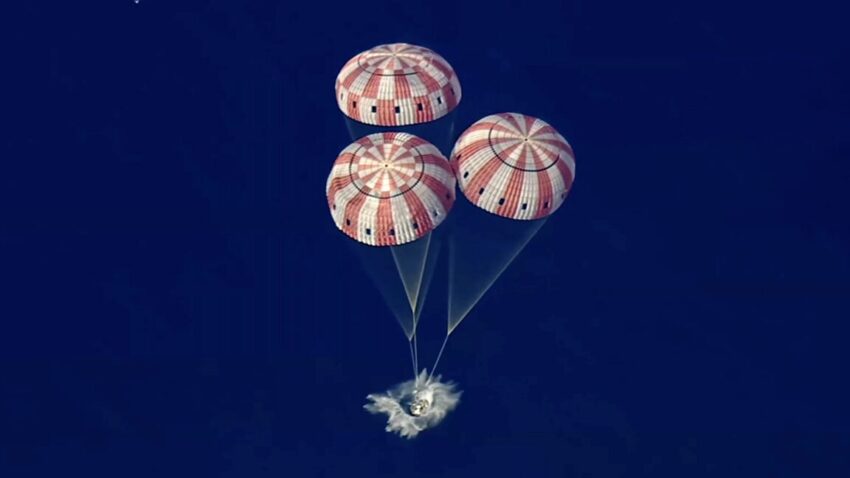
four astronauts are back home after a NASA’s Orion spacecraft has successfully returned to Earth, marking a significant milestone in human space exploration with its first mission to the Moon in nearly 54 years.
four astronauts are back home after a
Historic Return Journey
On Friday, the Orion spacecraft, aptly named Integrity, re-entered Earth’s atmosphere at a staggering speed of over 30 times the speed of sound. This remarkable feat culminated in a dramatic descent over the Pacific Ocean, where it safely returned four astronauts to Earth. The mission, known as Artemis II, represents a pivotal moment in NASA’s efforts to return humans to the Moon and beyond.
Extreme Conditions During Re-Entry
As the spacecraft hurtled towards Earth, it encountered extreme temperatures that soared to approximately 5,000 degrees Fahrenheit. This intense heat generated a sheath of plasma around the capsule, temporarily blocking radio signals between the Orion spacecraft and Mission Control in Houston. Such conditions are typical during re-entry, but they pose significant challenges for spacecraft and their crews.
During this critical phase, the Orion spacecraft flew from a southwest to northeast trajectory, guiding itself toward a designated splashdown zone located southwest of San Diego. A U.S. Navy recovery ship was strategically positioned in the area, ready to assist with the crew’s homecoming. Ground teams at Mission Control experienced a six-minute communication blackout, a common occurrence during re-entry due to the intense heat and plasma interference.
Successful Splashdown
After regaining communication with Orion commander Reid Wiseman, the spacecraft’s descent was closely monitored by airborne tracking planes that transmitted live video back to Mission Control. This provided a real-time view of the capsule’s journey as it approached the ocean.
Deployment of Parachutes
As the spacecraft neared the water, it jettisoned its parachute cover and deployed a series of smaller chutes to stabilize its descent. Following this, three larger main parachutes, each boasting an area of 10,500 square feet, opened to significantly slow Orion’s descent. The spacecraft ultimately splashed down at 8:07 PM EDT on Friday (00:07 UTC Saturday), marking a successful conclusion to its mission.
Significance of the Artemis II Mission
The Artemis II mission is a crucial step in NASA’s broader Artemis program, which aims to establish a sustainable human presence on the Moon by the end of the decade. This mission serves not only as a test of the Orion spacecraft’s capabilities but also as a precursor to future lunar exploration, including potential missions to Mars.
Objectives of the Artemis Program
The Artemis program has several key objectives:
- To land “the first woman and the next man” on the lunar surface.
- To establish a sustainable human presence on the Moon by 2028.
- To conduct scientific research and exploration on the lunar surface.
- To develop technologies that will enable human missions to Mars.
By successfully returning the Orion spacecraft and its crew, NASA has demonstrated the viability of its systems and processes, paving the way for future missions that will push the boundaries of human exploration.
Reactions from Stakeholders
The successful completion of the Artemis II mission has elicited a range of reactions from stakeholders, including NASA officials, astronauts, and the broader scientific community.
Nasa’s Perspective
Nasa Administrator Bill Nelson expressed his enthusiasm for the mission’s success, stating, “This is a historic moment for NASA and for humanity. We are one step closer to returning to the Moon and eventually sending humans to Mars.” Nelson emphasized the importance of international collaboration in space exploration, noting that the Artemis program involves partnerships with various countries and organizations.
Astronauts’ Reflections
The astronauts aboard the Orion spacecraft also shared their thoughts on the mission. Commander Reid Wiseman remarked on the significance of the journey, saying, “This mission is not just about us; it’s about inspiring the next generation of explorers. We are paving the way for future missions that will take humanity further into the cosmos.” The crew’s experience during the mission has been described as both exhilarating and humbling, highlighting the challenges and triumphs of space travel.
Scientific Community’s Insights
Members of the scientific community have also weighed in on the implications of the Artemis II mission. Dr. Sarah Johnson, a prominent astrophysicist, stated, “The data collected during this mission will provide invaluable insights into the challenges of deep space travel. Understanding how humans can thrive in such environments is crucial for future missions to Mars and beyond.” The mission’s success is expected to contribute significantly to ongoing research in space science and technology.
Future Implications
The successful return of the Orion spacecraft marks a significant milestone, but it also raises questions about the future of human space exploration. As NASA prepares for subsequent missions, including Artemis III, which aims to land astronauts on the lunar surface, the agency faces numerous challenges and opportunities.
Technological Advancements
One of the primary focuses for NASA will be the continued development of technologies that enhance the safety and efficiency of space travel. Innovations in spacecraft design, life support systems, and propulsion technologies will be essential for long-duration missions, particularly those aimed at Mars.
International Collaboration
The Artemis program is not solely a national endeavor; it involves collaboration with international partners. Countries such as Canada, Japan, and members of the European Space Agency are contributing to various aspects of the program. This collaborative approach not only enhances the capabilities of the missions but also fosters a spirit of unity in the pursuit of exploration.
Public Engagement and Education
Another critical aspect of the Artemis program is public engagement. NASA aims to inspire interest in science, technology, engineering, and mathematics (STEM) fields among young people. By showcasing the achievements of the Artemis missions, NASA hopes to encourage the next generation of scientists, engineers, and explorers.
Conclusion
The successful return of the Orion spacecraft and its crew marks a historic moment in space exploration, signaling humanity’s renewed commitment to lunar exploration and beyond. As NASA continues to build on the successes of the Artemis II mission, the agency is poised to make significant strides in understanding our universe and expanding the frontiers of human knowledge.
Source: Original report
Was this helpful?
Explore more: More General Technology Tech News Blog
Last Modified: April 11, 2026 at 12:36 pm
12 views