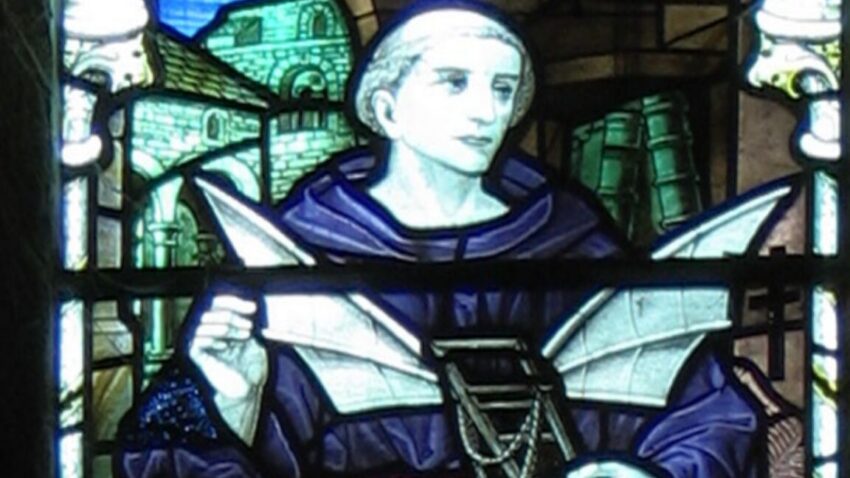
did a medieval flying monk spot halley A medieval monk’s remarkable leap from a tower may have coincided with his sightings of Halley’s Comet, raising questions about historical timelines and astronomical events.
did a medieval flying monk spot halley
The Legend of Eilmer of Malmesbury
In the early 11th century, a young Benedictine monk named Eilmer made headlines—or at least, historical footnotes—when he attempted a daring flight from the 150-foot tower of Malmesbury Abbey in England. This audacious act of medieval aviation involved Eilmer donning a pair of wings he had crafted from willow wood and cloth. According to accounts, he managed to glide approximately 600 feet before crash-landing in a small valley near the river Avon. The impact of the fall resulted in broken legs, leaving him crippled for life. Despite this unfortunate outcome, Eilmer’s experiment has been immortalized in history, with Malmesbury Abbey still featuring a stained-glass window dedicated to his daring endeavor.
Historical Context
The story of Eilmer’s flight comes to us primarily through the writings of 12th-century historian William of Malmesbury, who penned his account around 1125. However, William did not provide an exact date for Eilmer’s flight, leaving future historians to piece together the timeline based on contextual clues and historical events. This lack of specificity has led to various interpretations of Eilmer’s life and achievements, particularly concerning his observations of Halley’s Comet.
Eilmer’s Astronomical Observations
One of the most intriguing aspects of Eilmer’s life, as chronicled by William of Malmesbury, is his sighting of Halley’s Comet in 1066. William notes that Eilmer, “advanced in years,” remarked, “It is long since I saw you.” This statement has sparked considerable debate among historians regarding whether Eilmer had witnessed Halley’s Comet during its previous appearance in 989, when he would have been a young boy. If this interpretation holds true, it would suggest that Eilmer had a lifelong fascination with celestial events, a theme that resonates with the scientific curiosity of the time.
Calculating Eilmer’s Age
Assuming Eilmer was at least five years old in 989, he would have been born no later than 984. This estimation places Eilmer in his 80s during the sighting of Halley’s Comet in 1066. Furthermore, his attempt at flight, described as occurring when he was “in his first youth,” likely took place between 1000 and 1010. However, this timeline is fraught with assumptions, and the lack of concrete evidence makes it difficult to ascertain the exact dates of these events.
Alternative Theories and Historical Interpretations
James Aitcheson, a historian from the University of Leicester, offers an alternative perspective in a paper published in the journal Notes and Queries. Aitcheson posits that Eilmer may not have seen Halley’s Comet in his youth but rather a different comet that appeared in 1018. If this theory is accurate, it would imply that Eilmer was born much later than previously thought, potentially altering the timeline of his flight to a period between the 1020s and 1040s.
Implications of Aitcheson’s Theory
If Aitcheson’s hypothesis holds merit, it raises significant questions about the accuracy of historical records and our understanding of medieval astronomy. The implications extend beyond Eilmer’s personal narrative; they challenge the reliability of historical accounts that have been accepted for centuries. The discrepancies in Eilmer’s age and the timing of his comet sightings highlight the complexities involved in reconstructing historical timelines, especially when reliant on secondary sources like William of Malmesbury.
The Significance of Comet Sightings in Medieval Times
Comets have long captured human imagination, often seen as omens or harbingers of significant events. In medieval Europe, the appearance of a comet could provoke fear, awe, or even inspire artistic expression. For Eilmer, witnessing Halley’s Comet—or another comet—may have sparked a deeper interest in the natural world, leading him to experiment with flight. This connection between celestial phenomena and human innovation is a recurring theme in history, illustrating how the mysteries of the universe can inspire creativity and exploration.
Broader Historical Context
The 11th century was a time of significant change in Europe, marked by the rise of scholasticism and a renewed interest in science and philosophy. The period saw the establishment of universities and the translation of classical texts, which contributed to a burgeoning intellectual climate. Eilmer’s flight experiment can be viewed as part of this broader trend, reflecting the era’s spirit of inquiry and experimentation.
The Legacy of Eilmer’s Flight
Eilmer’s flight, despite its tragic conclusion, remains a testament to human ambition and curiosity. The stained-glass window at Malmesbury Abbey serves as a reminder of his daring attempt to conquer the skies, symbolizing the intersection of faith, science, and human endeavor. Eilmer’s story has inspired generations, prompting discussions about the nature of innovation and the limits of human capability.
Modern Interpretations and Cultural Impact
In contemporary times, Eilmer’s story has been revisited by historians, scientists, and enthusiasts alike. His flight has been the subject of various artistic interpretations, including literature, film, and even academic research. The tale serves as a bridge between the past and present, illustrating how historical figures can continue to inspire modern audiences.
Conclusion
The narrative surrounding Eilmer of Malmesbury is a complex tapestry woven from historical accounts, astronomical events, and human ambition. While the exact details of his life and achievements remain shrouded in uncertainty, the implications of his story resonate through the ages. Whether he witnessed Halley’s Comet or another celestial phenomenon, Eilmer’s legacy endures as a symbol of the human spirit’s quest for knowledge and understanding.
Source: Original report
Was this helpful?
Explore more: More General Technology Tech News Blog
Last Modified: June 15, 2026 at 9:35 am
12 views