causality optional testing the indefinite causal order A recent experiment suggests that the concept of causality may not be as rigid as previously thought, opening the door to the intriguing idea of “indefinite causal order” in quantum mechanics.
causality optional testing the indefinite causal order
Understanding Quantum Mechanics and Causality
Quantum mechanics has long been a field that challenges our classical intuitions about the nature of reality. One of the most perplexing aspects of quantum mechanics is the phenomenon of entanglement, where particles become interconnected in such a way that the state of one particle instantaneously influences the state of another, regardless of the distance separating them. This phenomenon raises fundamental questions about causality—the relationship between cause and effect.
Traditionally, causality is viewed as a linear process: an event (the cause) leads to another event (the effect). However, in the quantum realm, this linearity can become blurred. A decade ago, an experiment involving entangled photons illustrated this ambiguity. In this experiment, one half of a pair of entangled photons was sent through a device that allowed it to behave either as a particle or a wave. The other half was measured in a manner that forced the first photon to adopt a specific behavior. Remarkably, it appeared as though the measurement retroactively influenced the behavior of the first photon, raising profound questions about the applicability of causality in quantum mechanics.
The Quest for Indefinite Causal Order
In the years since that initial experiment, physicists have continued to explore the implications of quantum mechanics on our understanding of causality. Recently, researchers have designed new experiments aimed at probing the concept of “indefinite causal order.” This idea posits that events can exist in a superposition of different causal orders, meaning that the sequence in which events occur can be probabilistic rather than deterministic.
The recent experiment that has garnered attention demonstrates the feasibility of creating quantum superpositions of two different series of events. This means that, instead of definitively stating that event A occurred before event B, one can consider both possibilities simultaneously. The researchers involved in this study believe that their findings could pave the way for eliminating certain loopholes that currently exist in their experimental setup.
The Experiment: A Closer Look
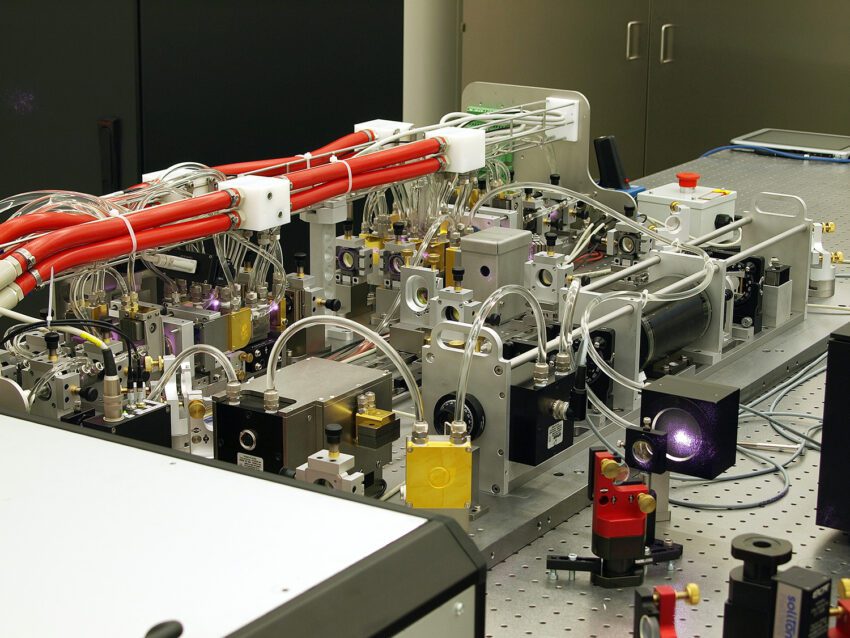
The experiment in question involved a sophisticated setup designed to test the concept of indefinite causal order. The researchers utilized a pair of entangled photons and a series of optical devices to manipulate their states. By carefully controlling the interactions between the photons, they were able to create a scenario in which the causal order of events could be placed in a superposition.
To achieve this, the researchers employed a technique known as quantum interference, which allows for the combination of different quantum states. By manipulating the paths taken by the entangled photons, they could create conditions where the photons could be said to exist in a state where both causal orders—A before B and B before A—were possible. This is a significant departure from classical physics, where events are strictly ordered.
Implications for Quantum Computing and Information
The implications of this research extend beyond theoretical physics. The concept of indefinite causal order could have profound effects on the fields of quantum computing and quantum information. In classical computing, the order of operations is crucial; changing the order can lead to different outcomes. However, if quantum systems can exist in a superposition of causal orders, it may be possible to develop new computational models that leverage this property.
For instance, quantum computers that utilize indefinite causal order could potentially perform calculations more efficiently than classical computers. This could lead to breakthroughs in various fields, including cryptography, optimization problems, and complex simulations. The ability to manipulate causal order could also enhance the capabilities of quantum networks, allowing for more secure communication channels.
Challenges and Future Directions
While the recent experiment provides exciting insights into the nature of causality in quantum mechanics, it is essential to acknowledge the challenges that remain. The researchers themselves have noted that there are still some loopholes in their experimental design that need to be addressed. For example, ensuring that the superposition of causal orders is maintained throughout the entire experimental process is a complex task.
Moreover, the interpretation of these findings raises additional questions. The concept of indefinite causal order challenges our classical understanding of time and sequence, prompting philosophical inquiries into the nature of reality. If events can exist without a definitive causal order, what does this mean for our understanding of time itself?
Stakeholder Reactions
The scientific community has reacted with a mix of excitement and caution to the findings of this experiment. Many physicists see the potential for significant advancements in both theoretical and applied physics. The idea that causality may not be a strict requirement in quantum mechanics opens up new avenues for research and exploration.
However, some researchers remain skeptical about the practical applications of indefinite causal order. They argue that while the theoretical implications are intriguing, the experimental challenges must be overcome before any real-world applications can be realized. The debate surrounding these findings highlights the ongoing tension between theoretical physics and experimental validation.
Conclusion
The exploration of indefinite causal order in quantum mechanics represents a fascinating frontier in our understanding of the universe. As researchers continue to investigate the implications of these findings, we may be on the cusp of a paradigm shift in how we perceive causality, time, and the fundamental nature of reality. The journey into the quantum realm is far from over, and each new discovery brings us closer to unraveling the mysteries that lie at the heart of existence.
Source: Original report
Was this helpful?
Explore more: More General Technology Tech News Blog
Last Modified: March 28, 2026 at 8:37 pm
14 views