Figma has been using AI agents to take on some of the most repetitive parts of security work, from alert triage and incident search to draft code fixes, and says the approach has made complex investigations roughly 70% faster while keeping human review in the loop.
How Figma Uses AI Agents for Security
The company’s engineering team recently described a security system built to help its security staff investigate alerts, search prior incidents, check company systems, and prepare code changes. The goal is not to replace security engineers, but to reduce the time they spend on routine investigation so they can focus on harder cases that need judgment.
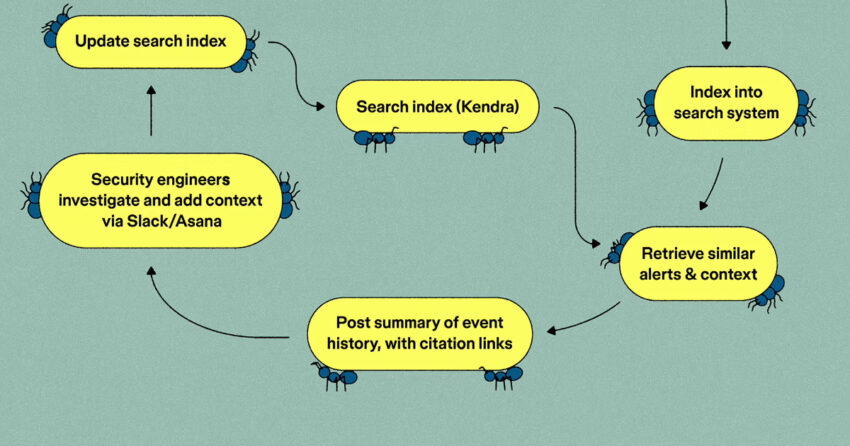
According to Figma, the agents learn from previous investigations and use that context to make later reviews more efficient. The company says the result has been about a 70% reduction in resolution time for complex alerts, along with a 20% drop in on-call pages after lowering the severity of some alerts.
A security stack built around Panther, cloud tools, and memory
Figma’s system is centered on Panther SIEM and checks audit logs across AWS, Okta, GitHub, GCP, and osquery. It also queries more than 100 additional sources and can open pull requests when it identifies work that needs to be done.
The alert triage agent is described as the part where most of the investigation happens. Figma says it uses a model like Claude Opus, receives the full Slack thread history as context, and gets access to tools that are scoped to what a typical security on-call engineer would use during triage.
The company also says the agentic setup uses AWS Bedrock Knowledge Bases, Amazon Kendra, Tines, and a Snowflake-based tool to search historical alerts and investigate Panther data. One of the clearest takeaways from the team’s write-up is that memory became essential as the system matured.
Three kinds of memory help the agents improve
Figma says it separates memory into three categories:
- Past alerts
- Behavioral guidance
- Learned database structures
The company says keeping those memories separate was important, and that the setup made the system more useful over time. In the team’s view, memory was the feature that had the biggest impact on the quality of investigations as the agents accumulated more context.
Controls are part of the design
Even with more automation, Figma says it has built safeguards into the workflow itself. Agent-created pull requests are set to draft by default, and prompts are designed to stop sensitive data from being shared in public Slack channels.
That matters because the system is being used in security operations, where a mistake can create a new incident rather than prevent one. The company’s approach suggests a practical pattern: let the agent do the searching and first-pass analysis, but keep humans in charge of anything that could create risk.
Figma’s broader push with security agents
In a separate article, Figma said its agents found more than 100 previously unknown vulnerabilities, including two critical flaws that traditional tools missed. The company also said its code reviewer reached 80% precision within a month.
Other gains included about a 30% improvement in detecting known bugs through a second review step and roughly a 50% reduction in some coding errors after automated guidance was added. Figma still cautions that its process is not a universal blueprint.
“We can’t tell you exactly what to do: The specifics depend on your company size, the risks you face, and the feedback loops you already run. But one main lesson is to improve precision before recall. The order is counterintuitive, because the historical bugs you already have can only measure recall; they barely help with the precision you must fix first.”
Why the human oversight question still matters
Figma’s experience lands in the middle of a wider industry debate about how far AI agents should be trusted in security and development workflows. As more teams hand agents access to code, logs, and internal tools, the boundaries around approvals and trust become more important, not less.
That concern has been reinforced by recent security research, including Wiz’s “GhostApproval” report, which said six AI coding assistants could be tricked by malicious repositories while displaying a harmless-looking approval prompt. InfoQ has also recently covered OpenAI’s disclosure about sandbox escapes.
Figma’s position is that the choice is not between AI and people, but about finding the right balance. The company acknowledges that its agents are not perfect, and says humans are not either.
For security teams, the appeal is obvious: less repetitive triage, faster investigation, and more consistent follow-through on known patterns. The challenge is making sure the automation stays inside clearly defined limits.
What Figma’s system shows is that AI agents can already do useful work in security operations, especially when they are constrained, monitored, and fed with the right history. The open question is how much more responsibility teams will be comfortable giving them next.
Source: Original report
Was this helpful?
Explore more: Application Audit & Review More Cybersecurity Tech News
Last Modified: September 6, 2026 at 10:33 pm
28 views