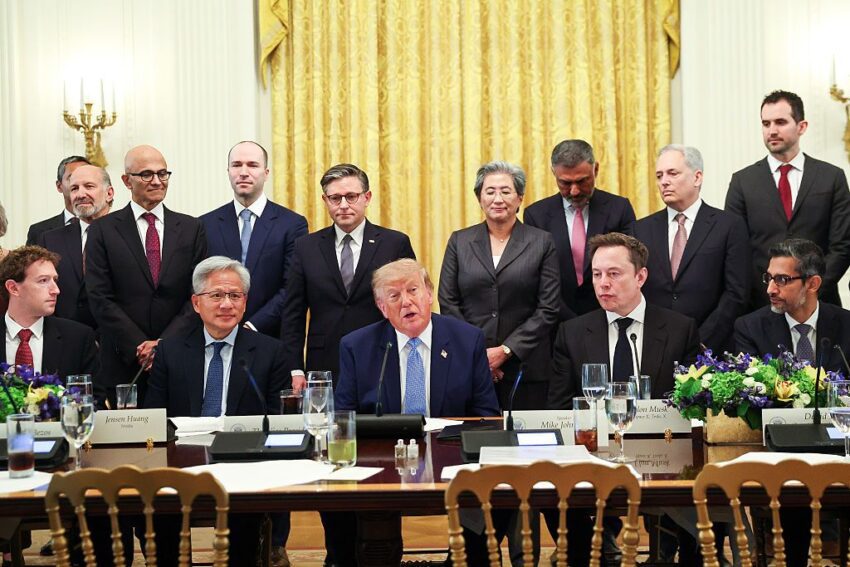
The White House spent the week trying to put a new frame around artificial intelligence, with President Donald Trump signing an executive order that officially rebrands AI as “super intelligence” while major tech executives gathered in Washington for a safety pledge the administration described as “morally binding.” The move landed at the same time Meta and OpenAI were giving their AI products friendlier public faces, even as the biggest money in the sector still appears to be coming from enterprise customers rather than ordinary consumers.
The White House’s AI pivot to “super intelligence”
According to the source material, Trump signed an executive order that changes the administration’s language around AI and labels it “super intelligence.” The terminology shift is notable less for what it changes technically than for what it signals politically: the White House is trying to set the tone for how the government and the public talk about the next phase of machine intelligence.
The same week, the administration also brought a long list of prominent tech leaders into one room. Among those named were Meta chief executive Mark Zuckerberg, Amazon founder Jeff Bezos, Tesla and xAI chief executive Elon Musk, and Anthropic co-founder and CEO Dario Amodei. The gathering produced an AI safety pledge that President Trump called “morally binding,” a phrase that suggests the White House wants the agreement to carry at least some reputational pressure, even if the practical enforcement details remain unclear from the source material.
Why the language shift matters
Rebranding AI as “super intelligence” is a rhetorical move, but it is also a strategic one. Words like “AI” have become broad enough to cover everything from chatbots and image generators to enterprise software and backend automation. “Super intelligence,” by contrast, implies a more advanced and potentially more consequential class of systems.
That framing could shape public debate in two ways. First, it may heighten attention on safety, alignment, and governance as companies race to build more capable systems. Second, it can also help policymakers draw a line between today’s practical products and the longer-term, more speculative capabilities that continue to animate much of the AI conversation.
Still, the source material does not spell out how the executive order changes policy, funding, or regulation. What is clear is that the White House is trying to position itself as the center of the conversation, not just a referee on the sidelines.
A pledge with big names and big expectations
The presence of Zuckerberg, Bezos, Musk, and Amodei in the same room underlines how concentrated power has become in the AI sector. These are executives whose companies sit at different points in the AI supply chain: platform distribution, cloud infrastructure, frontier model development, and consumer product design. Getting them to sign on to a safety pledge gives the administration a visible coalition, even if the substance of the pledge is not detailed in the source.
Trump’s description of the pledge as “morally binding” is also telling. It suggests the White House is leaning on moral persuasion and public accountability rather than a purely regulatory approach, at least in the way the week’s announcement was presented. For companies under pressure to move fast, that kind of language may be easier to accept than hard restrictions, but it also leaves open questions about how much it changes actual behavior.
Meta and OpenAI try a friendlier face
While policymakers were focusing on safety language, Meta and OpenAI were said to be putting friendlier faces on their AI products. That likely reflects a broader industry trend: the race to make AI feel less intimidating and more useful, especially for mainstream consumers who may not care about model architecture but do care about trust, tone, and ease of use.
This consumer-friendly positioning matters because AI products often face a split market. On one side, companies want to show progress and capability to investors, developers, and enterprise buyers. On the other, they need to avoid making products that feel opaque, unsafe, or socially abrasive to the general public. A warmer presentation can help on the second front, even if it does not solve deeper concerns about reliability, privacy, or cost.
The source material does not provide specifics about the changes Meta and OpenAI are making, but it does place them in contrast with the White House’s sharper language. In other words, the government is elevating the stakes while consumer-facing companies are trying to lower the temperature.
The economics still look enterprise-first
For all the attention on consumer AI assistants and chatbots, the source says the biggest money in AI still appears to be coming from enterprise. That is an important reminder that the market’s loudest products are not always its most profitable ones. Businesses buying AI tools for workflow automation, customer support, software development, and internal productivity remain a crucial source of revenue.
This enterprise tilt helps explain why so many AI companies continue to market themselves in two different ways. To consumers, they promise convenience, creativity, and accessibility. To businesses, they promise efficiency, integration, and measurable return on investment. The consumer story may generate headlines, but the enterprise story tends to generate invoices.
That split also makes the “super intelligence” branding feel somewhat paradoxical. If most of the money is still coming from mundane enterprise use cases, the market remains grounded in practical applications even as the political and media framing drifts toward more dramatic language.
Beyond AI: IPOs, startup deals, and the wider market
The week’s Equity podcast discussion did not stop at AI. Hosts Kirsten Korosec, Anthony Ha, and Sean O’Kane also dug into the shifting IPO market and a handful of startup deals. That broader context matters because AI is only one part of a tech landscape still adjusting to interest rates, investor caution, and uneven demand for public offerings.
For startups, the current environment rewards flexibility. Companies with strong enterprise traction may find better footing than those relying on consumer hype alone. Meanwhile, IPO timing remains highly sensitive, with the public markets still signaling that not every company can or should rush to list.
In that sense, the week’s AI headlines and the IPO discussion are linked by a common theme: investors, companies, and policymakers are all trying to decide which parts of the tech boom are durable and which are mostly branding.
What to watch next
Several questions follow from this week’s developments:
- Whether the White House’s “super intelligence” language becomes a real policy framework or simply a short-lived rhetorical shift.
- How much influence the safety pledge will have on the major companies represented in the room.
- Whether Meta and OpenAI’s friendlier product positioning translates into broader consumer adoption.
- Whether enterprise AI continues to outpace consumer products as the clearest source of revenue.
- How the IPO market absorbs continued volatility across the broader tech sector.
For now, the most important takeaway is that AI remains both a business and a political story. The White House is trying to define the language, the companies are trying to define the products, and the market is still deciding where the real economic value will settle.
What this means for the tech conversation
The shift from “AI” to “super intelligence” may sound cosmetic, but in tech policy, language often precedes regulation, funding, and public expectations. A label can shape how urgently lawmakers move, how cautiously companies communicate, and how much fear or enthusiasm the public brings to the topic.
At the same time, the industry’s practical reality remains less dramatic than the headline language suggests. The source material points to a sector where enterprise demand still drives the strongest economics, even as public-facing products are refined and rebranded. That tension between spectacle and revenue is likely to define the next phase of AI competition.
Source: Original report
Was this helpful?
Explore more: AI Automation Services More AI & Automation Tech News
Last Modified: October 3, 2026 at 10:31 pm
0 views