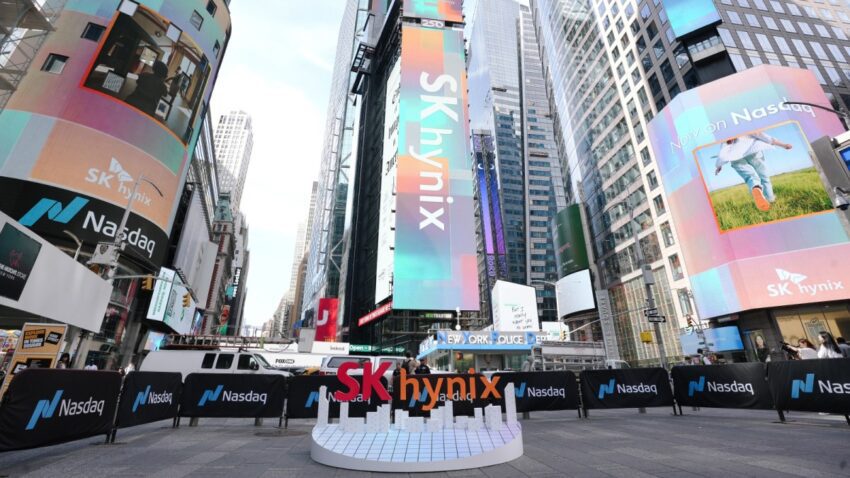
sk hynix ipo SK Hynix has pulled off a landmark U.S. market debut, raising $26.5 billion in what is being described as the largest foreign IPO in U.S. history. The South Korean memory chip maker’s blockbuster offering comes amid intense demand for AI infrastructure and growing pressure from Washington for more semiconductor manufacturing to move onto American soil.
sk hynix ipo
A record-setting debut for a Korean chip giant
The company said Friday that it raised KRW 40 trillion, or $26.5 billion, by selling 177.9 million American depositary shares at $149 each. The structure lets U.S. investors buy into the company at roughly one-tenth of the price of a full share in Seoul, according to the source material.
The deal eclipsed Alibaba’s $25 billion IPO in 2014 and became the biggest-ever U.S. debut by a non-American company. SK Hynix begins trading on Nasdaq on Friday, July 10, under the temporary ticker SKHYV. Regular trading is scheduled to open Monday, July 13, when the ticker officially changes to SKHY.
Early signs pointed to strong investor enthusiasm. The stock opened 14% above its IPO price and continued rising in early Friday trading.
Why investors lined up
SK Hynix is not the kind of Korean company that usually gets trapped by what investors call the “Korea Discount,” the persistent valuation gap that has long affected many firms from the country. That discount is often attributed to factors including complex corporate governance, lower shareholder returns, regulatory uncertainty, and geopolitical risks tied to North Korea.
In this case, however, SK Hynix benefits from being one of the most strategically important suppliers in the AI hardware boom. The company makes memory chips, including high-bandwidth memory, or HBM, which is a critical component of AI GPUs. Nvidia relies on SK Hynix as one of its primary suppliers, giving the chipmaker a direct link to one of the most valuable businesses in the AI supply chain.
Demand for the offering was reportedly more than seven times the available shares, according to media reports cited in the source material. Even more notably, the U.S. shares were priced at a 2.7% premium to SK Hynix’s three-day average in Seoul, based on its Korea Stock Exchange filing.
Where the money is going
SK Hynix said the proceeds from the sale will be directed to three major uses:
- a new fab in South Korea, which is already under construction and is intended to help ease the global memory shortage driven by AI demand;
- a new packaging facility in South Korea;
- and EUV scanners, the specialized tools used to produce next-generation chips.
The investment plan underscores how aggressively the company is expanding capacity at a time when memory chips have become central to the AI buildout. High-bandwidth memory is especially important because it helps AI accelerators handle the massive data requirements of modern models.
Washington wants more chip production in the U.S.
The IPO also arrives as the U.S. government continues pressing major semiconductor companies to invest more heavily in American manufacturing. Commerce Secretary Howard Lutnick made that message clear during a Micron event on Thursday, where he reportedly said he is already in talks with Samsung and SK Hynix about building new factories in the United States.
The goal, according to the source material, is to ensure that South Korea does not remain the dominant country in this critical part of the technology stack. The remarks were aimed not only at Micron, a U.S. memory chip maker, but also at the broader global memory industry.
Micron itself has already signaled how seriously it is taking that push. The company announced plans to invest $250 billion in new U.S. manufacturing, which it says would create more than 90,000 jobs and keep leading-edge chip production on American soil.
A global supply chain under political scrutiny
The timing is significant because SK Hynix’s fundraising comes just as both major Korean chipmakers have pledged more than $550 billion for new manufacturing investment in South Korea. That creates a complex picture: companies are expanding at home while U.S. officials are pushing for more of the industry’s most important capacity to be built in the United States.
For Washington, the stakes are both economic and strategic. Memory chips are not as visible to consumers as smartphones or laptops, but they are indispensable to AI servers, cloud data centers, and advanced computing systems. Whoever controls supply in this market has outsized influence over the pace and geography of the AI boom.
For SK Hynix, the IPO provides a major cash infusion at exactly the moment its products are becoming more essential to the global tech industry. The company is riding a wave of demand for HBM and other memory products, and its close ties to Nvidia place it near the center of the current AI hardware expansion.
A milestone with broader implications
The deal is notable not only because of its size, but also because it reflects how capital markets are rewarding companies positioned to benefit from AI infrastructure spending. A memory chip maker from South Korea has now delivered one of the biggest Wall Street moments in recent memory, while also becoming part of a broader policy conversation about where advanced semiconductors should be made.
Whether SK Hynix ultimately builds new U.S. fabs remains to be seen. But the IPO itself shows that investors are eager to back the firms supplying the AI economy, especially when those firms are linked to scarce technologies such as HBM. It also shows that the semiconductor industry’s geography is increasingly a matter of national strategy, not just business efficiency.
For now, the market verdict is clear: investors wanted in, and SK Hynix was able to sell the story at a historic scale.
Source: Original report
Was this helpful?
Explore more: More Hardware & Devices Tech News Blog
Last Modified: July 13, 2026 at 4:12 pm
23 views