scientists found the key to accurate maya Recent research has unveiled how the ancient Maya achieved remarkable accuracy in their eclipse predictions, shedding light on their sophisticated astronomical knowledge.
scientists found the key to accurate maya
The Significance of Eclipses in Maya Culture
Astronomical events, particularly solar and lunar eclipses, held profound significance in Maya culture. These celestial phenomena were not merely scientific curiosities; they were deeply intertwined with the Maya’s spiritual beliefs, agricultural practices, and societal organization. The ability to predict eclipses allowed the Maya to align their rituals and agricultural activities with celestial events, reinforcing their connection to the cosmos.
The Maya civilization utilized a complex system of calendars to track time and celestial events. Among these, the Long Count, Tzolk’in, and Haab’ calendars played pivotal roles in their daily lives and religious practices. The Long Count was a linear count of days used for historical records, while the Tzolk’in was a 260-day astrological calendar that combined days and months in a cyclical manner. The Haab’, a 365-day solar calendar, was used to mark the solar year. This intricate calendrical system reflects the Maya’s advanced understanding of time and astronomy.
The Dresden Codex: A Window into Maya Astronomy
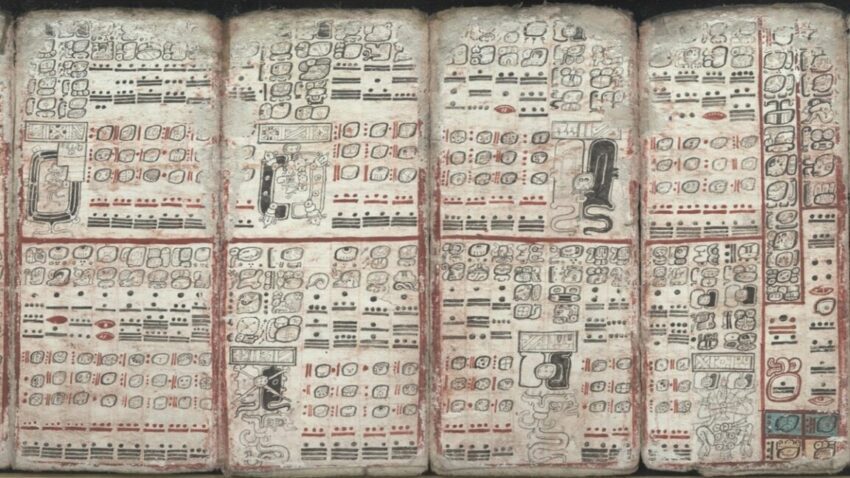
Among the few surviving texts from the Maya civilization is the Dresden Codex, a crucial artifact that provides insight into their astronomical knowledge. Dating back to the 11th or 12th century, this codex likely originated near the ancient city of Chichen Itza. The Dresden Codex is notable for its unique accordion-style format, stretching an impressive 12 feet when fully unfolded. It contains a wealth of information, including local history, mythology, and astronomical tables, particularly those related to lunar cycles and the planet Venus.
Despite the destruction of many Maya texts by Spanish conquistadors and Catholic priests, the Dresden Codex remains a vital source for understanding Maya astronomy. The text was deciphered in the early 20th century, revealing its significance as a record of the Maya’s sophisticated understanding of celestial phenomena. Among its many features, the codex includes a table of eclipses, which has long intrigued researchers and scholars.
New Insights from Recent Research
A recent study published in the journal Science Advances has provided new insights into the origins and accuracy of the eclipse table found in the Dresden Codex. Researchers concluded that this table was not created solely for the purpose of predicting eclipses; rather, it was repurposed from earlier lunar month tables. This revelation suggests that the Maya had a systematic approach to their astronomical records, utilizing existing knowledge to enhance their predictive capabilities.
The study’s authors employed a combination of historical analysis and mathematical modeling to understand the mechanisms behind the Maya’s eclipse predictions. They discovered that the Maya used a sophisticated method of adjusting their lunar month tables to account for the discrepancies between the lunar and solar calendars. This adjustment allowed them to maintain the accuracy of their eclipse predictions over extended periods, demonstrating a remarkable understanding of celestial mechanics.
The Mechanism of Accuracy
The key to the Maya’s accurate eclipse predictions lies in their ability to synchronize their lunar and solar calendars. The researchers identified that the Maya employed a technique known as “lunar month correction,” which involved adjusting the lunar calendar to align with the solar year. This correction was essential for ensuring that their eclipse predictions remained reliable over time.
By repurposing existing lunar month tables, the Maya could create a more comprehensive framework for predicting eclipses. This approach not only highlights their innovative thinking but also underscores the importance of continuity in their astronomical knowledge. The ability to adapt and refine existing records demonstrates a sophisticated understanding of timekeeping and celestial events.
Implications of the Findings
The implications of this research extend beyond the realm of astronomy. Understanding how the Maya created and maintained accurate eclipse tables provides valuable insights into their culture, societal organization, and intellectual achievements. It reveals a civilization that was not only deeply connected to the cosmos but also highly skilled in the art of observation and record-keeping.
This research also raises questions about the broader context of Maya civilization and its interactions with other cultures. The Maya were not isolated; they engaged in trade and cultural exchanges with neighboring civilizations. Their astronomical knowledge may have been influenced by or shared with other cultures, leading to a richer understanding of the interconnectedness of ancient societies.
Reactions from the Academic Community
The findings of this study have garnered attention from scholars and researchers in various fields, including archaeology, anthropology, and astronomy. Many experts have praised the innovative approach taken by the researchers, emphasizing the importance of interdisciplinary collaboration in uncovering the complexities of ancient civilizations.
Some scholars have pointed out that the study opens new avenues for research into other surviving Maya texts. By applying similar analytical techniques, researchers may uncover additional insights into the astronomical knowledge and practices of the Maya. This could lead to a more nuanced understanding of how the Maya viewed their place in the universe and how they integrated celestial events into their daily lives.
Challenges in Understanding Maya Astronomy
Despite the advancements in our understanding of Maya astronomy, challenges remain. The destruction of many texts and artifacts during the Spanish conquest has left significant gaps in our knowledge. While the Dresden Codex and a few other codices provide valuable information, much of the Maya’s astronomical knowledge may never be fully recovered.
Furthermore, the interpretation of ancient texts is inherently complex. The Maya used a sophisticated system of hieroglyphs, and deciphering these symbols requires a deep understanding of their language and culture. As researchers continue to study the surviving codices, they must navigate the challenges of translation and interpretation, which can lead to differing conclusions about the Maya’s astronomical practices.
Future Directions in Maya Studies
The recent findings regarding the eclipse tables in the Dresden Codex highlight the need for continued research into Maya astronomy and culture. Future studies may focus on the following areas:
- Comparative Analysis: Researchers can compare the Maya’s astronomical practices with those of other ancient civilizations, such as the Egyptians and Mesopotamians, to identify similarities and differences in their approaches to celestial observations.
- Technological Advances: The use of modern technology, such as computer modeling and simulations, can enhance our understanding of ancient astronomical calculations and predictions.
- Interdisciplinary Collaboration: Collaboration between historians, archaeologists, astronomers, and linguists can lead to a more comprehensive understanding of the Maya’s intellectual achievements.
Conclusion
The recent study on the Maya’s eclipse tables has illuminated the sophistication of their astronomical knowledge and the methods they employed to achieve remarkable accuracy in their predictions. By repurposing existing lunar month tables and employing a systematic approach to calendar synchronization, the Maya demonstrated an advanced understanding of celestial mechanics. This research not only enriches our understanding of Maya culture but also underscores the importance of preserving and studying ancient texts to uncover the complexities of human knowledge throughout history.
Source: Original report
Was this helpful?
Explore more: More General Technology Tech News Blog
Last Modified: November 21, 2025 at 2:36 am
16 views