WhatsApp is testing Scam Alert, an optional on-device machine learning feature designed to warn users when messages from people outside their contacts resemble scam patterns. The limited beta is built around privacy-preserving analytics, with Meta saying message content stays on the device during classification while confidential computing, differential privacy, and transparency controls are used to measure performance and limit targeted model delivery.
How WhatsApp Scam Alert works
When a user enables the feature, WhatsApp downloads a small machine learning model to the phone and uses it to evaluate incoming messages from non-contacts. The system looks at conversational structure and linguistic signals, then flags a likely scam if the model sees a match with patterns associated with fraud.
Meta says the model was trained on scam conversation patterns gathered from reports that users previously sent to WhatsApp. If Scam Alert identifies a suspicious message, the warning is shown only to the recipient, not the sender. From there, the user can block the chat, report it, or continue the conversation.
WhatsApp also gives users a way to reduce false positives. A chat can be marked as trusted, after which Scam Alert will not flag that conversation again. In addition, users can optionally share the last five messages from a trusted chat with WhatsApp to help improve the feature.
Privacy-preserving analytics stays separate from classification
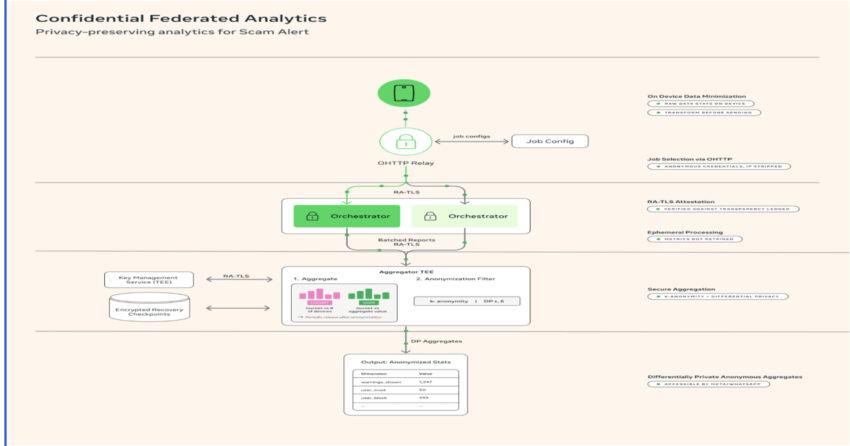
Meta’s design splits message classification from performance measurement. The on-device model decides whether to warn the user, while the device separately aggregates warning events and user actions into local counts for telemetry. Those metrics are then sent through an Oblivious HTTP relay using anonymous credentials.
Once the data reaches the backend, it is processed inside confidential virtual machines, which Meta describes as a form of trusted execution environment. Before any data is transmitted, the client verifies the code running in the confidential environment and checks privacy parameters. The aggregation process also applies minimum cohort thresholds and differential privacy, so WhatsApp only receives approximate population-level statistics rather than detailed user-level records.
That distinction matters for a consumer messaging product, where even safety telemetry can be sensitive. Meta’s approach is meant to let the company understand whether the feature works without turning message safety into a data collection pipeline.
Model distribution is treated as a security boundary
Meta is also applying a transparency framework to the way Scam Alert models are distributed. Each production or experimental model version, along with its SHA-256 hash, is published to a third-party append-only transparency ledger before deployment.
Clients then verify the ledger entry, the model signature, freshness, and hash before loading the model onto the device. Model downloads use anonymous credentials and OHTTP, while experiment assignment happens locally. That prevents the server from selecting a specific model variant for an individual user.
In practical terms, the model itself becomes part of the trust model. Meta is not only trying to protect the contents of messages, but also to show that the code and model shipped to a phone are the ones it intended to deploy.
Built on Meta’s PAPAYA analytics system
The Scam Alert architecture builds on Meta’s PAPAYA federated analytics system, which the company presented at USENIX NSDI 2025. PAPAYA uses trusted execution environments and on-device processing for privacy-preserving federated analytics, and it distinguishes analytics workloads from federated learning.
Meta is applying that foundation to a messaging product where telemetry, model verification, and user control all need to coexist. The result is a system that aims to support consumer safety features while keeping message content local and limiting what the backend can infer.
How it compares with Google Messages
A comparable anti-scam approach already exists in Google Messages, which provides real-time spam protection for scams and phishing and uses privacy-preserving mechanisms for detection. Google also documents on-device detection for some message safety features.
The two systems are not identical. They differ in architectural boundaries and in how much processing happens locally versus through company services. But the comparison shows a broader trend across messaging platforms: safety features are increasingly being designed to work without centralizing raw message content.
What Meta says about user control
Stephanie Lio, Head of AI Product Marketing at WhatsApp, described Scam Alert on LinkedIn as on-device only and emphasized that there is no automatic reporting. She also said users remain in control.
That positioning aligns with the feature’s manual controls. Users decide whether to enable it, can trust a chat if they choose, and can choose whether to share a small amount of chat history from trusted conversations to improve the system. The design is meant to be protective without making scam detection invisible or automatic.
Why the beta matters
Meta says the limited beta will let the company and its Bug Bounty community stress test the implementation before broader availability. The company is also expanding its Bug Bounty program to cover the confidential federated analytics pipeline.
As part of that review effort, Meta says it will publish the confidential virtual machine binary and privacy-relevant source components for independent security review. That suggests the company expects scrutiny not just of the model behavior, but also of the analytics stack that surrounds it.
Key points from the Scam Alert test
- Scam Alert is optional and runs on-device in WhatsApp.
- The feature only evaluates messages from non-contacts.
- Warnings are shown to the recipient, not the sender.
- Users can block, report, continue, or mark a chat as trusted.
- Telemetry is aggregated locally and sent through privacy-preserving systems.
- Model distribution uses transparency logging, signatures, and hash verification.
- Meta plans to involve its Bug Bounty community before wider release.
For WhatsApp, the test is about more than spam detection. It is also a live demonstration of how on-device machine learning, confidential computing, and privacy-preserving analytics can be combined in a mainstream consumer app. If the rollout succeeds, it could become a template for how messaging platforms handle scam defense without exposing the content that users expect to keep private.
Source: Original report
Was this helpful?
Explore more: Application Audit & Review More Cybersecurity Tech News
Last Modified: August 20, 2026 at 1:53 am
10 views