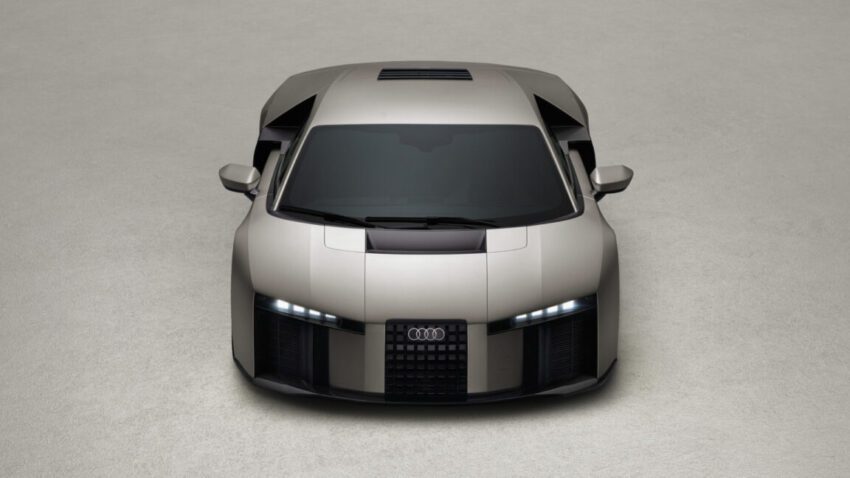
Audi has unveiled the Nuvolari concept in Southern France, giving the clearest hint yet at what could become the brand’s next R8-style supercar. Revealed on the eve of the Monaco Grand Prix, the mid-engined plug-in hybrid pairs Audi’s latest design direction with Lamborghini hardware, a 987 hp powertrain, and carbon-fiber bodywork that Audi says will reach production in a limited run of 499 cars beginning in the first half of next year.
A concept with supercar ambitions
The Nuvolari arrives just a couple of weeks after Audi CEO Gernot Döllner said the automaker was likely working on a replacement for its R8. Audi has not explicitly labeled the Nuvolari as that successor, but the package strongly suggests the company is aiming at the same territory: a low-slung, mid-engined halo car with serious performance and a close technical relationship to one of the Volkswagen Group’s most exotic brands.
Stylistically, the Nuvolari departs from Audi’s current design language, even if it retains some visual connection to the Concept C, a smaller coupe that will share its underpinnings with Porsche’s electric Boxster. The Nuvolari, however, is tied to another Group sibling instead: Lamborghini. As with both generations of the R8, the new concept uses Lamborghini’s smaller mid-engined platform.
Lamborghini roots, Audi interpretation
That platform choice matters because it explains the basic architecture of the car. In the past, the Audi R8’s mid-engine layout housed a naturally aspirated V10 in an aluminum space-frame chassis. That arrangement is now history, as the Lamborghini Huracán has gone out of production and with it the engine family that helped define the old R8’s character.
The replacement landscape has changed as well. Audi’s concept borrows from the Lamborghini Temerario era, which Ars Technica previously described as notably accessible in its performance delivery compared with its predecessor. The Nuvolari may actually outmuscle the Lamborghini on paper, with Audi quoting a total system output of 987 hp, or 736 kW. That is the same figure as the Bugatti Veyron’s output, a comparison Audi is clearly inviting even if the cars are very different in mission and character.
Powertrain: V8 plus three electric motors
The headline figure comes from a plug-in hybrid layout that combines a twin-turbo V8 with three electric motors. Two of those electric motors drive the front wheels, while a third sits on the rear axle. Each motor produces 148 hp, or 110 kW, according to Audi. The combustion engine contributes 788 hp, or 588 kW, and Audi says it still revs to 10,000 rpm despite the pair of turbochargers.
That combination gives the Nuvolari serious straight-line pace. Audi claims a 0-62 mph time of 2.6 seconds and a 0-125 mph sprint in 6.8 seconds. Top speed is quoted at more than 217 mph, or 350 km/h, though Audi’s phrasing suggests the company is not expecting the car’s maximum speed to be the headline act. The overall message is simple: this is meant to be an exceptionally fast road car with hybrid assistance augmenting, rather than diluting, the performance.
Battery and electric assistance
The plug-in hybrid system includes a lithium-ion traction battery with a gross capacity of 7.3 kWh. Audi did not specify the usable capacity, but the source material notes that, if it is packaged like the Temerario’s system, only about half of that may be available during driving. That would fit the concept’s performance-first brief, where electric power is likely intended to fill torque gaps, support launch performance, and improve response rather than provide long electric range.
Formula 1 influence in the details
Audi is also using the Nuvolari to underscore its Formula 1 ambitions. The company says its F1 drivers “provided targeted feedback” during aerodynamic development. The concept includes both high- and low-downforce settings for its active rear wing, which suggests the car is designed with track capability in mind as well as road manners.
The brakes are described by Audi as F1-derived, although they remain carbon-ceramic discs rather than the carbon-carbon brakes used by actual race cars. That distinction matters because carbon-carbon systems are not suitable for normal road use. Even so, the reference to Formula 1 reinforces the idea that Audi wants the Nuvolari to feel like a road-going extension of its future motorsport identity.
Carbon fiber production bodywork
Perhaps the most notable manufacturing detail is the body construction. Instead of aluminum, the Nuvolari uses carbon fiber bodywork, which Audi says is a first for a production car. That marks a meaningful shift for the brand, especially if the concept really is headed for limited production rather than remaining a design study.
Audi says 499 Nuvolaris will be built, with production starting in the first half of next year. That figure places the car firmly in the limited-run supercar category, rather than as a broader halo model. It also reinforces the idea that Audi is willing to use the concept to test the market for a more exclusive, more technically ambitious performance car than the old R8.
Audi keeps revisiting historic names
The Nuvolari name is not new in Audi’s concept-car archive. The company has used it before, and the source material points to a Nuvolari concept from 2003. Audi has also mined its history in other ways, including the Rosemeyer concept from 2016 and the Avus concept from 1991.
That naming pattern reflects a recurring Audi habit: pairing futuristic hardware with references to its prewar racing heritage and other historical touchstones. In this case, the Nuvolari name adds a layer of continuity to a car that otherwise looks like a sharp break from Audi’s current production design language.
What the Nuvolari means for Audi
Even without an official statement calling it the R8’s successor, the Nuvolari gives a strong indication of where Audi wants its next supercar to land. It is mid-engined, hybridized, extremely powerful, and built on Lamborghini foundations. It also arrives as Audi tries to align its road-car identity with the high-performance image of its incoming Formula 1 program.
There are still many questions left unanswered, including how closely the production car will resemble the concept and whether the Nuvolari name itself will make it to market. But the technical formula is clear enough. Audi is preparing something that mixes V8 theater, electric torque fill, and carbon-fiber construction in a package intended to sit at the top of the brand’s performance pyramid.
If the production version follows the concept’s outline, the old R8 formula will not simply be replaced. It will be reinterpreted for a new era, with more hybrid complexity, more power, and a stronger link to racing technology than ever before.
Source: Original report
Was this helpful?
Explore more: More Hardware & Devices Tech News Blog
Last Modified: July 7, 2026 at 9:32 pm
18 views