cybersecurity model Microsoft on Monday unveiled its first cybersecurity-specialized AI model and a new agentic security platform, stepping more aggressively into a field already crowded with offerings from Anthropic, Google and OpenAI. The company says the new tools are meant to help enterprise defenders move faster against increasingly AI-enabled attacks, while automating work that traditionally required multiple security specialists.
cybersecurity model
What Microsoft announced
The headline addition is MAI-Cyber-1-Flash, which Microsoft describes as a model built “to find challenging vulnerabilities in complex codebases.” The company said the model is designed to work with MDASH, Microsoft’s harness for software vulnerability identification and remediation. Alongside the model, Microsoft introduced Perception, a new security platform that deploys teams of agents to assist with and automate security workflows, including identifying and fixing bugs.
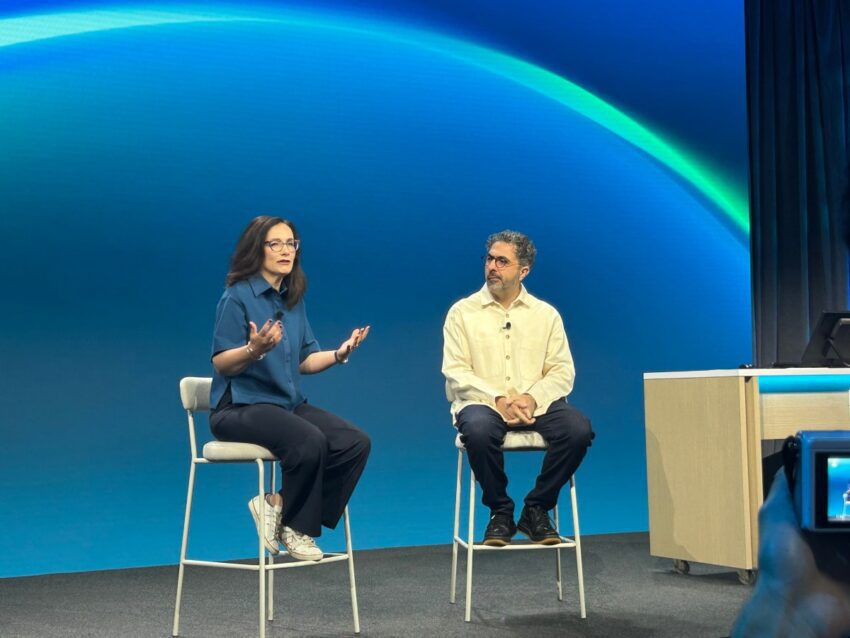
Microsoft said Perception can also integrate with MDASH, tying the new platform to the model and the company’s broader software security workflow. The announcement was made at a small event in San Francisco.
A direct challenge to rival AI labs
Microsoft framed the launch as a competitive shot across the bow of other major AI companies that have entered cybersecurity. The company claims MAI-Cyber-1-Flash is significantly more powerful and more cost-effective than competing models, based on its performance on an established AI cybersecurity benchmark.
That benchmark-based comparison was underscored by Mustafa Suleyman, the co-founder of DeepMind and current CEO of Microsoft AI, who said the company had “very very excited” results to share. “We have MAI-1 Cyber Flash binded [sic] with GPT 5.4 inside of the MDASH harness — which beats out Gemini, GPT 5.5 Cyber, GPT 5.6 Sol, and Mythos 5 on Cyber Gym, which is the primary benchmark that we all use. The golden benchmark,” Suleyman said. “We’re shipping this into production immediately,” he added.
The remark places Microsoft squarely in a fast-moving race where model performance, benchmark status and practical cost all matter. The company’s message was not just that it has built a cyber-specific model, but that it believes this model can outperform established alternatives in a domain where speed and precision are critical.
Perception’s agentic approach
Microsoft’s new platform, Perception, is designed around the idea that enterprise security work can be broken into specialized agentic roles. Hayete Gallot, Microsoft’s vice president for security, said the platform is intended to help defenders “defend against AI with AI at the scale and speed that the attackers have.”
Perception uses what Microsoft calls agentic red teams, blue teams and green teams. The red teams simulate possible attacks in detail, providing context about threat actors and the vulnerabilities they may try to exploit. Blue teams focus on detecting and triaging existing bugs. Green teams take “corrective actions” against those issues. The company’s pitch is that these roles can be coordinated by AI agents to reduce the time it takes to move from discovery to remediation.
Dave Weston, the lead engineer for Perception, said the platform could compress work that once consumed many hours and required multiple experts. “We’ve gone from this taking hours and hours of manual work from multiple specialized folks across the security organization — appsec hunters, remediation engineers, you name it — and in minutes, we have a fix for all of this. Not only do we discover the issues and prioritize them, but we have detection, posture fixing, and even a code fix,” Weston said.
Why Microsoft is betting on AI for defense
The launch reflects a broader reality in cybersecurity: the same technology that can help security teams investigate threats can also be used by attackers. Microsoft acknowledged that AI has created new defensive capabilities for companies, but also opened the door to a “dazzling array of potential threats” because cybercriminals now have access to similar tools.
That dynamic is driving a growing market for AI security systems that promise to automate parts of detection, triage, remediation and response. In Microsoft’s telling, the value of AI in defense is not just that it assists human analysts, but that it can operate at a scale and speed closer to the threats themselves.
Perception appears aimed at enterprise workflows where security teams are often overloaded by alerts and manual review. Microsoft’s description suggests a system that can not only identify problems, but also prioritize them, recommend changes and produce code fixes. That breadth is notable because it pushes beyond narrow detection into more automated remediation.
A crowded and increasingly competitive market
Microsoft’s new tools will enter preview on November 3, but they are arriving in a market that already includes other major AI vendors with security ambitions. Earlier this year, Anthropic launched Mythos, a security platform released to a limited set of partner organizations through a program called Glasswing. OpenAI also launched its own security solution in May through a program called Daybreak.
That makes Microsoft’s announcement part of a broader trend among frontier AI companies: each is now trying to prove that its models are not only useful for general-purpose chat and coding, but also reliable in the high-stakes, high-complexity world of enterprise security. The competition is not just about who can identify vulnerabilities, but who can do so in ways that are useful, economical and ready for deployment.
Microsoft’s approach also suggests the company wants a tighter connection between its own model development and security operations. By pairing MAI-Cyber-1-Flash with MDASH and then layering Perception on top, Microsoft is effectively offering a stack that spans model, harness and workflow automation. If the company’s benchmark claims hold up in practice, that stack could give Microsoft a notable position in the cybersecurity-AI market.
What comes next
For now, Microsoft is positioning the launch as an immediate product move rather than a distant research demonstration. Suleyman’s statement that the company is “shipping this into production immediately” signals confidence that the tools are ready for real use, while the preview date of November 3 gives enterprises a first chance to evaluate them.
The bigger question is whether Microsoft’s performance claims translate into operational gains for customers. Security leaders will likely want to know how MAI-Cyber-1-Flash performs outside a benchmark and how Perception handles real-world complexity, false positives and remediation workflows across varied enterprise environments. But Microsoft’s announcement makes one thing clear: the company intends to compete directly for the future of AI-driven cybersecurity, and it is doing so with both a specialized model and an automation platform built around agentic security teams.
Source: Original report
Was this helpful?
Explore more: Application Audit & Review More Cybersecurity Tech News
Last Modified: July 28, 2026 at 6:37 pm
7 views