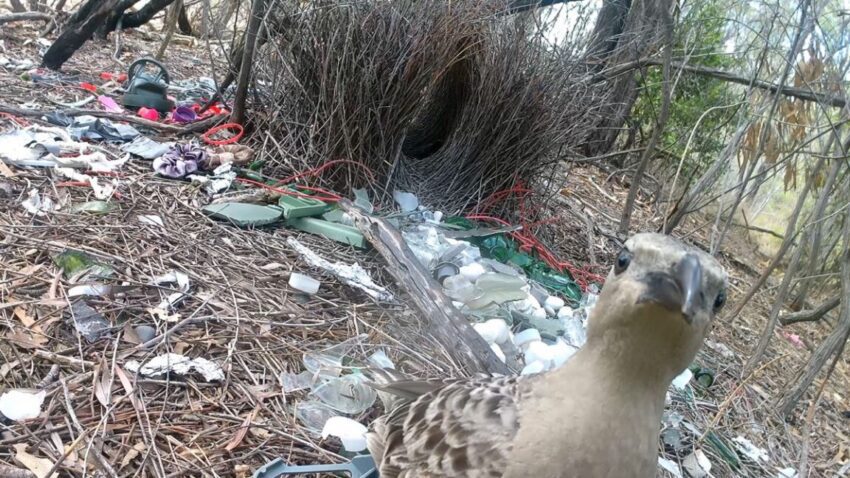
Male great bowerbirds are already famous for elaborate courtship displays, but new research suggests urban birds in Australia are taking their decorating instincts in a distinctly human direction. According to a study published in Royal Society Open Science by University of Exeter scientists, bowerbirds living near people are far more likely than rural birds to decorate their bowers with brightly colored human-made items such as glass, wire and plastic.
Urban birds favor human-made decorations
Great bowerbirds build stick-lined structures called bowers and fill them with colorful objects to attract females. When a female arrives, the male presents his display and shows off his plumage in hopes of winning her attention. The new study found that urbanization has changed the materials available to these birds, and that the birds appear to prefer human-made items even when natural options are also present.
The researchers said the difference may reflect access as much as taste. Birds in both rural and urban settings showed a strong preference for human items when given a choice, but urban males had far more opportunities to collect them.
How the study was done
The University of Exeter team monitored 61 male great bowerbirds at two sites in northern Queensland, Australia: the rural Dreghorn Cattle Station and the urban Townsville City. Observations were carried out during the main breeding season from September to December 2023.
To document the bowers, the scientists photographed decorations from above in both visible and ultraviolet light, using an umbrella to create diffuse lighting. That detail matters because bowerbirds can see in the UV range.
The team then focused on the 10 decorations nearest the bower entrance, since these were considered the most likely to be used in displays. Those items were photographed and marked so their origin could be tracked. After that, the researchers removed all decorations from each bower and created a mixed “slush pile” of 10 randomly selected urban items and 10 randomly selected rural items. They left the sites undisturbed for three days. The birds were never offered items from their own bower.
When the researchers returned, they recorded which items had been selected from the pile and moved into a bower, and whether each came from an urban or rural source. Afterward, all original decorations were returned.
What the birds chose
The patterns differed sharply between environments. Rural bowerbirds most often used green glass and green leaves or seeds, while urban birds preferred green glass and red wire. Plastic was also common in urban displays.
Co-author Caitlin Evans of the University of Exeter said the team also found some especially unusual items at urban bowers, including “a pair of handcuffs, medicine jars at bowers near a hospital, and fluorescent mouth guards from a site near an Australian Rules football ground.”
- Urban bowers were more than 10 times more likely to contain human-made decorations than rural bowers.
- Urban bowers averaged 90 decorations each, compared with 20 in rural bowers.
- One urban male collected 300 items for a single bower.
- Both urban and rural birds strongly preferred human-made items when offered a choice from both environments.
- Red decorations in urban bowers were more vivid, while green items were duller than those in rural bowers.
Rural bowers were more likely to contain natural materials such as fruit, seeds, leaves and sticks. Still, the authors noted that even rural birds sometimes obtained human-made objects, likely by raiding farm bins or garages.
Why this might matter for mating
The authors argued that the shift could amount to an adaptive change in display behavior for urban males. In their view, urban birds may be able to create more attractive displays, while rural males may be limited by what their environment provides.
They also suggested that having a ready supply of human items could lower the energetic costs and risks associated with leaving a bower unguarded. For a species that depends on maintaining and defending a display site, that could be a meaningful advantage.
At the same time, the study did not measure whether human-made decorations directly improved mating success. The authors said earlier research has found higher male display and mating rates in urban than rural environments, but other factors such as population density may also help explain that pattern. It is also still unclear whether urban females have different preferences from rural females when choosing mates.
A reminder of human influence
Laura Kelley, also of the University of Exeter, said the findings show that the availability of human items, “often glass and plastic,” is influencing bowerbird behavior. She added: “We don’t yet know whether this has any negative or positive impact on them, but it’s a reminder of how human activity is changing the natural world in unanticipated ways.”
For now, the study suggests that great bowerbirds are not just adapting to city life in general, but are also incorporating the detritus of human environments into one of nature’s more elaborate dating rituals. Whether those bright additions give urban males a real edge remains an open question.
Source: Original report
Was this helpful?
Explore more: More General Technology Tech News Blog
Last Modified: July 7, 2026 at 9:31 pm
5 views