Cloudflare says its AI agents have helped cut the number of open GitHub issues in Astro, the open source framework, by about 85%, reducing a backlog of more than 200 issues to around 30. The company describes the effort as a durable, multi-step triage workflow that reproduces bugs, diagnoses root causes, checks tests and documentation, proposes fixes, and then generates preview releases for reporters to validate before a pull request is opened.
How Cloudflare automated Astro issue triage
The system was built to mirror the steps Astro maintainers already followed when resolving issues manually. Rather than relying on one large agent to do everything, Cloudflare split the work into isolated subagents, each with a narrower responsibility and its own step in the workflow.
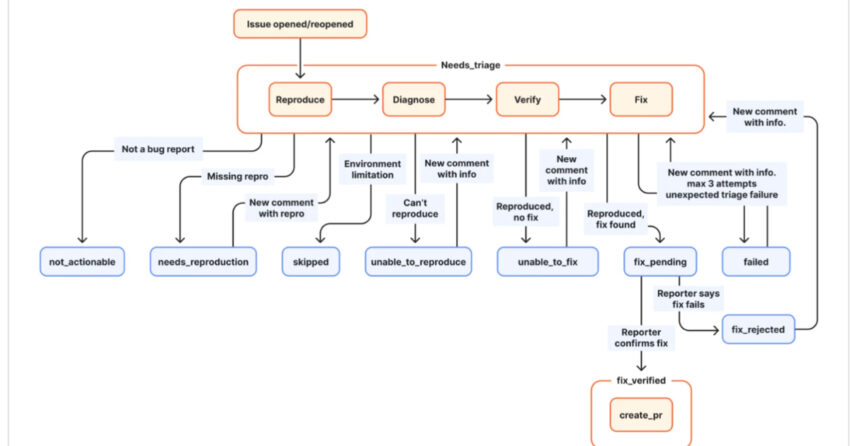
A reproduction agent first checks whether the reported behavior can be recreated. A diagnosis agent then instruments the code to determine why it happens. A verification agent reviews tests, documentation, and comments. A fix agent takes the reproduction and turns it into tests before implementing a solution. The agents exchange information through a report.md file instead of sharing a single execution context.
Cloudflare ran the workflow in GitHub Actions and organized it as a state machine driven by issue labels. New issues are tagged with triage needed, and later confirmations can move an issue toward fix verified. When the agents identify a likely fix, the workflow creates a preview release and posts logs, findings, and installation instructions back to the issue so the original reporter can validate the result.
From open issue to preview release
The validation step is a central part of the process. Instead of asking maintainers to inspect a patch immediately, Cloudflare’s workflow lets the reporter test a preview release that contains the proposed change. If the reporter confirms the fix, the automation opens a pull request.
Cloudflare pointed to a July 2026 Astro issue involving the Container API as one example of the flow in action. In that case, the issue was marked triage: fix verified after the reporter confirmed the bot’s fix.
The company’s broader aim is to push the number of unresolved issues down to zero. The reported drop from more than 200 open issues to about 30 suggests that the automation has had a meaningful effect on the project’s backlog, even though the process still depends on human validation before code changes are finalized.
Why the workflow is designed around small agent tasks
Commentary around the project emphasized that the main value is not merely letting AI “look at” an issue, but putting the work inside a sandboxed process where each agent handles a bounded task. That setup means human reviewers mostly see results that have already passed through automated reproduction, diagnosis, and verification steps.
Jordan Matthiesen, senior product manager at CloudBees, highlighted the importance of reproducing an issue before attempting a diagnosis, making fixes easy for reporters to test, and improving code, tests, and documentation when agents run into trouble. Shubhanshu Singh described the Astro workflow as an example of explicit agent system design, rather than depending mainly on orchestration-loop abstractions.
Cloudflare also treats failures in the agent workflow as useful signals about the maintainability of the codebase itself. In one Hot Module Replacement case, an agent repeatedly changed a conditional and introduced regressions because the behavior was not covered by enough tests. Adding a descriptive code comment changed the agent’s behavior and prevented the same modification from being repeated.
What the Astro workflow became
The system did not remain only an internal Astro workflow. Cloudflare later turned it into triagebot-action, a standalone GitHub Action. The orchestration approach behind it also evolved into Flue, an open-source framework intended for durable agent workflows.
Flue uses a declarative model. Instead of writing an orchestration loop directly, developers define an agent’s context, including its model, skills, sandbox, and instructions. The framework persists execution history in an append-only event log, which allows an interrupted workflow to resume from its previous state.
According to the material, Flue can integrate with GitHub, Slack, Linear, and Discord. It can run on Node.js, GitHub Actions, or Cloudflare infrastructure. On Cloudflare’s own platform, agents can run as Durable Objects with durable execution and isolated storage.
What this means for open source maintenance
The Astro case offers a concrete example of how AI agents can fit into software maintenance without taking over the entire process. The workflow is narrow, repeatable, and heavily constrained: reproduce the bug, inspect the cause, verify what is already documented or tested, make a targeted change, and let a human reporter confirm the result.
That matters because issue triage often consumes maintainer time before any actual code fix begins. If the reproduction and first-pass diagnosis are automated reliably, maintainers can spend more time on design decisions and less time on repetitive verification work. In Cloudflare’s framing, the aim is not just faster triage, but a workflow that stays durable as issues, tests, and external validation arrive in stages.
The Astro example also shows why observability and failure handling matter in agent systems. If an agent cannot make progress, that may point to missing tests, unclear behavior, or weak documentation rather than a simple tool failure. In that sense, the system is not only solving issues; it is also surfacing where the codebase itself is hard for both humans and machines to reason about.
Cloudflare’s broader agent workflow model
The Astro triage setup is presented as one instance of a larger model for agentic software. The common elements are bounded tasks, persistent state, external events, and human approval points. Those elements make the workflow easier to resume, easier to audit, and less dependent on a single long-running agent session.
That design is especially relevant in tools that touch real repositories and production-like previews. By isolating tasks and preserving execution history, Cloudflare aims to make AI-assisted workflows more predictable and operationally manageable. The company’s account suggests that the result is less about a single clever model call and more about how the surrounding system is assembled.
- Issue backlog reduction: from more than 200 open issues to about 30, according to Cloudflare.
- Workflow stages: reproduction, diagnosis, verification, fix, preview release, and reporter validation.
- Implementation: isolated subagents in GitHub Actions, coordinated through issue labels and
report.md. - Follow-on projects: triagebot-action and the open-source framework Flue.
For open source maintainers watching the rise of AI coding tools, the Astro workflow is notable because it focuses on one of the least glamorous but most expensive parts of software development: bug triage. Cloudflare’s numbers suggest that, when carefully structured, agents can help reduce that burden substantially while still leaving room for human judgment at the end of the loop.
Source: Original report
Was this helpful?
Explore more: Software Testing Services More Software Development Tech News
Last Modified: August 22, 2026 at 1:53 am
13 views