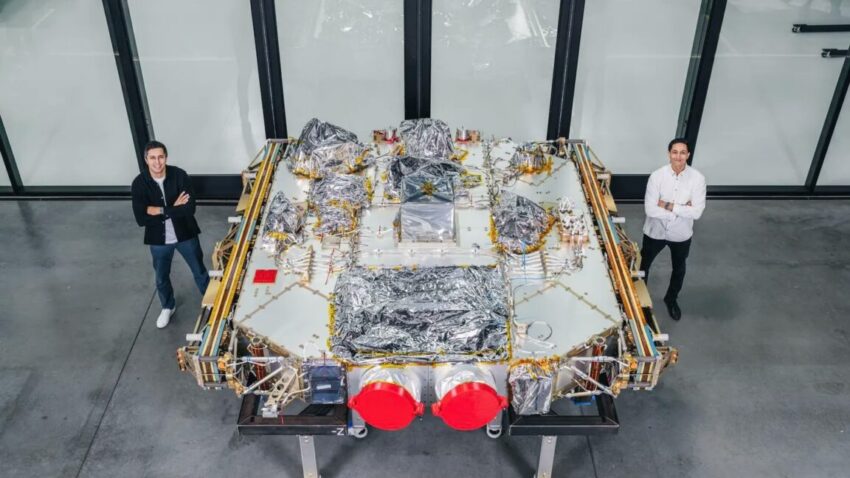
investors commit quarter-billion dollars to startup designing A startup focused on developing a new class of high-power satellites has successfully raised $250 million to enhance production capabilities at its Southern California facility.
investors commit quarter-billion dollars to startup designing
K2’s Ambitious Vision
Founded in 2022, K2 is positioning itself at the forefront of satellite technology, aiming to revolutionize how satellites are designed and deployed. The company specializes in what it refers to as “Giga” satellites, which are characterized by their high power and advanced capabilities. These satellites are expected to play a crucial role in various sectors, including telecommunications, Earth observation, and scientific research.
Recent Funding Milestone
On Thursday, K2 announced the successful completion of its Series C fundraising round, which garnered $250 million. This round was spearheaded by Redpoint Ventures, a prominent venture capital firm known for investing in innovative technology companies. Additional contributions came from a diverse group of investment firms across the United States, the United Kingdom, and Germany, highlighting the international interest in K2’s mission and technology.
With this latest funding, K2 has raised over $400 million since its inception. This significant financial backing is expected to accelerate the company’s production capabilities and support its ambitious plans for satellite deployment. The company has indicated that it is on track to launch its first major demonstration mission in the upcoming year, a critical step in validating its technology and business model.
Market Context and Opportunities
The satellite industry is undergoing a transformative phase, driven by advancements in launch technology and increasing demand for satellite services. K2 aims to capitalize on this momentum, particularly with the anticipated increase in heavy- and super-heavy-lift launch capacities. SpaceX’s Starship, for instance, is expected to begin deploying satellites as early as next year, which could significantly alter the competitive landscape.
Launch Vehicles and Their Impact
SpaceX’s Starship is designed to be a fully reusable spacecraft capable of carrying large payloads to orbit. Its introduction is expected to lower launch costs and increase the frequency of satellite deployments. In addition to SpaceX, Blue Origin’s New Glenn rocket has already completed two launches this year, with plans for more in 2026. The New Glenn is also undergoing enhancements to increase its lift capability, which could further benefit satellite manufacturers like K2.
The combination of these advancements in launch technology and K2’s innovative satellite designs positions the company to meet the growing demand for satellite services. As industries increasingly rely on satellite data for various applications, including climate monitoring, disaster response, and global communications, K2’s Giga satellites could play a pivotal role in fulfilling these needs.
Technological Innovations at K2
K2’s approach to satellite design emphasizes high power and efficiency. The company is leveraging cutting-edge technologies to create satellites that can operate more effectively in a variety of environments. This includes advancements in materials science, propulsion systems, and onboard processing capabilities.
High-Power Satellites
The term “Giga” satellites refers to K2’s focus on developing high-power satellites that can support a wide range of applications. These satellites are designed to deliver enhanced performance, allowing for improved data transmission rates and more robust communication capabilities. This is particularly important in an era where data consumption is skyrocketing, and the demand for high-speed internet access is greater than ever.
Production Capabilities
With the recent funding, K2 plans to ramp up production at its Southern California factory. This facility is equipped with advanced manufacturing technologies that enable the efficient production of satellites. By scaling its operations, K2 aims to reduce lead times and increase the number of satellites it can produce, thereby meeting the demands of a rapidly evolving market.
Stakeholder Reactions
The investment community has reacted positively to K2’s recent funding round, viewing it as a strong endorsement of the company’s vision and potential. Investors are increasingly recognizing the value of satellite technology in various sectors, from telecommunications to agriculture and environmental monitoring.
Industry Perspectives
Industry experts have noted that K2’s focus on high-power satellites aligns well with current market trends. As more businesses and governments seek to leverage satellite technology for data collection and communication, companies like K2 are well-positioned to meet this demand. The ability to deploy advanced satellites quickly and efficiently will be a key differentiator in the competitive landscape.
Future Prospects
Looking ahead, K2’s success will depend on its ability to execute its plans effectively. The upcoming demonstration mission will be a critical milestone, as it will provide valuable insights into the performance of K2’s satellites and their capabilities in real-world scenarios. If successful, this mission could pave the way for future contracts and partnerships, further solidifying K2’s position in the market.
Conclusion
K2’s recent $250 million funding round marks a significant milestone in the company’s journey to revolutionize satellite technology. With a focus on high-power “Giga” satellites and a commitment to leveraging advancements in launch capabilities, K2 is poised to play a vital role in the evolving satellite industry. As the demand for satellite services continues to grow, K2’s innovative approach and strategic partnerships may well define the future of satellite deployment and utilization.
Source: Original report
Was this helpful?
Explore more: More Business & Startups Tech News Blog
Last Modified: December 13, 2025 at 1:44 am
18 views