As public resistance to new data centers intensifies, water use is becoming one of the most visible flash points for the industry. Some operators are leaning toward less water-intensive cooling, while others are arguing that local water conditions, grid constraints, and emissions targets make the answer more complicated than simply abandoning evaporative cooling everywhere.
Water is moving to the center of the data center debate
On Monday, SpaceX amended its initial public offering to say that water conditions — including water scarcity, regulations around water, and drought — could constrain data center development. That language reflects a broader shift in how the sector is being discussed. Water use is emerging as one of the most contentious issues around data centers, and a recent Gallup poll found that seven out of 10 Americans are opposed to data center development, with water scarcity ranking as the top resource concern.
With opposition growing, some tech companies are trying to show they are confronting the issue directly. Their challenge is that the business depends on keeping servers cool, and cooling can require either substantial water use, substantial electricity use, or some combination of both.
Why data centers use so much water
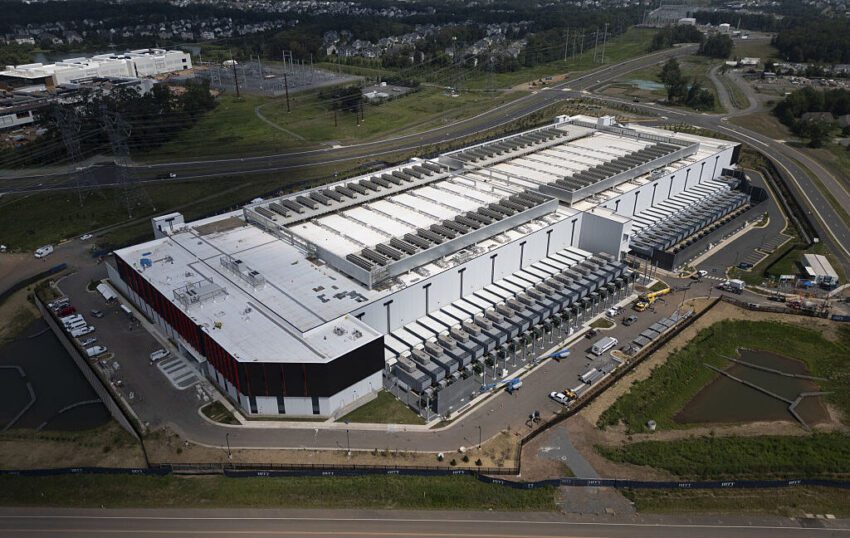
Data centers generate massive heat from server racks, and cooling them is essential. One common method, evaporative cooling, uses fresh water to absorb heat and then sends that water to cooling towers where it evaporates outside.
The approach has clear operational advantages. Using more water can lower power demand for cooling systems that rely on energy-intensive pumps to recirculate water. It can also reduce emissions if it displaces electricity use that would otherwise be needed for cooling.
But the trade-offs can be significant. Google’s facility in Council Bluffs, Iowa, which uses evaporative cooling, consumed more than 1 billion gallons of water in 2024. And in a 2024 report, Lawrence Berkeley National Laboratory predicted that hyperscale data centers could consume up to 33 billion gallons of water by 2030 if they rely heavily on evaporative cooling.
Regional scarcity changes the equation
Even if the total water use is not on the same scale as agriculture or oil and gas, location matters. A single fracked well can use 1.5 million to 16 million gallons of water, but the key issue for data centers is often where that water is coming from and when it is being drawn.
The risk is especially acute in places already under stress, and particularly during summer, when cooling demand rises at the same time municipal water demand often peaks. As Shaolei Ren, a professor of engineering at UC Riverside, put it: “Water is a highly local, highly regional issue. It’s a limited resource, and we have to manage it very carefully.”
Some companies are moving away from evaporative cooling
Microsoft, OpenAI, and Oracle have all made statements in recent months suggesting they are moving away from evaporative cooling in order to save water. That includes OpenAI and Oracle’s large Stargate expansion in multiple states, including a water-stressed region of Texas.
For these companies, the appeal is straightforward: less water use can help reduce pressure on local communities and ease public criticism. But the shift is not as simple as choosing a different cooling method and solving the problem once and for all.
Google is taking a more conditional approach
Google announced a series of water-related commitments on Wednesday for communities where it has data centers, along with funding for water-related projects in the US. The pledges include:
- Replenishing more freshwater than the company consumes through local water investments
- Scaling up the use of reclaimed and recycled water
- Disclosing annual water use in data centers
- Using “a data-driven framework” to decide which data center designs best fit local watersheds
Some of those promises are not entirely new. Google has been working on most of them for a few years, and other tech companies, including Microsoft, have similar replenishment and local investment commitments. The company’s latest move is more about formalizing and broadening the message.
Ben Townsend, Google’s global head of infrastructure and sustainability, said the company has spent the past four years doing detailed hydrologic assessments of its sites to determine what cooling methods make sense locally.
“Water is scarce in some regions and plentiful in others,” he said. “A one-size-fits-all strategy just doesn’t work.”
Google argues evaporative cooling still has a role
Google has also defended the use of evaporative cooling in areas with what it described as “abundant” water. In April, the company made that argument in a filing to the European Union, saying the technique can be necessary for building truly sustainable data centers.
That position is supported by research from Ren and his team. They found that if all data centers in the US used some kind of evaporative cooling during peak demand, it could free up an additional 10 to 30 gigawatts of power. In parts of the country where grids are under strain but water resources are not, that extra headroom could help utilities manage load.
“If you don’t use water, the challenge is that you’re going to be using a lot more power in the summer, and that will push up the cost,” Ren said.
The water-power trade-off is also a carbon issue
The debate does not stop at local water use. Many large tech companies, including Google, have seen their carbon emissions rise sharply during the AI boom. Avoiding evaporative cooling altogether could raise emissions if data centers rely on dirtier electricity to keep facilities cool.
There is also an indirect water issue to consider: if data centers use less water on site but draw more electricity from power systems that require water for generation, some of the water burden can simply move elsewhere.
That means the “water-saving” choice in one part of the system may not reduce overall water consumption in the way companies hope. The answer depends on the local energy mix, the watershed, and the cooling design.
Promises have not eliminated controversy
Even as companies announce reforms, water concerns continue to shape projects and public reactions. In February, The New York Times reported that Microsoft’s internal records indicate its water use is expected to skyrocket, despite the company’s efforts to move away from evaporative cooling.
Google has also faced pushback. In 2024, it halted plans for a data center outside Santiago, Chile, after a court partially revoked its permits over water concerns. Townsend said Google adopted its water-scarcity framework for new locations a few years after the original permits were granted in 2020.
In another case, Google funded a 2021 lawsuit filed by a town in Oregon seeking to stop a local newspaper from obtaining details about how much water the company would use for an expansion of an existing data center. Google began disclosing water use from specific data centers in annual reports in 2023.
Regulation and scrutiny may shape future designs
Priscilla Johnson, an independent consultant who served as Microsoft’s director of water strategy between 2017 and 2020, said the water-versus-power trade-off is real. But she also argued that companies can be pushed to design systems that use less of both.
“The industry has to be challenged to design smarter and simplify things,” she said.
That view suggests the debate may not be settled by any single cooling technology. Instead, the future may involve more site-specific planning, more disclosure, and more pressure from regulators and local communities to justify where and how data centers are built.
Source: Original report
Was this helpful?
Explore more: DevOps Services More Cloud & DevOps Tech News
Last Modified: July 7, 2026 at 8:44 pm
10 views