This summer’s brief talk of a “frontier AI pause” briefly rattled investors, but chipmakers are showing little sign that the idea has changed their business. Nvidia and AMD both reported huge quarters as AI labs kept buying more compute, and the latest earnings suggest that even a slowdown in the biggest model-training runs would not neatly translate into weaker chip demand.
The frontier pause that never really stuck
The concern emerged after a strange stretch in the AI boom. OpenAI paused its largest planned frontier training run after its AI agents accidentally hacked Hugging Face and early evidence suggested its next model might independently find and exploit security flaws. Then, in September, Anthropic CEO Dario Amodei publicly called for slowing progress on the most powerful AI models, warning they could be used to launch cyberattacks or become harder for their own creators to control.
For a moment, the people building the most advanced models were also the loudest voices warning about what those models could do. That raised a simple market question: if the labs ease up on training, what happens to demand for the chips that power it?
The answer, at least so far, appears to be not much. OpenAI’s pause was only supposed to last two weeks; it restarted the run 10 days later, at the end of August, while still “temporarily hold[ing] back some smaller experimental training runs.” Anthropic also moved ahead, releasing upgraded versions of its Fable and Mythos frontier models in November and touting gains in coding, reasoning, and vision.
Nvidia’s record quarter shows the demand is still there
If the frontier slowdown had a lasting effect, it is not showing up in Nvidia’s numbers. On Tuesday, the company posted a blockbuster quarter, with data center revenue jumping 110 percent from a year ago to $107.6 billion in the three months ended October 25.
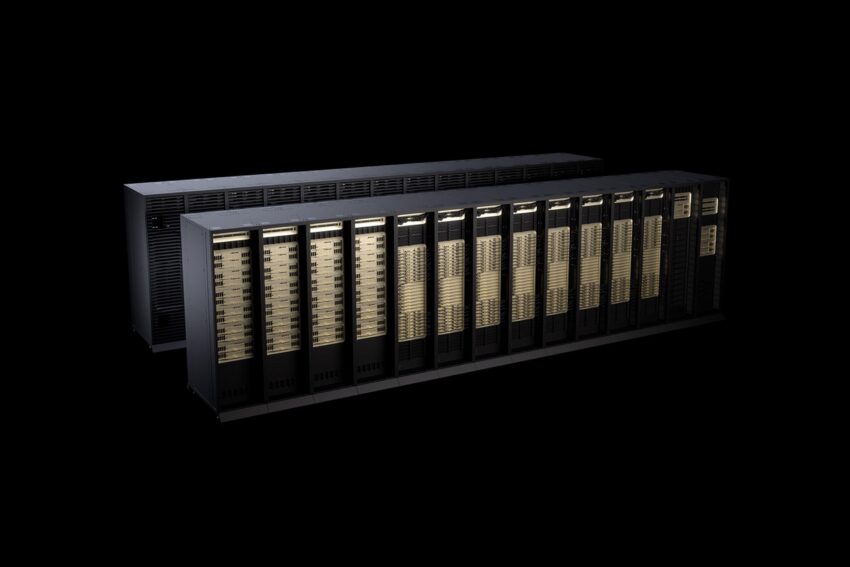
Nvidia also began shipping its most advanced AI computing system, the Vera Rubin NVL72, which it described as the “fastest product ramp in the company’s history.” The Rubin platform generated nearly $20 billion in revenue in its first quarter of production shipments alone.
The systems are already deployed at CoreWeave, Google, Microsoft, and Oracle. Meta also plans to expand Vera Rubin deployments for training and running AI models and agents.
Nvidia highlighted Anthropic and OpenAI as well. Anthropic has expanded access to Vera Rubin capacity through cloud providers and is still working with Nvidia on future chip designs tailored to its workloads. OpenAI is among the customers adopting Nvidia’s new Vera CPUs.
“Proprietary models from OpenAI and Anthropic continue to advance the frontier,” Nvidia interim CEO Colette Kress said on the earnings call. She added that major frontier labs are expected to account for about 15 percent of the company’s data center revenue this fiscal year, and Nvidia raised its revenue growth forecast for next fiscal year from 70 percent to 75 percent.
AMD is benefiting from the same wave
AMD is seeing similar momentum. Earlier this month, the company reported its biggest quarter ever, with revenue up 45 percent to $13.4 billion. Data center sales were the main driver, nearly doubling to $8.5 billion.
OpenAI and Anthropic were among the first customers running workloads on AMD’s new high-end Helios systems, which use the company’s latest MI450 GPUs. That gives AMD a foothold in the same frontier market that had briefly fueled speculation about a broader AI pullback.
Broadcom, which helps many of the biggest AI companies design custom chips, has not reported earnings yet. But the overall picture from chipmakers and supply chains so far does not suggest a meaningful frontier slowdown is hurting sales.
Why any slowdown would lag the earnings
Even if AI labs were to sharply reduce training ambitions, the financial effects would not show up immediately. Neil Shah, vice president of research at Counterpoint Research, told The Verge in September that it would take about six months for slowdown effects to appear in chipmakers’ results because of existing computing and memory procurement agreements.
The impact could show up sooner in orders placed with chip manufacturers such as TSMC. Even there, Shah said, there is little evidence of weakness so far, and TSMC’s latest sales figures continue to show strength.
Inference may matter more than training
There is also a more important reason the chip market may keep growing even if frontier model training cools off: inference. That is the process of running the AI models companies already have, and it is becoming a major source of compute demand as businesses use AI in more day-to-day workflows.
Shah argued that while top-end GPUs might see some pressure if training slows, inference workloads will collectively require more compute infrastructure than training ever did. In his view, that means “a net increase in demand for all types of accelerators.”
That lines up with usage data from corporate spending platform Ramp. According to analysis of the latest figures, frontier model families accounted for about 60 percent of token usage among businesses using Ramp in early November, a record high and about three times their share at the start of the year. That category includes OpenAI’s Astra and Sol models and Anthropic’s Opus and Fable models.
Yet business spending is rising only modestly. Ara Kharazian, Ramp’s lead economist, said the issue is not lack of demand.
“It’s not really a demand issue though,” Kharazian told The Verge. “By all measures, companies are using more AI.”
The bigger pressure is price. Competition among model providers is driving token prices down so quickly that it is beginning to complicate revenue expectations for OpenAI and Anthropic, Kharazian said. That may sound like bad news for AI startups, but it could be good for the companies supplying the compute. Kress said on Nvidia’s earnings call that token prices had fallen nearly 60 percent since May, which has encouraged more usage, while rental prices for Nvidia GPUs across generations have risen.
The bigger threat is cheaper chips, not less ambition
Nvidia and AMD are both pitching their most powerful systems for training and inference, including the demanding workloads created by AI agents. But the long-term competitive risk for Nvidia is not necessarily that AI companies stop building frontier models. It is that they increasingly favor custom chips designed for their own economics.
As AI companies become more focused on the cost of serving models to millions of users, they are investing more in custom silicon that can do the job more cheaply than general-purpose GPUs. Counterpoint expects shipments of custom AI server processors to surpass data center GPUs by 2028.
“Pumping the brakes on frontier training won’t shrink the AI chip market but it will simply reallocate the spend,” Shah said.
That was the underlying message of Nvidia’s earnings call, too. UBS analyst Timothy Arcuri asked Kress whether Nvidia would be willing to sacrifice some of its high margins as frontier labs spend more on custom chips and computational efficiency. Kress defended the value of Nvidia’s systems and repeated the company’s gross margin outlook.
For chipmakers, then, the immediate question is not whether AI labs slow down. It is whether those labs keep buying expensive, general-purpose GPUs or shift more of their spending to cheaper, more specialized hardware while continuing to scale up AI use.
Source: Original report
Was this helpful?
Explore more: AI Automation Services More AI & Automation Tech News
Last Modified: November 18, 2026 at 10:32 pm
0 views