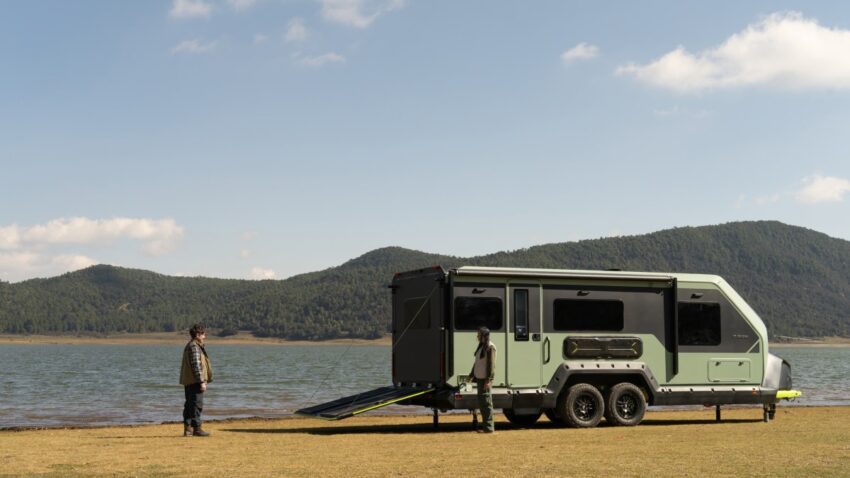
Evotrex, a two-year-old startup building hybrid RV travel trailers, has raised $30 million in Series A funding as it races toward a planned launch next year. The Los Angeles-based company says it is targeting production of roughly 1,000 units annually and is betting that a battery-powered trailer with an onboard gas engine can solve one of the biggest problems in recreational vehicles: how to stay off-grid for longer without depending on a charging station.
A larger war chest for an ambitious launch
The new round brings Evotrex’s total funding to $46 million. According to the company, much of the Series A came from a consortium of Chinese and Hong Kong-based investment firms, including GSR United Capital, Forebright Concerto Capital, TTGG Ventures, and Pegasus Capital, among others. Consumer electronics company Anker is among the startup’s seed investors.
For Evotrex, the funding is not just about growth. The company still needs capital to complete development, continue testing, and prepare its first RV for commercial release. It revealed the vehicle at this year’s Consumer Electronics Show after emerging from stealth mode last year, and now says the next phase is about proving the product can hold up in the real world.
A hybrid approach in a crowded market
Evotrex is entering an RV market where startups have been trying to move faster than legacy manufacturers. Some established players have been cautious in bringing new electric models to consumers. Thor’s first electric vehicle is headed to rental fleets rather than dealerships, and Winnebago’s eRV2 has remained in field testing since 2023 without reaching customers. That slow pace has created room for a wave of startups trying to claim first-mover status.
The company’s first product, the PG5, is not fully electric. Instead, Evotrex is building what is commonly described as an extended range electric vehicle, or EREV: a battery pack that can be recharged by an onboard gas engine. The approach is meant to give travelers more flexibility than a pure battery-electric trailer, especially in remote areas where charging access is limited.
Co-founder and CEO Alex Xiao said the goal is to enable people to live off the grid for extended periods, which he argues is difficult to achieve either with an all-electric setup or with a gas-powered system that still requires electrical hookup.
Why Evotrex thinks the market is ready
Evotrex says there is already strong demand for its first model. The company said 90% of its current order book is for the fully loaded Premium trim of the PG5, which is priced at around $160,000. That suggests customers are not only interested in the concept but are also willing to pay for a higher-end version of the vehicle.
Xiao told TechCrunch he is enthusiastic about the growing competition in the space and believes it can help expand the market overall. He said he draws on his experience as a product manager at Anker when thinking about how to position Evotrex against rivals.
“We are not afraid of competition, competition is a good thing. We educate the market together, we grow the market together,” he said. “I think in the long term the strongest companies will have many things — you must be very good at product definition, R&D, and supply chain. You also need to be very good at distribution [and] service. Many things together. It’s a very complicated business.”
The startup’s emphasis on product design, supply chain, distribution, and service reflects how challenging RV manufacturing can be. Unlike many consumer devices, RVs have many moving parts and complex mechanical systems, which makes durability a major concern. Xiao said the company has already validated a functional version of its first RV, but needs another 10 to 12 months of testing to ensure the PG5 can handle real use.
Testing, service, and the realities of RV manufacturing
That durability push appears to be shaping the company’s staffing priorities. Xiao pointed to the fact that Evotrex hired its first service employee about six months ago, while its first sales employee joined only last month. To him, that sequence reflects a deliberate choice to focus on support and reliability before scaling sales.
That may be particularly important in an industry where mechanical integrity cannot be taken for granted. The startup’s timetable indicates that it expects the next year to be heavily focused on validation and preparation rather than a rapid rollout.
Evotrex’s target of about 1,000 units per year is modest compared with the scale of larger RV makers, but for a new entrant it still requires substantial manufacturing and service readiness. The company’s challenge is not simply building a vehicle that works in the lab; it must also deliver a product that customers can trust in varied conditions over time.
Manufacturing plans split between China and California
The company still plans to manufacture its RVs in China and carry out final assembly in California, though Xiao said he is still finalizing the exact locations for both. The Los Angeles base, he said, should help Evotrex stay close to its target customer base while also giving it access to multiple nearby climates that can be useful for testing.
That geographic setup reflects both practical and strategic considerations. Building in China can help with manufacturing scale and supply chain access, while final assembly in California may make it easier to tailor the product for the U.S. market and support local testing and customer operations.
Lessons from Anker and the importance of customer advocacy
Xiao said another lesson from his time at Anker has shaped Evotrex’s strategy: identify the right customer segment and give them a reason to promote the product themselves. He framed that as a three-part formula.
“The first thing is you need to find the real customer demand,” he said. “The second is you need to deliver a really good product, and third is: The customer will say the story for you.”
That approach suggests Evotrex is not just trying to sell trailers; it wants to build a product that early buyers will champion. In a niche where word of mouth can matter as much as traditional advertising, customer advocacy could be a major asset.
For now, the company’s path is clear: finish testing, lock down manufacturing and assembly sites, and prepare to bring the PG5 to market next year. With $30 million in new funding and a total of $46 million raised, Evotrex has given itself a stronger chance to move from prototype to production in a sector where timing, reliability, and service may determine which startup gets there first.
Source: Original report
Was this helpful?
Explore more: More Business & Startups Tech News Blog
Last Modified: July 7, 2026 at 9:38 pm
9 views