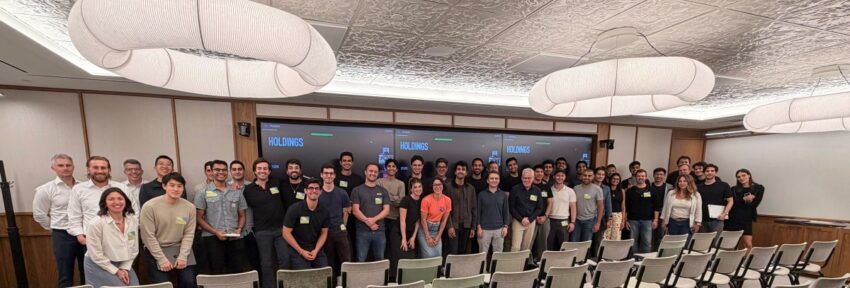
OpenAI-backed Thrive Holdings has raised $2 billion in new funding at a $12 billion valuation, adding fresh momentum to a strategy that uses artificial intelligence to remake traditional enterprise businesses from the inside. The company, which has been described as a kind of private equity firm for AI, buys firms in fragmented industries and then deploys AI tools and teams to reshape their workflows.
What Thrive Holdings is building
The new round included investors such as SoftBank, D1 Capital Partners, and Altimeter Capital, according to reporting first published by The New York Times. Thrive Holdings has so far concentrated on accounting and information technology, but part of the latest capital raise will help it expand into a third vertical tied to physical assets and the built environment.
That strategy depends heavily on Thrive’s close relationship with OpenAI. Thrive Holdings is a spinout of Thrive Capital, one of OpenAI’s major investors, and in December 2025 OpenAI took an ownership stake in Thrive Holdings. As part of that arrangement, OpenAI also sent employees to work alongside Thrive’s portfolio companies to speed up AI adoption.
A model built around hands-on implementation
The company’s approach goes beyond selling software. Instead, it embeds AI into operating businesses and uses specialists to help those businesses change how work gets done. That hands-on model has become a business in its own right, and it appears to be part of what is attracting investor interest at a time when AI deployment inside enterprises is becoming more commercialized.
OpenAI and Anthropic have both backed similar efforts with private equity partners. Those initiatives include OpenAI’s partnership behind The Deployment Company and Anthropic’s collaboration with Ode, both of which aim to assemble teams of engineers who work directly inside companies to implement AI systems in everyday workflows.
Results from Current and Shield
Thrive says the new round comes after its platforms have expanded to more than 70 businesses. Two divisions have been the main focus so far: Current, the accounting arm, and Shield, the information technology arm.
- Current includes more than 50 firms and more than 2,000 professionals.
- Shield includes around 20 companies on its platform.
- Current’s TaxAI system processed more than 7,000 tax returns at 98% accuracy.
- Thrive says TaxAI cut tax preparation times at participating firms by more than 30%.
- Shield’s AI products have sped up help desk resolution times by 36x, according to Thrive.
- The company says the number of custom AI agents deployed on Shield doubled in the last month.
Those are the kinds of metrics that help make the case for Thrive’s model: not just adding AI as a feature, but using it to reduce labor-intensive work in businesses that already generate revenue. The company’s focus on highly regulated, operationally complex industries also gives it a natural test bed for AI systems that can automate research, reporting, and workflow coordination.
Why the built environment is next
Part of Wednesday’s funding will support a new platform focused on regulatory services for the built environment. A spokesperson described that work as helping with “the work required to get physical assets approved, built, certified, and kept in operation.”
Anuj Mehndiratta, a founding member of Thrive Holdings, told TechCrunch that the U.S. needs more critical infrastructure and modernization, but that projects are often slowed by local, technical, and regulatory complexity. He said that challenge spans data centers, manufacturing, healthcare, power, water, transportation, and other physical infrastructure sectors.
Thrive sees those constraints as a natural fit for its approach. The company does not claim AI will replace field work, local judgment, or professional sign-off. Instead, it argues that AI can reduce the amount of manual work involved in research, reporting, permit preparation, inspection documentation, and compliance tracking.
Where AI fits in the workflow
That distinction matters. In Thrive’s view, the opportunity is not to automate everything, but to compress bottlenecks while keeping safety and regulatory standards intact. The company says that pairing AI with domain experts can lower the burden on builders and operators while also making projects faster and less costly.
Kareem Zaki, a founding member of Thrive Holdings, said in a statement emailed to TechCrunch that AI combined with experienced practitioners can help “compress [regulatory bottlenecks], keep the safety standards high, but also be able to do it with less of a burden to the actual building of that and help it do it more efficiently, lower cost and do it faster.”
What the raise signals for enterprise AI
Thrive Holdings’ latest round highlights how enterprise AI is moving beyond pilot programs and into ownership stakes, operating partnerships, and direct workforce integration. Investors appear willing to fund companies that can show measurable gains inside real businesses, especially in sectors where complexity and compliance have historically slowed digitization.
With $2 billion in fresh capital and backing from major investors, Thrive Holdings now has more room to scale its platform model and push into new categories. Whether its next chapter is accounting, IT, or the physical economy, the company is betting that AI becomes most valuable when it is embedded in the machinery of how enterprises actually operate.
Source: Original report
Was this helpful?
Explore more: AI Automation Services More Business & Startups Tech News
Last Modified: August 13, 2026 at 1:51 am
8 views