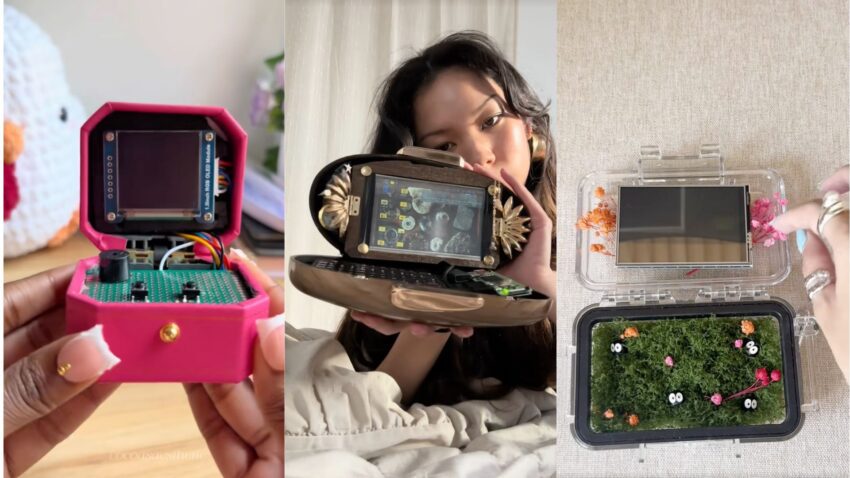
Cyberdecks have long been associated with a certain kind of DIY futurism: chunky, keyboard-forward gadgets in 3D-printed shells or rugged cases that look like they belong in a cyberpunk prop room. But a new wave of makers on TikTok is pushing the format in a more personal, playful direction, building tiny Linux computers that can hide inside purses, jewelry boxes, toys, and thrifted odds and ends.
From rugged boxes to disguised art objects
The shift is visible in the projects getting shared across social media. Instead of the familiar “little laptop” aesthetic, these builds often look like ordinary accessories or decorative objects at first glance. Under the surface, though, they still function as compact computers built for specific tasks, usually offline, such as reading, journaling, or listening to music.
That evolution reflects a broader change in how people are approaching cyberdecks. The devices are still DIY creations centered around small single-board computers like Raspberry Pi boards, but the design goal is no longer just to make something practical or cyberpunk-looking. For many makers, the appeal now seems to be transformation: taking a found object, a thrift-store item, or a childhood toy and turning it into a personal computing device with a hidden purpose.
Annike Tan’s purse-based builds helped spark attention
One of the names drawing attention is DIYer and TikTok user Annike Tan, who posts as @ubeboobey. Tan can carry her cyberdeck around without anyone noticing because, as described in the source material, it does not look like a computer at all. Her builds have already attracted attention beyond TikTok: Tan has been featured in The Cut and Wired.
Earlier this year, Tan went viral with a mermaid-themed cyberdeck she built inside an old purse. Since then, she has expanded her collection of projects, including an MP3 player and a solar-powered cyberdeck. Those follow-up builds reinforce a theme that is common across the new crop of homemade devices: the hardware may be compact and technical, but the outer shell can be anything from nostalgic to whimsical.
Tan’s work is part of a larger ecosystem of creators showing that a cyberdeck does not need to resemble a conventional computer case. The purse build, in particular, highlights how much the category has drifted from its older image. A device hidden in a handbag can be both portable and discreet while still being distinctly handmade.
Why the new cyberdeck aesthetic is taking off
According to the source material, countless DIYers are now attracting millions of views by showing off personal computers built inside purses, jewelry boxes, toys, and old tech. The appeal is not just the novelty of seeing a computer hidden in an unexpected place. It is also the creativity of repurposing objects that already carry meaning, style, or nostalgia.
This more artistic approach leans heavily on recycled or thrifted parts. Rather than starting with a blank, custom-printed enclosure, makers often begin with an object that already has a visual identity. A retro TV-themed purse can become a display case. An old toy can become a shell. A decorative tin or box can become a compact terminal. The result is a device that feels more like a personal artwork than an engineering exercise.
That distinction matters because the cyberdeck world has traditionally emphasized visible hardware and an explicitly technical look. The newer builds still rely on the same core ingredients — a Raspberry Pi, a screen, and input devices — but the exterior is increasingly about concealment, humor, or aesthetics rather than rugged utility.
Examples range from purses to snack boxes
One TikTok creator who goes by @diypagancrafts built a cyberdeck out of a retro TV-themed purse, placing the screen on the outside and storing the Raspberry Pi, keyboard, and a game controller inside. The example captures the spirit of the current trend: the object is recognizable as a fashionable accessory, but it also functions as a self-contained computer.
The range of possible housings is remarkably broad. The source material mentions cyberdecks made from a Dunkin’ Donuts munchkin box, a Pokeball, an Altoids tin, and even a plastic box stuffed with fake moss and flowers. In each case, the idea is similar: as long as there is enough room for a single-board computer and a screen, almost anything can become a cyberdeck.
That flexibility is part of what makes the trend so shareable. A finished build can be funny, nostalgic, pretty, or surprising all at once. It can also blur the line between tech project and craft project, inviting makers who may not be interested in traditional computer hardware enclosures but are drawn to decorating, upcycling, or themed art objects.
What makes a cyberdeck a cyberdeck
At the core, these homemade devices are mini Linux computers designed for narrow uses. The software side tends to be straightforward and purpose-built, especially for offline tasks. The hardware, too, is usually compact and relatively low-power. But the defining feature of the new movement is that the outer shell no longer needs to signal “computer” at all.
That’s a meaningful departure from the usual cyberdeck formula. Earlier examples commonly leaned on 3D-printed chassis or bulky enclosures such as Pelican-style cases, often with a distinctly cyberpunk visual language. Those designs made their function obvious. The latest wave is more interested in disguise and reinterpretation, turning the computer into a hidden layer inside an object that might otherwise sit on a shelf, in a closet, or on a tabletop.
In practical terms, the builds still serve the same type of narrow, personal use. But in cultural terms, they are becoming more expressive. A cyberdeck can now say something about the maker’s taste, humor, or interests just as much as it says something about their technical skills.
DIY computing meets thrift culture
The trend also fits neatly with the broader popularity of thrifted and recycled materials in maker culture. Using an old purse, a discarded toy, or a decorative container reduces the need for purpose-built cases and gives each project a one-of-one feel. It also encourages experimentation, because the object itself helps shape the final build.
That makes the finished devices feel more personal than standard homemade tech. Two builders using the same Raspberry Pi and the same screen can end up with completely different results depending on whether the computer lives inside a jewelry box, a snack container, or a toy. The object becomes part of the story, and often the main reason people pause on a video long enough to watch the whole build.
As the examples from Tan and others show, cyberdecks are no longer limited to a single visual identity. They can still be rugged, but they can also be cute, strange, or disguised. In that sense, the movement is becoming less about imitating a science-fiction prop and more about turning everyday objects into intimate little computers.
Source: Original report
Was this helpful?
Explore more: More Hardware & Devices Tech News Blog
Last Modified: July 7, 2026 at 9:25 pm
6 views