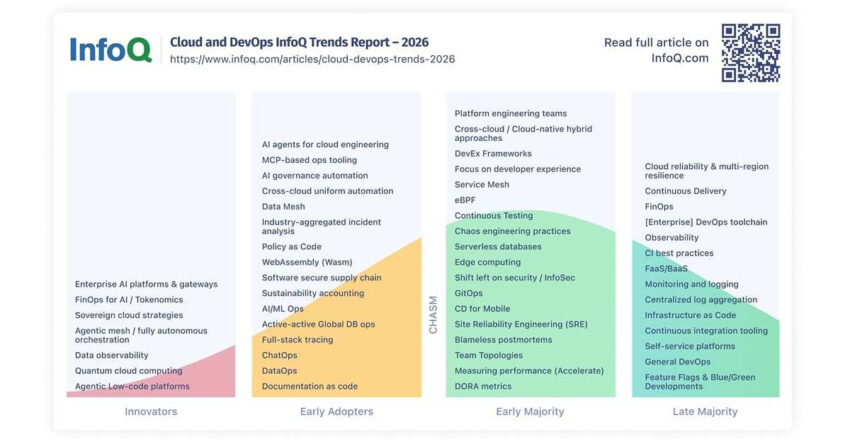
InfoQ’s Cloud and DevOps Trends Report 2026 podcast paints a picture of an industry moving rapidly from AI experimentation to enterprise-scale execution, while still wrestling with familiar problems around resilience, governance, cost and architecture. In the discussion, the panel repeatedly returned to the same theme: AI is no longer a side project for individual developers, but a strategic concern reshaping cloud platforms, platform engineering, FinOps and digital sovereignty.
AI has shifted from novelty to infrastructure strategy
One of the strongest signals from the episode is that AI is now influencing cloud planning at the infrastructure level. Shweta Vohra said what surprised her most was not chips or agents, but the scale of AI infrastructure spending, which she described as the largest build-out in technology history. She pointed to reported spending of around $450 billion by 2025 and said the pace of new deals was “surprising” and sometimes “shocking,” particularly because of the electricity and hardware required.
Steef-Jan Wiggers described a wider “agent infrastructure arms race,” citing hyperscalers investing in AI-related products such as agent registries, DevOps agents, sandboxed workloads and governance layers. He framed this as a major shift from last year’s conversations, when AI was still mostly about what to do with it. Now, he said, the focus is on shipping concrete products and infrastructure around it.
Mark Silvester added that AI has moved from being a team-level experiment to a board-level requirement. In his view, that shift is happening faster than many organisations are ready for, exposing gaps in operating models and team structures.
Cloud resilience is back on the agenda
Not every surprise in the panel was AI-related. Renato Losio said he was struck by how poor the reliability of major cloud services has been over the last year, referring to major outages and the broader operational impact they had across the internet. His point was simple: resilience, multi-region planning and operational readiness are once again front-line concerns, not background assumptions.
That concern echoed through the rest of the discussion. Even as organisations race to adopt AI services, the panel suggested that cloud teams cannot afford to treat reliability as solved. The more services and agents are layered into production systems, the more operational discipline matters.
AI governance is becoming a practical enterprise problem
When the conversation turned to enterprise adoption, compliance and security were described less as abstract blockers and more as day-to-day design constraints. Mark Silvester said regulated organisations are trying to adopt AI without letting individual teams move ahead in isolation, creating duplicated efforts and gaps in security coverage. He said teams are increasingly being built into systems from the start rather than being asked to retrofit controls later.
Steef-Jan Wiggers said the same issue is visible in regulated European environments, where requirements such as DORA and other compliance obligations shape what is possible. He also highlighted a coordination problem: classic ML teams, generative AI teams and platform teams may all be solving similar problems in different ways, without a clear shared architecture.
Shweta Vohra said the industry has moved beyond individual productivity and is now dealing with team-level AI use. She noted that organisations are trying to secure models, tool access and MCP exposure, while also narrowing down tool sprawl as the market settles around a smaller number of preferred combinations.
What the panel sees as the current blockers
- Security and compliance around models, tools and access paths
- Uncoordinated AI initiatives leading to duplication
- Unclear governance for agent-driven workflows
- Gaps between experimentation and enterprise-wide control
Platform engineering is changing, but not disappearing
The panel did not describe platform engineering as obsolete. Instead, it is evolving under pressure from AI, governance and sovereignty requirements. Mark Silvester said platform teams are becoming AI-native enablers, with the goal of standardising capabilities across organisations so that teams do not build their own shadow platforms.
Matt Saunders said platform engineering is in a “holding pattern” because the problem space has changed. Teams are no longer focused mainly on Terraform, wikis or basic cloud hosting choices. Instead, the new questions are about model hosting, sovereignty, access control and how to provide shared AI capability without letting every team make its own incompatible decision.
Shweta Vohra argued that platform engineering has matured into the early-majority phase. She said internal developer portals and platform layers are now established enough that the next challenge is creating clearer abstraction boundaries, including a sharper distinction between platform engineers working close to infrastructure and developers operating at higher layers.
FinOps is becoming AI-aware
FinOps was another area where the panel said the old assumptions are no longer enough. Matt Saunders said token spend has become a major concern and joked that teams are now “tokenmaxxing.” He said current tools can show cost, but not yet connect that cost cleanly to business outcomes or productivity.
Renato Losio said the focus has shifted from deterministic cloud cost optimisation to a much murkier world of AI spending, where costs can be hard to predict and even harder to tie back to value. He also noted that it is still unclear whether current pricing reflects long-term reality or provider subsidies designed to encourage adoption.
Steef-Jan Wiggers said AI gateways and policy controls may help organisations direct requests to cheaper or more appropriate models, but he agreed that proving business value remains difficult. Shweta Vohra added that the FinOps community is already exploring token-focused approaches, reflecting the industry’s growing need to account for AI consumption more precisely.
Digital sovereignty is becoming a design constraint
The podcast closed with a discussion of digital sovereignty, especially from a European perspective. Steef-Jan Wiggers said complete sovereignty is difficult for organisations already deeply invested in American cloud, software and policy systems. He suggested that IaaS may have viable alternatives in Europe, but platform services and SaaS remain much harder to replace.
Mark Silvester said his European clients are increasingly committed to keeping everything within Europe, and he has seen a gradual move back on-premises in some cases. Renato Losio took a more skeptical view, saying many European alternatives are still closer to marketing than to full technical parity with hyperscale offerings.
Shweta Vohra said the core question is not fully settled: is sovereignty about data, models or boundaries? In her view, organisations are trying to solve a problem whose scope is still evolving, especially as model training and internet-scale data use complicate the concept.
What stands out from the trends report
The recurring thread across the discussion is that AI has become inseparable from cloud and DevOps strategy. That does not mean the older priorities have gone away. It means reliability, governance, platform design, cost control and sovereignty now have to be reconsidered in a world where models and agents are part of the stack.
For cloud and DevOps teams, the message from InfoQ’s 2026 trends conversation is less about chasing the newest capability and more about building the controls, abstractions and operating model that make it usable at enterprise scale.
Source: Original report
Was this helpful?
Explore more: DevOps Services More Cloud & DevOps Tech News
Last Modified: August 13, 2026 at 1:53 am
14 views