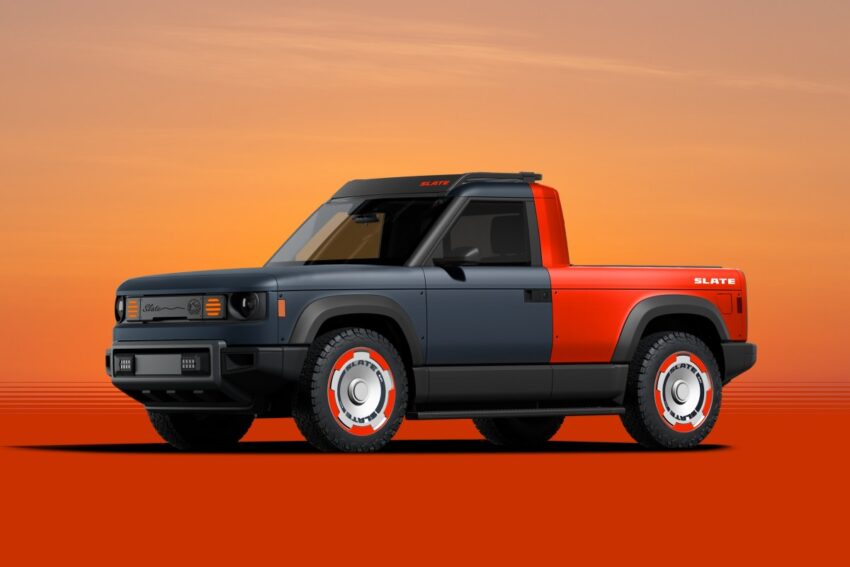
Carvana has received the option to invest in Slate Auto, the Jeff Bezos-backed electric vehicle startup, according to documents obtained by TechCrunch. The move comes as the online used car retailer explores a push into new car sales, a shift that could bring it closer to one of the more closely watched EV startups in the market.
Paperwork filed with Delaware’s division of corporations shows Carvana was granted a warrant in 2025 to buy shares in Slate Auto, around the same period the startup was putting together its $650 million Series C funding round. It is not clear whether Carvana has exercised the warrant, or how many shares it is entitled to purchase. Carvana declined to comment, and Slate Auto did not respond to requests for comment.
The arrangement appears to sit at the intersection of two broader strategies: Carvana’s possible expansion beyond used vehicles, and Slate’s effort to bring a low-cost electric pickup to market without the traditional dealership model. According to the Wall Street Journal, Carvana is evaluating ways to expand into new car sales and has reportedly bought several Stellantis dealerships across the United States. On a recent earnings call, Carvana CEO Ernie Garcia III told analysts to “stay tuned” when asked about new car sales.
What the paperwork shows
The Delaware filing is the key public clue tying Carvana to Slate Auto. In March, Carvana disclosed in a regulatory filing that it had been granted a warrant to purchase shares of a “private consumer products company” in June 2025. The company did not identify the business, but said the warrant’s aggregate value was $1.5 million at the end of 2025. It also said the warrant “vests in tranches through 2029 based on jointly determined performance goals.”
Carvana added that Guggenheim Partners CEO Mark Walter has a “substantial ownership interest in the warrant issuer.” That detail is notable because Walter has a major stake in both Slate Auto and Carvana. He owns 8% of Carvana’s Class B common stock and 1% of the overall voting power, behind only Ernie Garcia III and his father, Ernie Garcia II, in terms of control.
The March filing did not name Slate Auto, and Carvana has not publicly said whether the warrant was in fact tied to Slate or to another company in Walter’s investment portfolio. But the Delaware paperwork obtained by TechCrunch points to Slate as the likely recipient of the warrant, making the connection more concrete than Carvana’s earlier disclosure.
Why the tie-up matters
For Slate Auto, a relationship with Carvana could be useful for a company that says it plans to sell directly to customers without traditional dealerships. On its website, Slate says it “won’t have traditional dealerships.” That direct-to-consumer approach mirrors the model used by Tesla and other all-electric car companies such as Rivian, but it can create practical hurdles in logistics, delivery, and the customer handoff process.
Physical Carvana locations, if they become part of the equation, could help address some of those challenges. Carvana’s retail infrastructure is built around vehicle buying, selling, and delivery, and that could offer Slate a way to expand its reach while reducing the operational strain that comes with handling car sales at scale. It could also raise Slate’s profile just as the startup is preparing to move from development to actual customer deliveries.
There is no public confirmation that Carvana will play any role in Slate’s sales strategy. Still, the timing is suggestive. Slate is only weeks away from announcing final pricing and opening the first nonrefundable preorders for its low-cost EV, which is expected to start in the mid-$20,000 range. The company has said it expects to deliver its first vehicles by the end of this year.
Slate Auto’s funding and investor lineup
Slate has been unusually quiet about its backers since emerging from stealth last year. TechCrunch first reported that Bezos and Walter were backing the startup, and Slate later confirmed in April that Walter’s TWG Global led its Series C round. That move made Walter one of the startup’s largest shareholders.
The startup’s funding profile matters because it helps explain why a Carvana warrant tied to Walter might also be associated with Slate. Walter’s overlapping ownership in both companies creates an obvious line of inquiry, especially now that Carvana is signaling interest in new vehicle sales and Slate is nearing the market launch of a vehicle that fits into a new price category for EV buyers.
Slate’s upcoming launch also raises operational questions. The company has promoted a vehicle expected to land in the mid-$20,000 range, which would place it among the more affordable electric vehicles on the U.S. market. Yet as with any new automaker, the ability to move from reservation to delivery depends on more than pricing. It requires distribution, service, and customer support systems that can handle real-world demand. If Carvana were to become involved, that could potentially ease one part of that puzzle, though neither company has confirmed any such plan.
Carvana’s broader strategy
Carvana is best known as an online used car retailer, but recent reporting suggests it is considering a broader role in automotive retail. The company’s reported purchase of Stellantis dealerships across the U.S. signals interest in new car sales and perhaps a more hybrid approach that blends digital commerce with physical retail assets.
That would represent a notable expansion for a company that built its brand around used-car e-commerce and vehicle vending machines. New car sales could open a larger and different market for Carvana, but they also would bring fresh competitive and logistical demands. A partnership or investment in an EV startup like Slate could offer Carvana a foothold in a segment where direct sales, delivery logistics, and consumer education are all central to the buying experience.
Carvana’s earnings-call comment to “stay tuned” has already fueled speculation that a formal announcement is coming. For now, though, the company has not publicly detailed any new-car launch or a direct relationship with Slate Auto beyond the warrant disclosures surfaced in the filings.
Open questions remain
Even with the Delaware documents and Carvana’s earlier regulatory filing, several important details remain unknown. It is still unclear whether Carvana has exercised the warrant, how many shares it could buy, or whether the arrangement is meant as a financial investment, a strategic partnership, or both. Slate has not publicly addressed the warrant either.
What is known is enough to show that the two companies are connected in at least one meaningful way, and that the connection arrives at a moment when both are moving into new territory. Carvana is considering how to extend its sales model beyond used cars. Slate is moving toward first deliveries and final pricing for a vehicle intended to reach buyers at a relatively low entry point for EV ownership.
If the relationship develops further, it could become one of the more unusual examples of cross-pollination between a used-car marketplace and a startup automaker. For now, the public record suggests a warrant, an investor overlap through Mark Walter, and a set of strategic priorities that appear to align just as Slate approaches launch.
Source: Original report
Was this helpful?
Explore more: More Business & Startups Tech News Blog
Last Modified: July 7, 2026 at 9:27 pm
10 views