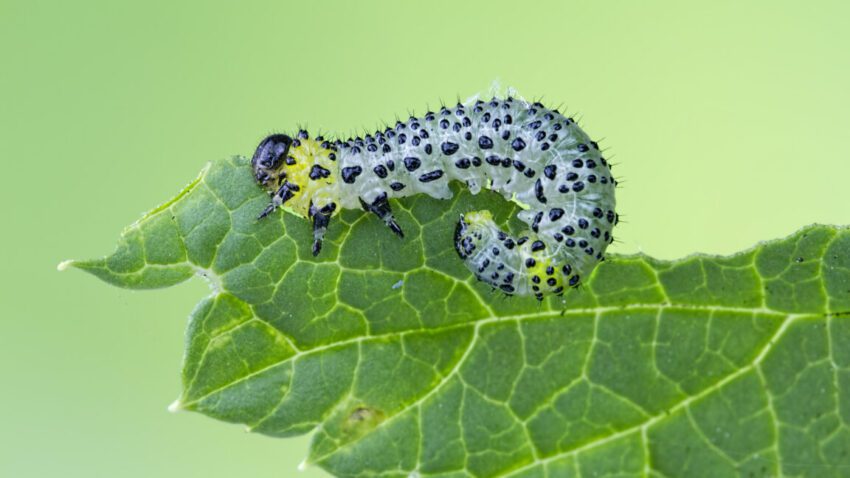
Common bean plants do more than passively endure caterpillar damage: according to a new study, they can detect a molecular clue in caterpillar spit, switch on immune defenses, and even call in predatory wasps for backup. Researchers led by Adam Steinbrenner, a biologist at the University of Washington, say a single immune receptor helps explain how beans turn being eaten into both direct chemical defenses and an airborne distress signal.
How beans recognize a caterpillar attack
For years, scientists have known that plants emit volatile organic compounds, airborne chemical signals that can attract the natural enemies of herbivores such as caterpillars. What remained unclear was how a plant distinguishes a live feeding insect from simple mechanical injury. Steinbrenner’s team focused on the common bean and tracked the response to a peptide called In11, a fragment associated with herbivore saliva and regurgitate.
In11 is derived from a piece of ATP synthase found in chloroplasts, meaning the signal ultimately traces back to a plant protein. As caterpillars feed, their gut enzymes break down plant tissue and the resulting fragments are regurgitated onto the leaf surface in extremely small concentrations. Beans have evolved an immune receptor known as the inceptin receptor to detect that signal.
A receptor tied to defense
The key challenge was proving that this receptor was responsible for the plant’s anti-caterpillar response. That was difficult because common bean plants are notoriously hard to genetically modify. The researchers could not simply silence the gene at will, and switching to a different model plant was not an option because the receptor is only present in certain bean species.
To work around that limitation, the team turned to selective breeding. They screened 89 Mesoamerican bean varieties for plants that failed to produce ethylene gas, a classic stress response, after exposure to In11. Two varieties ignored the peptide entirely, and the researchers chose a Honduran strain, W6 13807, for further study.
Genome sequencing showed that this insensitive bean carried a naturally occurring 103-base-pair deletion in the gene encoding the inceptin receptor. The deletion produced a truncated, non-functional protein.
Breeding near-identical bean siblings
Using crosses and backcrosses between the mutant line and a standard bean variant that responded to In11, the researchers created sibling plants that were nearly identical genetically except for whether they had a functional inceptin receptor. Steinbrenner said the process took several years.
Once those sibling lines were in hand, the results were striking. Caterpillars feeding on plants with the inactive receptor grew more than 70 percent faster over a five-day period than caterpillars feeding on plants with the working receptor.
What the receptor controls
Detailed analysis showed that beans with a functional receptor rapidly ramped up 527 genes after caterpillar feeding, including genes linked to anti-herbivore defenses. Plants lacking the receptor did not mount that specific response. Instead, they reacted as though they were simply wounded mechanically, rather than recognizing the presence of a hungry insect.
That difference mattered beyond direct leaf defense. Beans that could not detect In11 were also unable to send out the volatile chemical blend that normally helps attract predatory wasps.
Calling in the wasps
In lab tests, plants with the active receptor emitted a distinctive mix of volatile organic compounds when exposed to synthetic In11 or to actual caterpillar oral secretions. The mutant plants did not. To a wasp, those scents appear to function as a highly specific alert: not just “damage,” but “a caterpillar is feeding here right now.”
The team then moved into an experimental agricultural field in Oaxaca, Mexico, where they placed paired bean plants — one with the functional receptor and one without it — outdoors. The plants were treated with water, caterpillar oral secretions, or In11, and live sentinel caterpillars were attached to the leaves. Local predatory wasps were active in the field, but they did not search randomly. They disproportionately targeted the plants with functional inceptin receptors, especially those treated with In11 or caterpillar spit, and removed the caterpillars in response to the chemical signal.
Not the whole defense story
The mutant beans were not completely defenseless. Steinbrenner noted that other studies have shown caterpillars can grow much larger when all immune signaling is disabled, suggesting the plant has additional pathways for deterring herbivores.
The authors also say the downstream signaling pathway is still not fully understood. They suspect the specific caterpillar detection may piggyback on the plant’s broader wound response, possibly involving damage-associated molecular patterns, or DAMPs, but the route from receptor activation to volatile emission remains unresolved.
There are still other caveats. The test insect, Spodoptera exigua, or the beet armyworm, is a generalist herbivore that feeds on many plants and is vulnerable to plant defenses. It is not yet clear whether the inceptin receptor would provide broad resistance against more specialized pests that have evolved ways to bypass or detoxify host defenses.
Why the finding matters
Even with those open questions, the study gives a clearer picture of how beans convert an insect attack into a coordinated defense strategy: detect the molecular signature of feeding, activate internal immune genes, harden the leaf against further damage, and release airborne cues that summon predators.
Steinbrenner said the long-term goal is to better protect crops such as beans by identifying useful receptors and volatiles from different plants. “Today, we do that with chemicals, with pesticides, but if we could use the best receptors and the best volatiles from lots of different plants, maybe we might be able to confer immunity to most problematic pests or pathogens in a sort of targeted way,” he said. “That’s the big picture, the goal of our lab in the long run. And I think doing that would mean understanding more of these types of receptors and volatiles.”
The study appears in Science Advances (2026) under DOI: 10.1126/sciadv.aec3229.
Source: Original report
Was this helpful?
Explore more: More General Technology Tech News Blog
Last Modified: July 7, 2026 at 9:36 pm
4 views