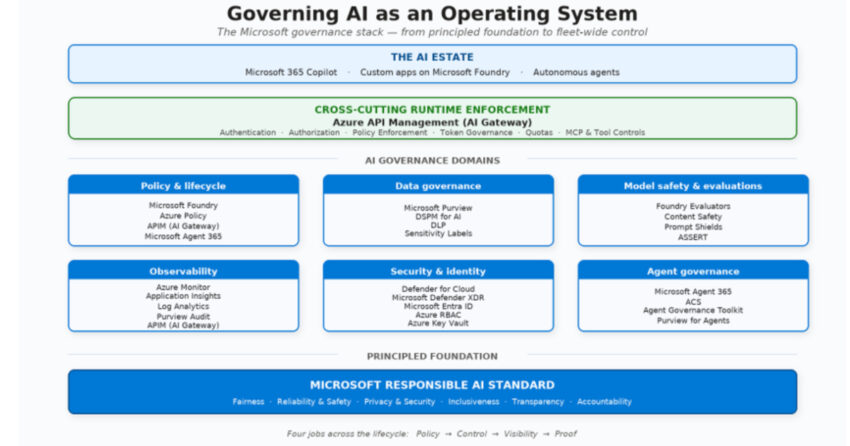
Microsoft has published an AI governance architecture that shifts the focus from written policy to runtime enforcement, continuous evaluation, observability, and audit evidence as AI applications and agents move into production. The framework is designed to make governance something teams can verify in operation, not just document on paper.
Microsoft AI governance moves into the runtime
The core idea in Microsoft’s approach is that governance should operate as a continuous loop. Policies define requirements and risk classifications, controls translate those rules into access and runtime enforcement, observability records what systems actually do, evaluations test quality and safety, and audit processes turn telemetry into evidence for compliance or incident review.
In a LinkedIn post cited alongside the architecture, Manasa T. Ramalinga, Cloud Solution Architect at Microsoft, said organizations moving AI workloads into production are re-architecting their foundational structures to build safer systems rather than treating governance as an afterthought.
“Organizations cannot scale what you cannot control”
Microsoft’s architecture is framed around a simple operational message: AI governance has to be enforceable in production if it is going to scale. Anthony Bartolo, Principal Cloud Advocate at Microsoft, described the distinction in another LinkedIn post, saying: “Your AI policy is not governance until production can prove it.”
He summarized the lifecycle as policy defining the rules, runtime controls enforcing them, observability capturing behavior, evaluations testing quality and safety, and audit converting telemetry into evidence.
Nine governance domains, four operational functions
Microsoft identifies nine governance domains in the architecture:
- Policy
- Data governance
- Model governance
- Observability
- Evaluations
- Security
- Identity and access
- Audit and compliance
- Agent governance
Those domains are mapped to four functions: policy, control, visibility, and proof. The company’s point is that governance should not stop at drafting rules; it should include the mechanisms that enforce them, the telemetry that shows whether they are working, and the evidence needed for audits and investigations.
The runtime scope is broad. Microsoft says the controls can span interactions among users, agents, models, tools, APIs, MCP servers, and enterprise systems. That reflects the growing complexity of production AI systems, where one agent may trigger several downstream services and tools in a single workflow.
Microsoft Foundry, Purview, Entra ID, Defender, and Azure API Management
Microsoft says the architecture combines Microsoft Foundry with other platform services, including Microsoft Purview, Microsoft Entra ID, Defender, and Azure API Management. Foundry’s AI Gateway is positioned as a runtime boundary for authentication, token limits, quotas, and policy enforcement.
Microsoft also says the gateway can be used to govern MCP tools. In that setup, centralized authentication, rate limiting, IP restrictions, and audit logging can be applied without changing MCP servers or agent code. That is notable because it allows governance to be layered into existing systems rather than rebuilt into every service individually.
The architectural approach reflects a broader shift in AI operations: organizations want controls that are central, consistent, and visible, especially when agents can invoke external tools or interact with enterprise systems.
Evaluations are no longer just pre-release checks
Microsoft places evaluations both before deployment and in production. Foundry supports evaluation of AI applications and agents against datasets using built-in and custom evaluators, giving teams a way to assess quality and safety before release and monitor behavior after launch.
That matters because model behavior can change once systems are exposed to real users, real prompts, and real integrations. In Microsoft’s framing, evaluation is not a one-time gate; it is part of the ongoing governance loop that helps teams spot drift, unsafe outputs, or other operational issues.
Agent governance gets its own controls
The architecture also gives special attention to agent governance. Microsoft says this includes controls for agent identity, access, activity, and workflow checkpoints. As autonomous agents take on more work, the company argues that they need the same kind of operational oversight that enterprises already apply to human users and machine identities.
Microsoft’s open-source Agent Governance Toolkit is described as providing runtime security capabilities for autonomous agents, including policy enforcement and interception points. The architecture also references the Agent Control Specification, which adds checkpoints across agent inputs, model calls, tool execution, and outputs. For higher-impact actions, human approval can be required.
Why runtime checkpoints matter
In practical terms, that means organizations can put guardrails around what an agent is allowed to do, when it can do it, and which actions need review. For teams deploying agentic systems, that is a meaningful distinction: governance is no longer only about setting boundaries in advance, but also about intervening during execution when risk is highest.
How Microsoft’s approach relates to NIST
Microsoft says its architecture is broader than a Microsoft-specific control plane. It points to the NIST AI Risk Management Framework and the Generative AI Profile as vendor-neutral guidance for managing AI risks across the lifecycle, including governance, measurement, evaluation, and risk mitigation.
The company’s contribution is to map those concerns into concrete platform controls and operational telemetry. In other words, NIST provides the framework for thinking about risk, while Microsoft is presenting a way to implement those ideas in its own stack.
What this means for AI teams
For organizations deploying AI applications and agents, the architecture underscores a practical challenge: policies are necessary, but they are not sufficient. Teams also need enforcement points, logging, visibility, evaluation pipelines, and audit trails that hold up under operational scrutiny.
Microsoft’s message is that governance has to be verifiable in production if AI systems are going to be trusted at scale. That will likely resonate with teams already dealing with AI security, compliance, and agent oversight, especially as more workflows depend on autonomous systems touching APIs, tools, and business data.
Source: Original report
Was this helpful?
Explore more: AI Automation Services More AI & Automation Tech News
Last Modified: August 26, 2026 at 1:53 am
9 views