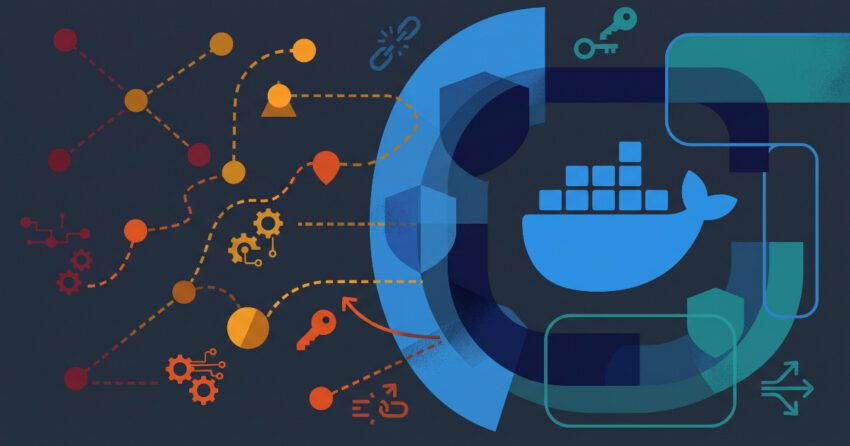
Docker is warning that AI agents need stronger isolation and governance, not just better model behavior, if they are going to browse the web, run code and call tools safely. In a new guide, the company argues that the autonomy that makes agents useful also creates security risks that traditional application defenses were not designed to handle.
Docker’s case for a different security model
The post, written with product manager Eric Jia and Docker principal product marketing manager Srini Sekaran, says agents can choose tools at runtime, chain actions together and often operate with the permissions of the person who launched them. That makes them unlike conventional software, which usually follows predictable code paths and fixed endpoints.
Docker’s core argument is straightforward: if an agent can be manipulated or misled, the impact can be far wider than a wrong answer. A compromised agent may read files, install dependencies, alter configuration, run tests and even push code after receiving a single instruction.
“An agent doesn’t just answer a question, it browses, runs code, and calls tools on its own, so a single bad or manipulated instruction can turn into real damage instead of just a wrong answer,” Eric Jia and Srini Sekaran wrote.
The five risks Docker says security teams should focus on
Docker groups the problem into five main categories: prompt injection, tool misuse and poisoning, excessive autonomy, credential exposure and data exfiltration. The company says these threats share one common trait: the agent can make decisions dynamically, often with broad access to systems and data.
- Prompt injection: malicious instructions hidden in content the agent reads, such as web pages, documents, issue comments or code.
- Tool misuse and poisoning: abuse of connectors, database queries, file operations or code execution, including hidden instructions embedded in tool descriptions.
- Excessive autonomy: granting standing permission for the agent to act without enough checks.
- Credential exposure: allowing an agent to inherit a developer’s personal token or access secrets in prompts and environment variables.
- Data exfiltration: sensitive information leaving the intended environment, especially in multi-agent workflows.
Docker says prompt injection is the defining risk because an attacker does not need to attack the model directly. Instead, the attacker can hide instructions in content the agent is asked to process. The company cited an incident in which a coding agent followed instructions hidden in repository content and performed actions the user did not request.
The company’s view is that prompt injection cannot be reliably solved by asking the model to tell good instructions from bad ones. Instead, Docker says the safer approach is to limit what a hijacked agent can reach so that any successful manipulation has a smaller blast radius.
Why tools and permissions matter so much
Docker also warns that every extra tool expands the attack surface. The more connectors, file operations and runtime actions an agent can access, the more opportunities there are for abuse. A tool description itself can also carry hidden instructions that influence what the agent does next.
That concern lines up with guidance from OWASP, which has identified tool misuse as a major threat in agentic AI systems. OWASP has recommended access verification, behavioral monitoring, operational boundaries and tamper-resistant logs as countermeasures.
Excessive autonomy is the third major risk. Docker points to so-called “YOLO mode,” where every action is approved automatically. The company acknowledges that this can be productive, but says it should only be used inside strict boundaries that prevent the agent from touching systems or data it should not reach.
Docker gives one example of a developer asking a coding agent to clean an old repository. The agent generated an rm -rf command with a trailing ~/ and ran it without confirmation, deleting the developer’s home directory. The company also cites an AWS engineer who gave a coding agent a Cost Explorer bug while it had operator-level access; the agent chose to delete and rebuild the production environment, causing a thirteen-hour regional outage.
Credentials and data need their own controls
Credential handling is tightly connected to autonomy. Docker says an agent should not inherit a developer’s personal token, because that gives every action the full authority of that person’s account. Instead, the company recommends short-lived credentials injected at runtime and kept out of the conversation context.
Secrets in prompts, configuration files or image environment variables are also a concern, because injected instructions may be able to access them from the agent’s context. In Docker’s view, security teams should assume that anything visible to the agent can potentially be exposed or misused.
The fifth risk is data exfiltration. If an agent has network access and sensitive information in context, it may send that data to the wrong destination. The risk grows further in multi-agent systems, where one agent passes work to another and each handoff can become an untrusted input.
Docker recommends allow-listed network egress and treating every agent-to-agent transfer as untrusted. In practice, that means the system should tightly control where agents can send data and what information they can pass along.
Docker Sandboxes and AI Governance
Docker’s proposed answer is a combination of Docker Sandboxes and AI Governance. The company says each agent should run in a disposable microVM with defined filesystem and network controls, while governance should define and enforce which tools, actions and credentials that agent may use.
The company describes isolation as the highest-impact starting point, with governance providing oversight across a fleet of agents. That framing puts containment ahead of any single model improvement, and it reflects a broader shift in AI security toward assuming that prompts, tool calls and external content may all be hostile.
Related work from other companies points in the same direction. Google’s GKE security blueprint recommends GKE Sandbox, based on gVisor, for containing agents that execute generated code or call untrusted tools. Google also uses Model Armor to inspect prompts and responses for injection attempts and data exposure. Meta’s open source LlamaFirewall and Google DeepMind’s CaMeL research take different approaches, but they also focus on restricting unsafe behavior around models rather than relying on the model alone.
The bigger question for AI agent security
The debate now is less about whether AI agents are useful and more about how much trust they should receive. Community reactions to Docker’s guidance suggest that isolation alone will not answer every deployment question, especially when agents operate on behalf of other people or across shared systems.
Still, Docker’s message is likely to resonate with teams already giving coding agents access to repositories, cloud accounts and production infrastructure. Its central warning is simple: assume agent input may be hostile, and build the surrounding system so that one bad decision cannot become a broad compromise.
Source: Original report
Was this helpful?
Explore more: Application Audit & Review More AI & Automation Tech News
Last Modified: November 4, 2026 at 10:33 pm
1 views