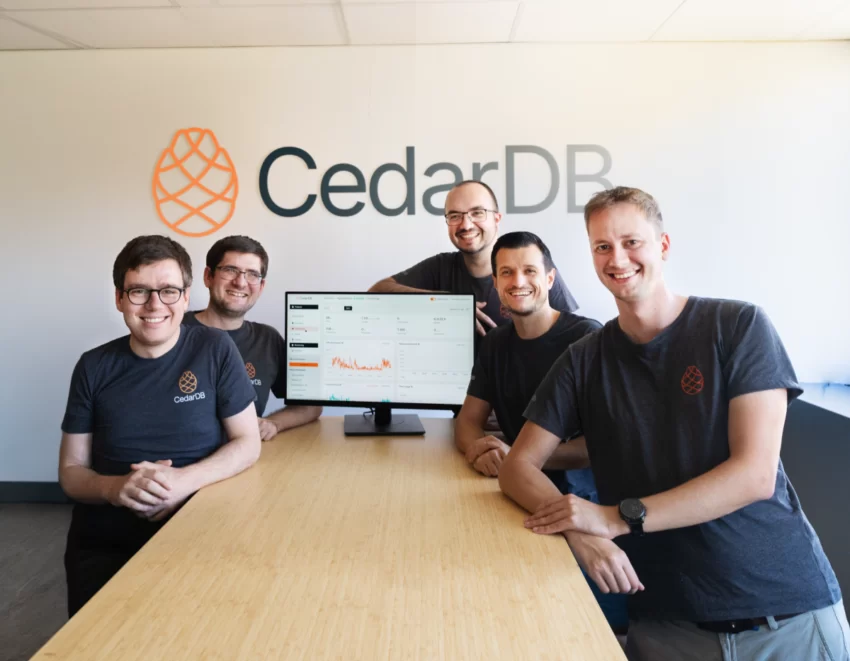
Munich-based CedarDB is betting that the old split between transactional and analytical databases is becoming less useful, especially as AI agents push companies to ask more questions of their data, more quickly. The startup says its database engine can handle both jobs in one system, and that promise is drawing fresh attention as businesses look for faster, simpler ways to support natural-language querying and other agentic AI workflows.
CedarDB and the case for one database
For decades, databases have usually been designed around one of two tasks. Operational databases are built to manage day-to-day records such as orders, payments, and customer updates, while analytical databases are optimized to help businesses identify patterns, generate reports, and answer broader questions about their data.
CedarDB’s pitch is that this divide is increasingly awkward for modern applications. The company’s co-founder and CEO, Moritz Sichert, told TechCrunch that the rise of agentic AI has made the issue more urgent because enterprise teams now want systems that can respond quickly to analytical questions posed in natural language, without requiring a separate analytics stack.
That argument is especially relevant for companies whose data infrastructure was built to store years of transactions but was not necessarily designed to surface those records rapidly for analysis. CedarDB believes those workloads can live together more efficiently, reducing complexity while improving responsiveness.
Built from research, shaped by hardware efficiency
CedarDB did not emerge from a typical startup template. The company is a spinout from the Technical University of Munich and traces its roots to Umbra, a research project focused on building a database engine from scratch that could outperform legacy systems by taking better advantage of modern hardware.
The startup’s founders came out of that research environment with a strong emphasis on performance. CedarDB says its engine is designed to deliver faster processing without demanding more CPUs, more memory, or extra processing power from customers. In practical terms, that means it is trying to offer higher efficiency without forcing companies to buy bigger infrastructure.
Five Umbra researchers are among CedarDB’s co-founders, and the company has carried over the philosophy behind the project: improve speed by rethinking the engine rather than layering on more hardware. That approach is also intended to minimize disruption for customers that are considering a switch from existing systems.
Why PostgreSQL compatibility matters
One of CedarDB’s most important technical choices is compatibility with PostgreSQL, the widely used open source database system. According to Sichert, that compatibility lowers switching costs because customers do not need to rebuild their applications from the ground up.
It also has another advantage in the current AI moment: Sichert said CedarDB follows logic that large language models are already most familiar with from training. In a world where developers and AI systems increasingly interact with databases through natural-language prompts and automated agents, that familiarity could make integration easier.
In retrospect, Sichert said, some of those decisions look lucky. But not all of them were accidental. Co-founder Christian Winter described the team’s early priorities in a blog post, saying that after leaving academia, the founders focused on “reliability, fault tolerance and compatibility with popular tools.”
From on-premise software to a cloud service
The company’s path to market has been deliberately cautious. CedarDB debated whether to launch with a cloud offering immediately, but ultimately started with an on-premise enterprise product alongside a free community edition. Both were announced in May of last year, when the company also revealed a €5.3 million seed round, or about $6 million.
At the time, CedarDB framed the enterprise version as CedarDB Enterprise and the free version as CedarDB Community Edition. That launch strategy suggested the company wanted to establish credibility with technical users and larger organizations before expanding into a broader managed service.
The cloud product was not abandoned, only delayed. After beta testing with users from its waitlist, CedarDB announced limited availability of CedarDB Cloud on Wednesday onstage at TechCrunch Disrupt. The event also placed the startup among 20 companies competing in TechCrunch’s Startup Battlefield competition.
Why the cloud launch matters for CedarDB
A fully managed cloud version could be important for CedarDB’s next stage of growth. While an on-premise product may appeal to large enterprises with strict infrastructure requirements, a cloud-hosted service could make the database easier to adopt for a wider range of customers.
It also positions CedarDB more directly against larger data platforms that are making similar arguments about the need to unify analytical and operational workloads. The clearest example in the source material is Databricks, which has been moving in the same direction.
At its Data + AI Summit in June, Databricks cited “the agentic era” as the reason for launching LTAP, a new data architecture intended to “[unify] transactions, analytics, streaming, and operational data on a single copy of storage in the lake.” CedarDB appears to view that move as validation that demand exists for systems that reduce fragmentation across data workloads.
A crowded market, but a timely one
It is still too early to say whether this approach will prove disruptive, but CedarDB’s timing is notable. Enterprises are under pressure to make data more usable for AI tools, especially as companies move from experiments to production deployments of agents that need broad access to information.
In that context, databases that can support both transaction-heavy operations and analytical exploration may gain appeal. The promise is not only technical elegance, but also operational simplicity: fewer separate systems, fewer copies of data, and fewer places for latency and incompatibility to creep in.
CedarDB’s challenge is to turn that idea into a product that can scale beyond early adopters. For now, the company says its current team of 14 people will serve the first cloud users. Sichert said that if traction grows, CedarDB will need to expand its team and then raise its next round of funding.
That could set up a more competitive phase for the startup, particularly if demand for AI-ready data infrastructure continues to increase. The broader market is clearly interested in technologies that make enterprise data easier for humans and agents to query, and CedarDB is trying to position itself as one of the companies built for that shift.
For a company that began in academic research and has spent a decade developing its engine, the recent momentum is tied less to a sudden pivot than to a changing environment. CedarDB’s core claim has remained consistent: one database should be able to do more than one job, and modern hardware should make that possible without unnecessary overhead.
Source: Original report
Was this helpful?
Explore more: More Business & Startups Tech News Blog
Last Modified: October 15, 2026 at 10:32 pm
0 views