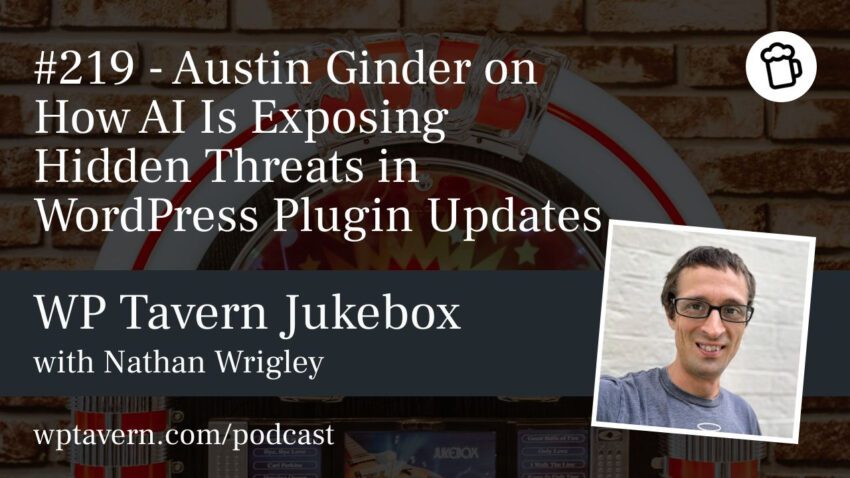
AI is changing how WordPress security researchers work, and in Austin Ginder’s case, it helped uncover a troubling pattern in plugin supply chain attacks. In a recent WP Tavern podcast episode, Ginder explained how malware cleanups on customer sites led him to a wider investigation of compromised plugins, hijacked update channels, and the hidden risks that can follow a plugin change in ownership.
How a routine cleanup turned into a deeper investigation
Ginder has worked in the WordPress ecosystem since 2010 and has run Anchor Hosting since 2014. He manages thousands of WordPress websites, which gave him enough visibility to notice a shift earlier this year: sites that had been stable for years were suddenly showing signs of malware infections.
What began as normal cleanup work evolved into something more serious. Ginder said he used AI-assisted forensics to dig deeper into infected sites, then traced the activity upstream to plugin behavior and update mechanisms that did not look right. That process eventually led him to document multiple supply chain incidents.
Why WordPress plugin updates can become a security risk
The core issue, Ginder said, is that plugin updates are trusted by default. In a normal scenario, that is a feature: a site can update a plugin from the WordPress dashboard, often automatically, and receive fixes without manual intervention. But the same system can be abused if a bad actor gains control of the plugin’s distribution path.
He described two broad attack patterns. One is a compromise of the plugin author or repository access, where malicious code is pushed as if it were a legitimate update. The other is more unsettling: an attacker buys a plugin business and then weaponizes the software itself, sometimes by adding a third-party updater that quietly moves updates away from WordPress.org to a rogue channel.
Once that happens, WordPress.org loses visibility into what is being distributed. End users may continue receiving updates as usual, but the code can now include backdoors, SEO spam, ad injection, or other malicious payloads.
Why these attacks are hard to notice
Ginder stressed that these changes are often subtle. A plugin may keep working normally, even while a few lines of code alter its update source or introduce hidden behavior. That means site owners may never see an obvious warning sign unless they inspect the code directly or run a specialized audit.
He also noted that these attacks are not necessarily “loud” malware drops. Instead, bad actors may wait until a plugin is installed across many sites before triggering the malicious functionality. That delay can make the compromise much harder to detect.
Four incidents, four different paths to compromise
During the interview, Ginder described four separate investigations he had published or helped surface. He said each one had a different origin story, which is part of what makes the problem so difficult to track.
- Essential Plugins: The WordPress Plugin Team flagged bad activity across a suite of more than 30 plugins and warned users their sites may be compromised. Ginder said the issue turned out to involve the purchase of a company.
- Widget Logic: A security feature he was rolling out to monitor JavaScript embeds on customer sites flagged suspicious sports-related JavaScript, which led him to another supply chain compromise.
- Quick Redirection: Ginder said his tool found 12 sites running a version of the plugin that was not the version available on WordPress.org, indicating a hijacked variant.
- Scroll To Top: While scanning top WordPress sites, he identified a compromised plugin affecting around 20,000 sites, though he said the bad actor had not yet pulled the trigger on the malicious functionality.
He emphasized that the WordPress Plugin Team responded quickly in the cases he encountered, closing down repositories, reverting patches, and issuing notices where needed.
AI made the forensics practical
One of the most important themes in the conversation was AI’s role in making this kind of research feasible. Ginder said the WordPress.org plugin repository contains more than 60,000 plugins, which makes manual inspection unrealistic. By using tools such as Claude Code, he was able to point AI at backups, logs, and code changes, then get detailed reports on what had changed and why it mattered.
He argued that AI does not replace careful security work, but it does make large-scale pattern detection practical for individuals and small teams in a way that was not possible before. In his view, that changes the economics of plugin security investigations.
WP Beacon is meant as a signal, not a standard plugin database
Those investigations led Ginder to create WP Beacon, a site where he can publish the findings in a way that security researchers and hosting teams can act on. He said the goal is not to duplicate a traditional vulnerability database, because the issue here is not simply “bad code.” It is bad actors, compromised distribution chains, and the infrastructure that makes those attacks possible.
Ginder sees WP Beacon as a way to document supply chain attacks, surface relevant identifiers, and help security teams take action against compromised infrastructure. He gave an example of a friend who was able to take a compromised server offline after being shown the findings privately.
Who should pay attention to WP Beacon
- WordPress hosts with large numbers of sites
- Security teams tracking post-compromise infrastructure
- Plugin authors concerned about ecosystem trust
- Site managers who need another layer of review before installing plugins
What larger hosts and the WordPress ecosystem can learn
Ginder believes larger hosting companies are sitting on a valuable source of security intelligence because they see malware incidents at scale. In his view, every infection can become a clue if AI is used to correlate patterns across many sites. He suggested that hosts with millions of sites could help identify recurring tactics and shut down malicious infrastructure faster.
He also argued that the WordPress ecosystem may need better long-term monitoring of plugin changes, not just one-time review at submission. In his ideal scenario, code changes would be audited continuously, especially PHP and JavaScript, while noisy assets such as CSS and images could be deprioritized.
Open source flexibility remains both the strength and the challenge
The discussion also touched on whether WordPress should adopt a more permission-based model, similar to mobile app platforms. Ginder said that approach may make sense for a new project, but it would be difficult to impose on an ecosystem that is already built around openness and flexibility.
That openness is part of what makes WordPress powerful, but it also creates a broad attack surface. Ginder’s position was pragmatic: the ecosystem may not be able to eliminate the threat entirely, but it can make abuse harder and more visible.
For now, Ginder expects more discoveries to follow. He said the work is not finished, but he hopes the combination of AI-driven analysis, community reporting, and stronger coordination with hosts and researchers will make supply chain attacks less effective over time.
Source: Original report
Was this helpful?
Explore more: WordPress Troubleshooting More WordPress & CMS Tech News
Last Modified: August 10, 2026 at 4:24 pm
5 views