Meta is extending its Private Processing architecture to AI glasses, adding confidential computing controls for sensitive AI workloads and persistent user context in the cloud. The company says the system is designed to support features such as streaming transcription, contextual search, and long-term recall while keeping that data outside Meta’s view.
How Meta is bringing Private Processing to wearables
According to the company, basic tasks such as calls and messages can run directly on the glasses, while more advanced AI features need larger models and access to accumulated personal context. That combination is what makes the architecture relevant for AI glasses, where the assistant may need to remember prior interactions and process ongoing input throughout the day.
Meta introduced Private Processing for WhatsApp and Meta AI in 2025, and is now extending the same approach to wearable AI workloads. Oskar Linde, VP of XR Technologies at Meta, described the effort on LinkedIn as a way to make AI more useful throughout the day while supporting the stateful, personal context required by AI glasses without allowing Meta to access that data.
Confidential computing moves into Meta’s cloud boundary
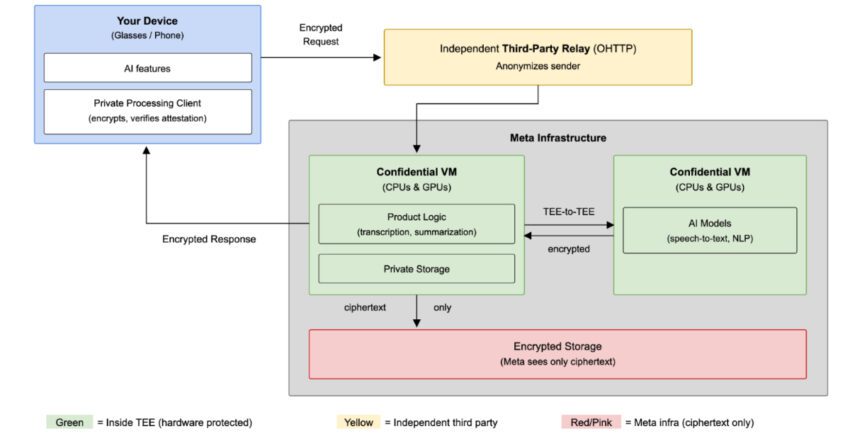
The architecture shifts the confidential computing boundary from the device into Meta’s cloud infrastructure. AI models run inside confidential virtual machines, or CVMs, backed by hardware trusted execution environments and processor-encrypted memory.
Meta says the protection boundary spans both CPUs and GPUs so mixed workloads can remain protected. That matters for modern AI systems, where inference and storage often involve multiple components rather than a single isolated model call.
Verification before any personal data is sent
Before the glasses transmit personal context, they perform remote attestation and establish an attested TLS session with a TEE. The device checks a hardware-signed certificate and compares the workload measurement against an append-only transparency ledger.
If verification fails, data is not transmitted. Meta also uses anonymous credentials and third-party OHTTP relays operated by Fastly or Cloudflare to further separate user identity from request processing.
Persistent state stays inside the protected environment
One of the key changes in this design is that persistent state remains inside the confidential boundary. Meta places the storage engine inside the TEE and encrypts data with user-provided keys before it leaves the protected environment.
Queries also execute within the same boundary, which limits exposure of database access patterns. That approach is intended to support the long-lived memory features that wearable AI products may need, without turning that stored context into a readable asset for the platform operator.
What Meta says the system is built to provide
- Hardware isolation for protected AI processing
- Fail-closed behavior if verification does not succeed
- Public verifiability through the transparency ledger
- Non-targetability for the protected workloads
- Encrypted storage for persistent user context
Limited visibility, broader assurance goals
Meta says production CVM images are registered in the transparency ledger. Because engineers cannot inspect protected memory or capture model inputs and outputs, the company says it relies on aggregate operational signals such as CPU utilization, memory allocation, network latency, and hardware failure rates.
The model reflects a familiar trade-off in confidential computing: stronger isolation for user data, but less direct observability for operators. Meta’s approach attempts to preserve security guarantees while still allowing the company to maintain and scale a production service.
Privacy questions around always-on AI glasses
The rollout comes against a backdrop of continued concern about wearable devices that may listen and observe constantly. In a Reddit discussion about Meta’s glasses, one commenter argued that an assistant providing contextual information would need to continuously listen and observe its surroundings, underscoring the privacy implications of persistent sensing.
That tension is central to AI glasses. The more helpful the assistant becomes, the more context it may need to collect and retain, which raises the stakes for how that information is protected in transit, at rest, and during processing.
Not yet available on Meta’s glasses
Deployment remains a limitation. WIRED reported that Private Processing is not yet available on Meta’s glasses, and Meta has not said which features will use the system first or provided a timeline for availability.
Meta engineering director Pritam Shah said the platform is ready and working, but that the company is announcing it before broader deployment to engage security and privacy researchers and a third-party auditor. Meta says it is working with independent security firms, including NCC Group, to review the architecture and attestation mechanisms.
What happens next
Meta says it also plans to provide researchers with CVM binaries, tools, and documentation as it expands the system for increasingly stateful, multimodal, and agentic AI experiences. That suggests the company sees Private Processing as a foundation for more advanced assistants rather than a one-off privacy feature.
For now, the announcement signals where wearable AI is heading: toward assistants that are more persistent and personal, but also wrapped in stronger technical boundaries meant to keep the company out of the middle of sensitive processing.
Source: Original report
Was this helpful?
Explore more: More Big Tech & Platforms Tech News Blog
Last Modified: October 15, 2026 at 10:33 pm
0 views