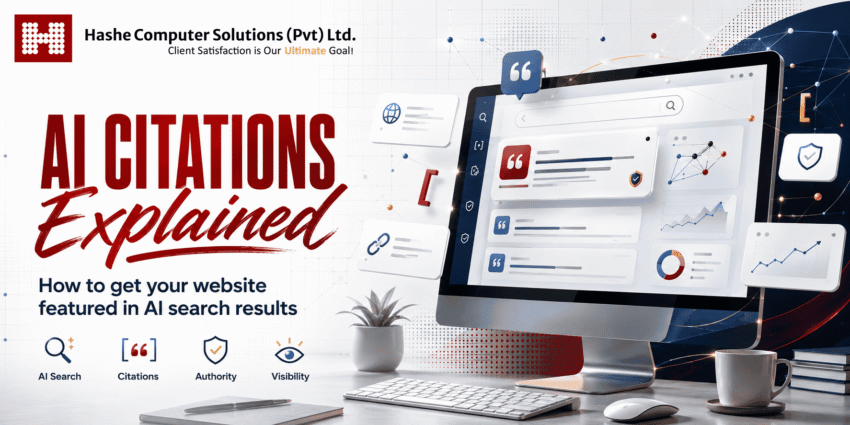
Search is no longer just about ranking on a list of blue links. With the rise of AI-powered search experiences, users are increasingly getting direct, summarized answers, often without ever clicking through to a website. This shift is redefining how content is discovered, consumed, and credited.
At the center of this transformation is a new concept: AI citation. Instead of simply indexing pages, AI tools now evaluate, extract, and reference the most relevant information to support their responses. In other words, your content is no longer just competing to rank; it is competing to be trusted enough to be quoted.
For website owners, marketers, and content creators, this presents both a challenge and an opportunity. The challenge is adapting to a system where visibility doesn’t always mean clicks. The opportunity lies in becoming a reliable source that AI platforms consistently cite and surface.
In this guide, we’ll break down what AI citation means, how AI search engines choose which content to reference, and most importantly, how you can position your website to earn those valuable citations.
What is AI Citation?
AI citation is the process by which AI-powered search engines and assistants reference specific websites as sources when generating answers. Instead of simply listing links, these systems analyze multiple pages, synthesize information, and attribute the original sources within the response.
In more practical terms, an AI citation is an explicit reference, link, or footnote provided by an AI search engine such as ChatGPT Search, Perplexity, Gemini, or Google AI Overviews that credits your content as part of its generated answer.
| User Prompt ──> AI Engine Scans Web ──> Synthesizes Answer ──> Cites Your Website. |
When an AI system processes a query, it doesn’t just retrieve one page. It:
- Breaks the query into smaller sub-questions
- Scans multiple sources across the web
- Extracts the most relevant and reliable information
- Combines those insights into a single, coherent response
If your content is clear, accurate, and easy to extract, the AI is more likely to include it and cite your website as a trusted source. In simple terms, AI citation is the new “top ranking.”
If your content is cited, it means:
- Your information is trusted by AI systems
- Your website contributes directly to answers
- You gain visibility even without a click
This shift marks a major evolution in search: from ranking pages to referencing knowledge.
Why do AI Citations Matter?
For over two decades, search engine optimization was straightforward: perform keyword research, build backlinks, rank on Page 1, and collect clicks.
However, user behavior has shifted dramatically. Search is no longer just a list of directories; it is an answer engine. Here is why earning AI citations is essential for your brand’s digital presence.
The Era of “Zero-Click” Search
Search engines are increasingly answering user questions directly on the results page. Recent data shows that over 68% of search queries now end without a click to an external website, driven largely by the rise of instant AI-generated answer summaries like Google AI Overviews.
When Google AI Overviews or ChatGPT Search synthesize a direct answer, traditional link click-through rates (CTR) can drop significantly. If a user gets their full answer from an AI summary, being cited within that summary is often your only opportunity for brand exposure.
Instant Social Proof and Trust
When an AI platform credits your website as a source, it provides a powerful, impartial seal of approval.
Users treat AI citations differently than traditional sponsored ads or ranked blue links. When an AI engine generates a response and explicitly tags your content as the supporting evidence, it signals to the user that your brand is an established authority in that niche.
In fact, brands cited in AI-generated answers often see higher downstream direct-brand searches and improved conversion rates because trust is built before the user ever lands on the site.
Capturing High-Intent Buyers Early
Whether someone is comparing software platforms, researching medical advice, or evaluating financial services, they increasingly use AI tools like Perplexity and ChatGPT during their initial research phase.
If your company isn’t cited during these initial comparison prompts, your competitors dictate the narrative. Being cited ensures your brand is included in product recommendations, industry overviews, and buyer comparisons long before a customer reaches out to sales.
Compounding “Entity Authority” Across Platforms
AI engines don’t evaluate pages in a vacuum; they build complex knowledge networks connecting concepts, experts, and brands.
Earning consistent citations across platforms (e.g., Google, ChatGPT, Perplexity, and Copilot) reinforces your entity authority. The more AI models recognize your website as a primary data source on a specific topic, the more likely other platforms are to cite you in the future, creating a compounding advantage over time.
Types of AI Citations: How Brands Appear in Generative Results
Not all AI citations look or function the same way. Depending on the platform, query type, and retrieval method, AI systems attribute content using several formats and sourcing strategies.
Understanding these citation types is essential. It helps you optimize not just for clicks, but also for visibility, authority, and brand recall across AI-driven search experiences.
At a high level, AI citations fall into two core categories:
- Presentation & Visual Formats (How they appear)
- Sourcing Origin Types (Where they come from)
1. Presentation & Visual Citation Formats
These define how your content is displayed within AI-generated answers.
(i) Inline Hyperlinked Citations
What it looks like: Numbered references (e.g., [1], [2]), linked phrases, or small badges embedded directly within the text.
Where you see it: ChatGPT Search, Perplexity, Claude
Why it matters: These citations appear next to specific claims or data points, making them highly clickable. Users often trust and click these links because they directly support what they are reading.
Optimization tip: Create concise, fact-driven “answer blocks” with clear statistics, definitions, or step-by-step explanations.
(ii) Source Cards & Carousel Chips
What it looks like: Visual cards showing your page title, favicon, domain, and sometimes an image positioned above or alongside the AI answer.
Where you see it: Google AI Overviews, Gemini, Microsoft Copilot
Why it matters: These act like enhanced search results within the AI interface, offering strong visual visibility even without a click.
Optimization tip: Focus on structured data (schema markup), strong SEO rankings, and clear page hierarchy.
(iii) Unlinked Brand Attributions (Text Mentions)
What it looks like: Explicit mention of your brand, study, or expert name within the answer (e.g., “According to a study by SparkToro…” or “Expert recommendations from Forbes suggest…”) without a clickable link.
Where you see it: Across all major LLMs when synthesizing background knowledge.
Why it matters: Although it may not generate immediate traffic, it establishes significant trust in the entity. Users often follow up by searching for your brand directly in a separate query.
Optimization tip: Publish original research, expert insights, and thought leadership content.
(iv) Multi-Modal & Rich Media Citations
What it looks like: Images, infographics, videos, comparison tables, screenshots, or structured pricing tables pulled directly from your web page into the AI response.
Where you see it: Google AI Overviews, Gemini, and other multimodal AI tools
Why it matters: Visual content increases engagement and is more likely to be cited for tutorials, product comparisons, and technical explanations.
Optimization tip: Use high-quality visuals with descriptive alt text and structured formatting.
2. Sourcing Origin Types: Where Citations Come From
AI search engines do not rely solely on your official website; they evaluate how the broader web discusses your brand.
(i) First-Party Citations (Owned Media)
The AI quotes your blog, documentation, or product pages directly. This occurs most frequently when your page contains unique data, primary research, or clear answer-first summaries.
The best use cases include definitions, how-to guides, and original data or research.
(ii) Third-Party Consensus Citations (Earned Media)
The AI cites an external review site (G2, Capterra), community forum (Reddit), or news publication that reviews or quotes your brand.
For decision-based queries (e.g., “best tools,” “top software”), AI systems often prioritize consensus across multiple sources rather than a single brand’s website.
A significant portion of AI citations, especially in comparisons, comes from third-party validation rather than owned content. Studies show that for decision-making and product comparison prompts, about 82% of citations originate from third-party consensus sources rather than brand sites alone.
Summary: AI Citation Types at a Glance
| Citation Type | Format / Appearance | Primary Platforms | Best Optimization Strategy |
|---|---|---|---|
| Inline Links | [1], linked text in sentences | ChatGPT, Perplexity, Claude | Clear answers, stats, structured writing |
| Source Cards | Visual preview boxes | Google AI Overviews, Gemini, Copilot | SEO + schema + strong rankings |
| Text Attribution | Brand/expert mention (no link) | All AI systems | Thought leadership, original research |
| Rich Media | Images, videos, tables | Gemini, Google AI | Visual content + alt text optimization |
| Consensus Mentions | Third-party reviews/forums | ChatGPT, Perplexity | PR, reviews, community engagement |
Understanding the Key Players in AI Search
Not all AI search tools discover, interpret, and cite information in the same way. Each platform relies on different data sources, ranking signals, and citation formats. Understanding how these systems work helps you tailor your content for better visibility across AI-generated results.
At a high level, AI search engines can be grouped into three categories:
- Search-Engine Backed (Google AI Overviews, Gemini, Copilot)
- Native Answer Engines & RAG (Perplexity, ChatGPT Search, Claude)
- Real-Time Social Search (Grok)
1. Google AI Overviews
How It Works: Integrated directly into standard Google Search, AI Overviews synthesize multi-source answers for complex user queries using Google’s core web index.
Citation Style: Prominent source cards display alongside or directly beneath the AI-generated text, linking directly to the source websites.
What Influences Citations: Strong traditional SEO fundamentals (high-quality content, E-E-A-T signals, structured data, and top-ranking pages) play a major role in whether Google’s AI features your content.
2. ChatGPT (ChatGPT Search)
How It Works: Powered by OpenAI’s models and the OAI-SearchBot crawler, ChatGPT Search blends conversational dialogue with live web search.
Citation Style: Inline links appear within responses, supported by a dedicated “Sources” side panel where users can explore referenced web pages.
What Influences Citations: Clear, direct answers to conversational questions (“who,” “what,” “how-to”) perform best, especially when supported by credible mentions across the web.
3. Google Gemini
How It Works: Deeply integrated into Google’s ecosystem, Gemini uses Google’s real-time Web Grounding and Knowledge Graph to deliver context-rich, up-to-date responses.
Citation Style: Provides expandable source dropdowns and inline citation links beneath generated summaries.
What Influences Citations: Strong entity signals, consistent brand mentions, and well-structured content improve visibility.
4. Claude
How It Works: Anthropic’s Claude uses live web retrieval (powered by Brave Search indexing) combined with passage-level extraction to generate precise, well-grounded answers.
Citation Style: Selective, highly visible inline citations with explicit source attributions tied directly to extracted content.
What Influences Citations: High factual accuracy, strong visibility in the Brave Search index, and clearly structured content. Claude is conservative with citations and tends to cross-verify information before referencing it.
5. Perplexity AI
How It Works: Purpose-built as an “answer engine,” Perplexity performs live web searches for every query, breaking down requests into multiple subtopics.
Citation Style: Features numbered superscript citations ([1], [2]) directly in the text that link to an interactive source bar above the answer.
What Influences Citations: High-density factual content, expert commentary, and fresh data. Perplexity heavily favors pages with concise definitions and structured lists.
6. Microsoft Copilot
How It Works: Built on Bing’s search index and OpenAI’s language models, Copilot blends traditional web results with conversational synthesis.
Citation Style: Uses numbered footnote links corresponding to Bing search results in a sidebar or bottom tray.
What Influences Citations: Strong Bing SEO indexing, structured metadata, and clear site taxonomy.
7. Grok
How It Works: Developed by xAI and integrated into X (formerly Twitter), Grok excels at analyzing real-time news, trending topics, and social commentary, supplemented by web search.
Citation Style: References posts from X as well as web URLs used during real-time web retrieval.
What Influences Citations: Active social presence, real-time news coverage, and widespread brand discussion on social platforms.
| Platform | Category | How It Works | Citation Style | What Influences Citations | Key Strength |
|---|---|---|---|---|---|
| Google AI Overviews | Search-Engine Backed | Synthesizes answers directly within Google Search using its core index | Source cards (visual link previews) around the answer | Strong SEO signals, E-E-A-T, structured data, top rankings | Massive reach + tight integration with search |
| ChatGPT (Search) | Native Answer Engine (RAG) | Conversational AI + live web retrieval via OpenAI systems | Inline links + “Sources” panel | Clear, conversational answers + strong web mentions | Natural language responses + high engagement |
| Google Gemini | Search-Engine Backed | Uses Google’s Knowledge Graph + real-time web grounding | Expandable links + inline references | Strong entity signals, structured data, consistent mentions | Deep ecosystem integration (Search, Docs, etc.) |
| Claude (Anthropic) | Native Answer Engine (RAG) | Retrieval-based system using Brave Search + passage extraction | Selective inline citations tied to exact passages | High factual accuracy, Brave index visibility, structured content | High trust + precision in citations |
| Perplexity AI | Native Answer Engine (RAG) | Real-time search for every query + multi-step query decomposition | Numbered superscripts ([1], [2]) + source panel | Concise, data-rich, structured content | Strong citation frequency + transparency |
| Microsoft Copilot | Search-Engine Backed | Combines Bing search index with AI-generated summaries | Footnote-style references linked to Bing results | Bing SEO, metadata, clear site structure | Enterprise + Windows ecosystem reach |
| Grok (xAI) | Real-Time Social Search | Pulls from X (Twitter) + web for real-time insights | Social post references + web links | Active social presence, trending content, brand discussions | Real-time awareness + cultural relevance |
How AI Search Selects Content to Cite
Unlike traditional search engines that simply rank a list of blue links, AI search systems retrieve, evaluate, and synthesize information into a single generated response.
That means your content isn’t just competing to rank; it is competing to be quoted, summarized, or directly referenced inside the answer itself.
To understand how to get cited, it helps to look at the six-stage selection pipeline most AI engines follow.
1. Query Understanding & Intent Mapping
Everything starts with the user’s prompt. AI models don’t just match keywords; they analyze:
- Context
- Query intent (informational vs. commercial)
- Expected format (definitions, steps, comparisons)
What this means for you: Content that directly mirrors conversational questions, such as “What is…”, “How to…”, or “Best tools for…,” is far more likely to be selected for retrieval.
2. Search & RAG Retrieval
Once intent is established, the system gathers candidate sources using:
- Search-backed indexes (Google, Bing)
- Retrieval-Augmented Generation (RAG), which breaks complex queries into sub-questions
What this means for you:
You don’t need to rank number one, but you do need to be:
- Topically authoritative
- Well-structured
- Present across trusted web ecosystems
3. Content Evaluation & Quality Filtering
AI systems aggressively filter candidate pages based on:
- Relevance
- Readability
- Authority
- Cross-source consistency
Low-value or overly promotional content is often discarded.
What this means for you:
AI favors content that is:
- Direct and factual
- Easy to scan
- Free from unnecessary fluff
Highly promotional language or buried answers often lead to exclusion.
4. Passage Extraction (The Critical Step)
AI systems don’t cite entire 3,000-word pages. They extract specific 50–150-word passages. They prioritize:
- Clear definitions
- Step-by-step instructions
- Statistics
- Self-contained summaries
What this means for you:
Structure your content with “citation-ready blocks”, such as:
- 40–60 word answer paragraphs (right under headers)
- Bullet lists
- Cleanly formatted sections
5. Synthesis & Multi-Source Verification
The AI combines extracted passages into a cohesive answer by:
- Merging multiple sources
- Removing redundancy
- Highlighting consensus
What this means for you:
Distinct insights, like original data or unique framing, are more likely to survive synthesis and earn explicit attribution.
6. Final Citation Attribution
Finally, the AI decides which sources to display based on:
- Confidence in the source
- Uniqueness of the information
- Diversity of perspectives
- Interface constraints (limited citation slots)
What this means for you:
To increase your chances of being cited:
- Publish original research
- Maintain consistent brand/entity signals
- Earn third-party mentions (reviews, forums, media)
How to Get Your Website Cited in AI Search
Getting cited in AI search isn’t about gaming rankings but about making your content easy to retrieve, extract, trust, and attribute.
Think of it this way: AI engines aren’t searching for the “best entire page.” They’re searching for the best self-contained answer block they can confidently quote.
Here is a 9-step blueprint to systematically increase your chances of being cited.
1. Write in an “Answer-First” Format
AI engines prioritize content that immediately answers the question, not content that builds up slowly.
- Instead of: Long introductions → context → eventual answer
- Use: Direct answer → supporting details → examples
- Best practice: Begin sections with a clear 1–2 sentence answer (40–60 words) right beneath question-style subheadings (“What is…”, “How to…”).
- Why it works: It creates ideal passages for AI models to lift and extract without needing to synthesize complex paragraphs.
2. Create “Citation-Ready” Content Blocks
AI systems scan web pages for clean, self-contained chunks of data.
- Use short paragraphs (40–80 words) focused on a single point.
- Format complex processes into bulleted lists or Markdown comparison tables.
- Break long-form guides down with clearly labeled headers (H2, H3).
- Why it works: Modular formatting allows RAG (Retrieval-Augmented Generation) algorithms to evaluate and quote your exact text quickly.
3. Build Strong Topical Authority (Not Just Single Posts)
AI models evaluate your broader domain expertise rather than viewing pages in isolation.
- Build content clusters anchored around main pillar pages and supported by deep-dive subtopics.
- Cover topics comprehensively through guides, comparison pieces, and targeted FAQs.
- Interlink related articles using descriptive, context-rich anchor text.
- Why it works: Broad coverage across interconnected URLs gives AI engines high confidence in your overall brand expertise, making your content more citable.
4. Optimize for Entity Clarity (Not Just Keywords)
AI models rely heavily on entities (brands, people, products) rather than just keywords.
- Maintain a consistent brand name across all online channels.
- Include an updated About Us page and detailed Author Bios with verifiable credentials.
- Add structured JSON-LD Schema markup (Organization, Article, FAQ Page).
- Why it works: Clear, unambiguous entity signals make it safe and reliable for an AI model to reference your brand without confusing it with competitors. They help AI systems understand who you are and why you’re credible.
5. Earn Third-Party Mentions (Critical for Trust)
AI search engines don’t just rely on what you say on your own website; they cross-reference external sources.
- Secure features on industry publications and news media.
- Maintain presence on review portals (e.g., G2, Capterra, Trustpilot).
- Participate in relevant community discussions on platforms like Reddit and Quora.
- Why it works: When independent websites corroborate your claims, AI engines gain the cross-source consensus needed to cite you.
6. Use Hard Data, Statistics, and Original Insights
AI engines heavily favor unique, verifiable facts over generic qualitative summaries.
- Embed original surveys, industry benchmarks, or proprietary data points.
- Explicitly attribute statistics (e.g., “According to a 2026 study…”).
- Why it works: Hard numbers give LLMs concrete evidence to extract and cite as primary references.
7. Keep Content Fresh and Updated
Generative search tools strongly favor up-to-date information, particularly for fast-evolving industries.
- Regularly audit and update outdated statistics, source links, and year markers.
- Display clear “Last Updated” dates at the top of your articles.
- Why it works: Fresh content signals active maintenance and relevance, keeping your URL in the active retrieval pool.
8. Improve Technical Accessibility
Your content cannot be cited if AI crawlers struggle to parse or access your server.
- Allow key AI user-agents (like GPTBot, PerplexityBot, OAI-SearchBot) in your robots.txt file.
- Maintain fast server response times and pre-render dynamic JavaScript content.
- Consider deploying an llms.txt file to provide a clean, markdown-formatted map of your content.
- Why it works: Fast, clean HTML ensures AI bots can index and parse your answer blocks without hitting timeout limits.
9. Format for Multi-Modal Citations
Modern AI search results combine text with rich visual assets.
- Include structured comparison charts, infographics, and step-by-step visual guides.
- Use descriptive image alt text to help vision-capable AI models interpret visual content.
- Why it works: Visual assets increase your chances of being featured in AI source carousels, visual cards, and rich answer snippets.
GEO vs. AEO: Optimizing for AI Citations
As AI-powered search reshapes how information is delivered, two complementary optimization frameworks have emerged: Answer Engine Optimization (AEO) and Generative Engine Optimization (GEO).
While they overlap, they operate at different layers of how AI systems retrieve, interpret, and cite content.
What Is GEO (Generative Engine Optimization)?
GEO expands beyond single answers. It focuses on making your content valuable enough to be selected, trusted, and synthesized into AI-generated responses across multiple sources.
Its core objective is to establish your site as a reliable authority that AI systems repeatedly reference.
Key Characteristics:
- Format: Deep, context-rich, and insight-driven
- Query Type: Complex, multi-step, or exploratory queries
- Content Style: Data-backed, expert-informed, semantically comprehensive
- Primary Surfaces: ChatGPT, Perplexity, Gemini, Claude, Copilot
Strategic Outcome: GEO ensures your content is woven into the final AI-generated narrative, not just extracted as a snippet.
What is AEO (Answer Engine Optimization)?
AEO focuses on structuring content to deliver direct, immediate answers to specific user questions. It originated from featured snippets and voice search, but is now foundational for AI-generated responses.
Its core objective is to provide the clearest, fastest, and most unambiguous answer to a defined query.
Key Characteristics:
- Format: Short, structured, and scannable (40–60 word summaries, bullet points, FAQs)
- Query Type: Explicit questions (“What is…”, “How to…”, “Why does…”)
- Content Style: Definition-first, minimal fluff, high clarity
- Primary Surfaces: Featured snippets, voice assistants, AI overviews, quick chat responses
Strategic Outcome: AEO positions your content as the primary extractable answer.
Why You Need Both
AEO and GEO are not competing tactics; they are complementary layers of modern search optimization.
- GEO ensures your brand is consistently referenced and trusted as a core authority across complex AI responses.
- AEO gets your content extracted quickly for immediate answers.
The Two-Layer Content Rule
To win across all AI tools, structure your articles in two distinct layers:
- The AEO Layer (Top 30% of section): Start with a concise, direct 40–60-word summary right below the header.
- The GEO Layer (Remaining 70%): Follow up with detailed explanations, original data, expert commentary, and structured comparison tables.
Wrapping Up!
AI search is redefining what it means to be visible online. Instead of competing for rankings alone, your content now competes to shape the answers themselves. The brands that succeed will be those that make their content easy for AI to extract, meaningful enough to trust, and distinct enough to credit.
By combining the precision of Answer Engine Optimization (AEO) with the authority of Generative Engine Optimization (GEO), you move beyond traditional SEO and position your website as an irreplaceable building block in AI-generated responses.
As AI systems continue to evolve, the advantage will go to those who adapt early, structuring content not just for human readers, but for the intelligent engines that synthesize and deliver knowledge to the world.
Turn Your Content Into a Trusted AI Source with Hashe
Getting cited by AI systems requires more than traditional SEO; it demands precision, structure, and authority at scale. Our approach is fundamentally different here.
We help you transform your content into AI-ready assets that are easy to extract, reliable to trust, and valuable to cite. From identifying high-intent queries to restructuring your pages with AEO layers and enriching them with GEO depth, every step is designed to improve how AI systems interpret and reuse your content.
Our approach focuses on three core areas: structuring content for AI extraction (clear summaries, strong headers), building authority and entity signals, and creating citation-worthy content with original insights and data.
The result is not just better rankings, but greater visibility inside AI-generated answers, where users are increasingly getting their information.
Ready to Get Cited by AI? Contact us to build content that AI systems trust, select, and cite.
Searching for premier technology partners to elevate your next project? Hashe Computer Solutions is a distinguished digital services firm delivering elite software development, mobile app development, web development, strategic digital marketing, and AI automation services. Reach out today for high-performance creative web design and results-oriented digital marketing strategies.
Was this helpful?
Last Modified: August 24, 2026 at 3:06 pm
62 views