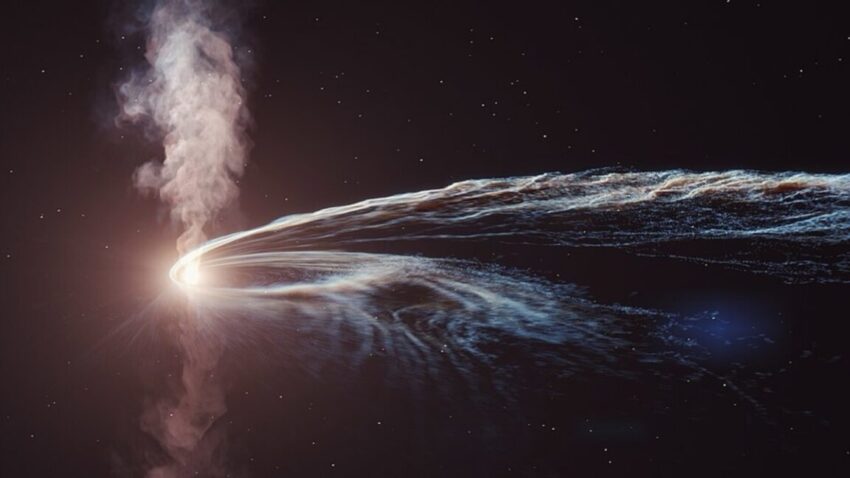
this black hole burps with death star A remarkable phenomenon involving a black hole has captured the attention of astronomers and astrophysicists alike, revealing insights into the dynamic nature of these enigmatic cosmic entities.
this black hole burps with death star
Understanding Tidal Disruption Events
Tidal disruption events (TDEs) occur when a star or other celestial object ventures too close to a black hole, resulting in the gravitational forces of the black hole tearing the object apart. This process generates a significant amount of energy, often observable across various wavelengths, including visible light, X-rays, and radio waves. The event is characterized by a dramatic increase in brightness as the black hole consumes the remnants of the disrupted object.
The TDE known as AT2018hyz was first detected in 2018, but it exhibited unusual behavior that has intrigued scientists. Unlike typical TDEs, which tend to fade after their initial outburst, AT2018hyz re-emerged with a resurgence of brightness, leading to its monitoring by astronomers worldwide. The phenomenon has been likened to a “burp” from the black hole, a term that captures the unexpected nature of its reactivation.
The Discovery of AT2018hyz
In 2022, researchers, including Yvette Cendes from the University of Oregon, published findings on AT2018hyz that shed light on its unusual behavior. The black hole, humorously nicknamed “Jetty McJetface” by Cendes, demonstrated a 50-fold increase in brightness since its initial detection. This dramatic change raised questions about the underlying mechanisms driving such an extraordinary event.
The name “Jetty McJetface” is a playful reference to a 2016 internet poll in the UK where the public voted to name a research vessel Boaty McBoatface. This lighthearted approach to naming reflects the often serious nature of scientific research, allowing researchers to engage with the public in a more relatable manner.
Current Observations and Predictions
As astronomers continue to monitor AT2018hyz, they have noted that its brightness is not only sustained but continues to increase. According to a new paper published in the Astrophysical Journal, the energy emissions from the black hole may not reach their peak until 2027. This prediction has significant implications for our understanding of black hole behavior and the nature of TDEs.
The sustained brightness of AT2018hyz suggests that the black hole is actively ejecting material in the form of powerful jets. This behavior contradicts the common misconception that black holes are merely cosmic vacuum cleaners, indiscriminately sucking up all matter in their vicinity. In reality, black holes are more complex entities, exhibiting both destructive and constructive behaviors.
The Mechanics of Black Holes
To understand the behavior of AT2018hyz, it is essential to grasp the mechanics of black holes. When an object approaches a black hole, it experiences extreme gravitational forces. If the object is a star, for instance, the tidal forces can stretch and compress it, leading to its eventual disintegration. Some of the material from the disrupted star is consumed by the black hole, while other parts are expelled outward at high velocities, forming jets.
These jets are composed of charged particles and can emit radiation across the electromagnetic spectrum. The energy released during this process can be immense, often outshining entire galaxies. The jets produced by AT2018hyz have been observed emitting exceptionally bright radio waves, contributing to its classification as a TDE.
Implications for Astrophysics
The ongoing observations of AT2018hyz provide valuable insights into the behavior of black holes and their interactions with surrounding matter. The sustained brightness and energy emissions from this TDE challenge existing models of black hole dynamics and may lead to new theories regarding their formation and evolution.
One of the critical implications of this research is the potential for a deeper understanding of the role black holes play in the evolution of galaxies. Black holes are thought to influence the formation and growth of galaxies through their gravitational pull and the energy they release during events like TDEs. By studying TDEs such as AT2018hyz, scientists can gain insights into the processes that govern galaxy formation and the lifecycle of stars.
Stakeholder Reactions
The scientific community has expressed excitement over the findings related to AT2018hyz. Researchers are eager to continue monitoring the black hole as it evolves, with many anticipating that the data collected will lead to groundbreaking discoveries. The collaborative nature of astrophysical research allows for a diverse range of perspectives and expertise, enhancing the overall understanding of such complex phenomena.
Public interest in black holes and TDEs has also surged, fueled by the captivating nature of these cosmic events. The playful naming of AT2018hyz as “Jetty McJetface” has resonated with the public, making the research more accessible and engaging. This connection between scientists and the public is crucial for fostering interest in science and encouraging future generations to explore the field.
Future Research Directions
As researchers continue to study AT2018hyz, several avenues for future research have emerged. One area of focus is the detailed analysis of the jets produced by the black hole. Understanding the composition, structure, and dynamics of these jets could provide crucial insights into the mechanisms driving black hole activity.
Additionally, researchers are interested in comparing AT2018hyz with other TDEs to identify common patterns and behaviors. By compiling data from multiple events, scientists can refine their models of black hole dynamics and improve predictions regarding future TDEs.
Technological Advancements in Astronomy
The study of AT2018hyz has been made possible by advancements in astronomical technology. Observatories equipped with powerful telescopes and sensitive instruments can detect and analyze the faint signals emitted by distant cosmic events. The ability to observe across various wavelengths, including radio, optical, and X-ray, has revolutionized our understanding of the universe.
As technology continues to evolve, astronomers will have access to even more sophisticated tools for studying black holes and TDEs. Future telescopes, such as the James Webb Space Telescope, are expected to provide unprecedented views of the cosmos, allowing researchers to explore the intricacies of black hole behavior in greater detail.
Conclusion
The case of AT2018hyz serves as a compelling reminder of the complexities of black holes and the dynamic nature of the universe. As researchers continue to monitor this extraordinary TDE, they are not only uncovering the mysteries of black holes but also contributing to our broader understanding of cosmic evolution. The excitement surrounding AT2018hyz underscores the importance of continued investment in astronomical research and technology, paving the way for future discoveries that may reshape our understanding of the cosmos.
Source: Original report
Was this helpful?
Last Modified: February 6, 2026 at 12:37 am
1 views