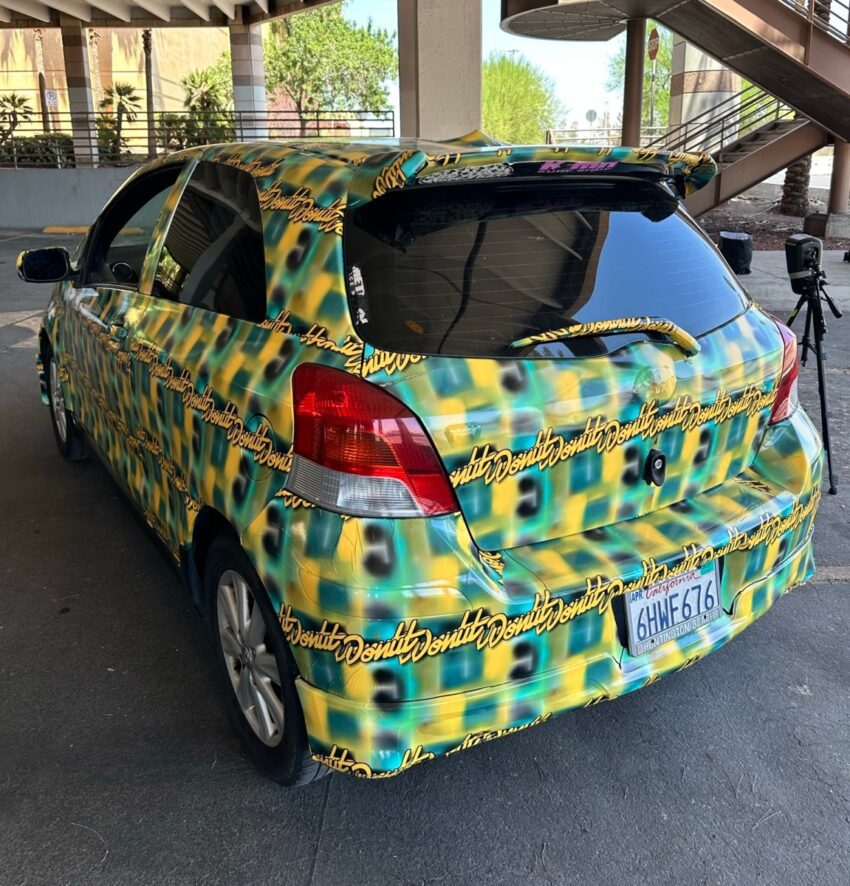
Bill Swearingen says he has built a pattern that can help clothing, objects and even vehicles slip past some of the surveillance cameras now common on American streets. After roughly 31 million tests, the Kansas City cybersecurity professional says his noRecognition project can generate designs that stop several widely used camera-detection systems from flagging what they cover, including people, license plates and cars.
How noRecognition works
The patterns do not stop cameras from recording video. Instead, Swearingen says they interfere with the detection layer that modern surveillance systems use to identify faces, objects or plates in footage. In practice, that means a camera may still see the scene, but the software behind it may fail to trigger an alert.
That distinction matters because today’s surveillance systems are often built to do more than store video. They scan footage automatically, looking for activity of interest so law enforcement or security operators can quickly spot a target in a sea of recordings.
A year of testing, millions of attempts
Swearingen said the project began as a proof-of-concept test lab and grew steadily over the past year as he worked through open-source detection systems one by one. He eventually scaled up the effort with more computing power and support from the broader community, which he thanked for contributing hardware to help push the research forward.
From there, his work evolved into a reinforcement learning model that could repeatedly test patterns, learn from failures and keep refining its output. Swearingen described the process simply: he taught the model “how to paint.”
Each time a pattern was detected, the model adjusted and tried again. Over time, he said, it began producing patterns that could defeat multiple detection systems at once.
What the model has beaten so far
According to Swearingen, the patterns were able to defeat all 11 open-source detection algorithms he tested. He said that included software associated with:
- Flock license plate readers
- Axon body-worn cameras
- Cameras running Clearview AI
He also said the system now generates new patterns every minute, with each batch “mathematically better than the last.”
Why Swearingen says the project matters
Swearingen told TechCrunch he sees the work as a privacy tool, not a novelty. “Privacy is a fundamental right,” he said, adding that the patterns are meant to let people “opt-out of being tracked.”
He said his motivation came partly from the environment around him in Kansas City, where he described surveillance cameras as dense and often placed close together. He also said he never agreed to be watched in public or to have his driver’s license used for facial recognition.
Swearingen said he is aware that his own background has shielded him from some of the harms surveillance can inflict. But he pointed to a moment last year when he wanted to attend a protest and felt uneasy about the number of cameras that could track people exercising constitutional rights to free expression.
First public test at Def Con
The project’s first public demonstration took place Friday at the Def Con cybersecurity conference in Las Vegas. With help from Donut Media, Swearingen covered a 2009 Toyota Yaris in one of his newest patterns and tested whether a Flock camera would fail to detect it.
Swearingen said the test worked, though the wheels posed a challenge. Donut Media said video of the demonstration will be released in the coming weeks.
That live test is important because it moves the project beyond the lab. Swearingen’s earlier results were based on algorithmic testing, but the Def Con demo offered a real-world example of how a pattern can alter what surveillance software notices.
From research to merchandise
Swearingen said the next step is getting the patterns into the hands of people who want them. The noRecognition project already has a crowdfunding campaign tied to early merchandise, including T-shirts and hoodies, with the possibility of vehicle skins later.
He said the goal is to make the designs high quality, with enough resolution to work from a distance while still looking good. At the same time, he said he is keeping his strongest patterns offline so camera makers do not immediately adapt to them.
That cat-and-mouse dynamic is likely to continue. Swearingen said his models keep generating new patterns, and that every failure makes the system stronger.
What this says about surveillance today
Swearingen’s work highlights a broader shift in public surveillance: cameras are increasingly paired with software that can make sense of what they see. That includes license plate recognition, facial recognition and other automated detection tools that can process huge amounts of footage far faster than a human watcher.
For people concerned about being identified in public, that makes countermeasures more appealing. Earlier attempts have included art projects, clothing designed to confuse facial recognition and eyewear meant to reduce detection, though Swearingen suggests his approach is more systematic and tuned to modern detection software.
The project is still early, and its long-term effectiveness against commercial systems remains to be seen. But the Def Con demonstration suggests that algorithmic surveillance, at least in some cases, can be disrupted with patterns designed specifically to exploit how detection models work.
Source: Original report
Was this helpful?
Explore more: Application Audit & Review More Cybersecurity Tech News
Last Modified: August 10, 2026 at 4:48 pm
4 views