The Hisense L9Q is a reminder that ultra-short-throw projectors have quietly matured: in a small theater room, it delivers a big-screen experience with very few compromises. After spending time with the projector, the reviewer concluded that Hisense’s latest model combines high brightness, strong color, solid built-in audio and a compact footprint in a way that makes the “low-profile theater room” feel more convincing than ever.
Design and setup
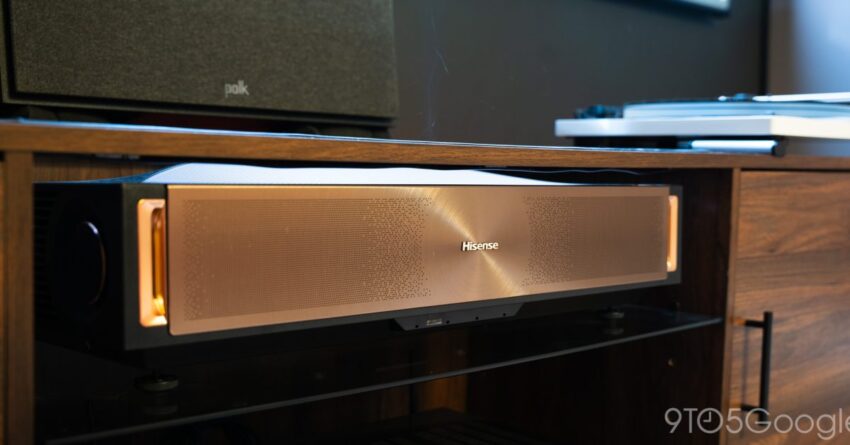
The L9Q arrives with a presentation that leans premium. Hisense gives the projector a gold facade with a textured faceplate that catches the light, plus two orange LEDs on either side that glow when the unit is sleeping. It is not a look everyone will want on a media console, but in the review it was described as adding warmth rather than flash.
Around back, the projector includes a practical set of ports, including HDMI 2.1 and HDMI 2.0 with eARC. In the review setup, a single HDMI connection ran to an AVR handling other devices such as an Nvidia Shield Pro and Xbox Series S. Hisense also placed ventilation fans on the sides and rear, and while the projector does get warm, it was not described as running hot.
Setup appears to be the main area where precision matters. The L9Q has four adjustable feet on the bottom, which help with angle correction, but as with other ultra-short-throw models, there is very little room for error when positioning it. The reviewer recommended pulling the projector away from the wall first to determine the desired image size, then marking the final screen placement. In this case, the projector sat about 12 inches off the ground to fit a 120-inch screen, and only needed to extend about 16 inches from the wall. Even in a small room, that footprint was described as workable and generous compared with some rivals.
Brightness and image performance
Brightness is where the L9Q stands out most. Hisense rates the projector at 5,000 ANSI lumens, and the reviewer said it actually lives up to that claim. In day-to-day use, the maximum output was sometimes so strong that it felt excessive, with the reviewer settling around level 8 on a 1-to-10 scale even for daytime viewing.
That level of output makes a meaningful difference for SDR and HDR content, allowing comfortable viewing without needing to fully darken the room. Dolby Vision is a different story, but that is not unique to this projector. As the review notes, Dolby Vision tends to make scenes darker in pursuit of a more cinematic result, which means a bright room can still wash out shadow detail. The takeaway was that the L9Q remains an excellent daytime projector, even if curtains and controlled lighting still help.
Color performance also landed strongly. The reviewer said that with settings adjusted to basics such as color space set to “native” and temperature set to “Warm2,” the image looked detailed and clean. There was little need for the usual hours spent fine-tuning UST projector color settings, which is notable for a category that often demands a lot of manual adjustment.
Hisense also appears to have improved focus compared with the PX4-Pro, the previous model the reviewer had tested. Corners were sharper overall, with only slight softness near the top edges. The image was described as pixel-perfect even with 1080p sources, and Hisense’s “Ultra Sharp Mode” seems to use pixel-shifting tech to smooth text and reduce the jagged look that lower-resolution content can sometimes expose.
A note on the sharpness engine
There is one small trade-off. The reviewer said the upscaling and sharpening engine can produce a quiet ticking noise when it is active, most noticeable during some streaming content rather than Blu-ray playback. It was compared to the sound of bubbles popping in a near-empty sparkling water can. From the couch, it was not a major distraction, but it was audible.
Noise, audio and everyday use
Like most high-output projectors, the L9Q has fans, but the review found them to be relatively restrained. The fan noise was noticeable, but far quieter than models such as the Epson LS800. That matters in a small room, where every extra sound tends to stand out more clearly.
Audio performance is better than expected from a projector of this type. While the reviewer preferred an AVR and external speakers, he said the built-in system is genuinely decent and better than most TV speakers. Hisense also includes a Devialet-tuned speaker system, which helps the projector serve as a more self-contained solution for users who do not want to build a full home theater setup immediately.
Google TV and gaming
On the software side, the projector runs Google TV in what the reviewer described as a near-stock experience, with minimal added clutter apart from a channel switcher. That simplicity seems to work in the L9Q’s favor. While a separate streaming box remains an option, the onboard platform was described as more than good enough for many users, especially those who want to keep the setup to one remote and one content hub.
The L9Q also handles gaming well. Hisense designed it with console use in mind, and the system automatically wakes when a console is connected. The menu also shifts into a more gaming-focused theme. The reviewer did not spend a huge amount of time gaming on a 120-inch screen, but said the projector handled everything from modern consoles to an original Nintendo Switch well, with the image sharpening helping older or lower-resolution content look better at scale.
Bottom line
The review’s overall verdict was simple: the Hisense L9Q is the best projector the reviewer has used so far. It checks the key boxes that matter most in a premium ultra-short-throw model: brightness, color, focus, usable onboard software and a strong enough built-in speaker system that it can work without immediate upgrades.
That does not mean it is inexpensive. The Hisense L9Q sells for $5,999 at retailers such as Amazon and Crutchfield. But for buyers trying to create a large-screen theater in a smaller room, the appeal is clear. It can produce an image up to 200 inches while keeping its footprint close to the wall, and the review suggests it does so with fewer frustrations than many competing projectors.
Source: Original report
Was this helpful?
Explore more: More Consumer Technology Tech News Blog
Last Modified: July 7, 2026 at 9:23 pm
10 views