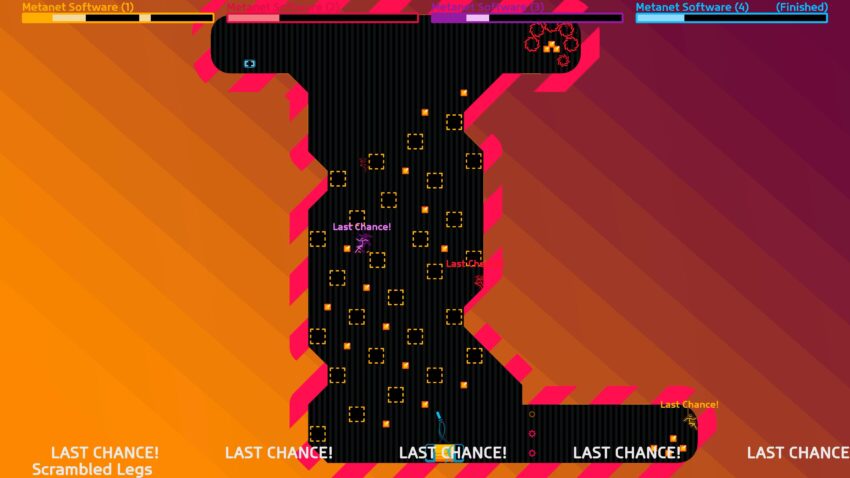
More than a decade after N++ arrived as the “ultimate” single-player version of Metanet’s long-running platformer series, the two-person studio is returning to the franchise with a multiplayer sequel. The new game, N Plus Infinity Times Two, is due in 2027 on PS5, Xbox, Switch 2, and PC, and Metanet says it is being built as a competitive and cooperative “virtual couch party game” rather than another solitary endurance test.
A sequel to a sequel, but with company
Metanet’s N++ launched in 2015 after a decade of work on a series that began with the freeware Flash game N. At the time, cofounder Raigan Burns joked, “We hope it’s not another 10 years before we come up with a game.” The new project makes that remark feel almost prophetic: more than 10 years later, the studio is back with another entry in the series, this time centered on multiplayer play.
According to the studio’s description, N Plus Infinity Times Two keeps the signature qualities that defined the earlier games: slick platforming, precise movement, and the minimalist visual style inspired by graphic design. The difference is that the new title is being designed around playing with others in a handful of modes, either competitively or cooperatively. Metanet is positioning it as a game with a “low skill floor and no skill ceiling,” meaning it should be approachable for newcomers while still leaving room for highly skilled play.
Why Metanet came back to N
Burns said the studio’s return to the series began in 2022, when the team started to get “the ‘let’s take another crack at it’ bug.” Over the previous 11 years, Metanet had not stood still. The company relocated from Toronto to Montreal, prototyped ideas for larger projects, and last year released a 10-year anniversary update for N++.
Still, the team’s basic approach to making games has remained unchanged. Burns says Metanet has resisted scaling up in the way many game studios do, even after making two successful games in the series. The reason, he explained, is that it can take a long time to identify a game idea worth pursuing commercially.
“We’ve resisted doing something that would compromise our ability to keep iterating and prototyping until something good shows up,” Burns said.
Cofounder Mare Sheppard framed that same philosophy in more personal terms.
“It’s important to feel that magic,” Sheppard said. “That’s what’s compelling about making games. That’s when we know that we’re doing it in a way that’s right for us.”
Staying small on purpose
Burns offered a blunt comparison for how Metanet prefers to work: “We like being in a band. That’s fun. Being in a lot of meetings and doing a lot of managing: not fun.” That attitude stands in contrast to much of the modern game industry, where studios often grow quickly after a hit and then struggle with the cost and complexity that follow.
The studio’s small size is not an accident. It is a deliberate choice tied to how Metanet makes games and how it wants to keep making them. Rather than expanding for its own sake, the team has prioritized keeping its process nimble enough to allow for experimentation until it lands on something that feels right.
From solo obsession to shared play
The new sequel also reflects a broader shift in how players, especially younger ones, tend to experience games. Burns said part of the inspiration came from observing that even when kids are playing alone, they are often still talking with friends on their phones. In effect, the social layer is already there, even in games that are technically single-player.
Metanet wanted to connect that reality with the couch co-op experiences Burns and Sheppard grew up with. That led them back to the N formula, but with a multiplayer angle designed to make the game feel naturally social rather than bolted on.
The team described making N++ as grueling, especially because the game’s own difficulty meant testing levels repeatedly. By contrast, Burns said this new project has felt energizing from the start.
“This one really feels like we’re having fun,” Burns said. “We’re really fluent in this one instrument. So now the fun challenge becomes playing new styles of music we’ve never played before, but with this thing we’re really comfortable with.”
Why sequels can still feel fresh
Burns also argued that revisiting a familiar idea can still be creatively valuable, particularly at a time when games and other creative industries can feel increasingly homogenous. In his view, returning to a concept like N is not necessarily a lack of imagination if the new version offers a distinct point of view.
He pointed to examples such as Hades II and Silksong, describing them as indie sequels that build on a core idea while doing something new enough to stand on their own. Burns said the same logic applies to Metanet’s work: “Being yourself is more fun and exciting anyways,” he explained. “But I honestly think it’s more commercially viable to do something only you can do, because then you have no competition.”
What comes after N Plus Infinity Times Two
Metanet is not saying much yet about its next project beyond the new sequel. Burns and Sheppard said there are a few larger 3D game ideas in the mix, though those would likely require the kind of studio expansion the team has so far avoided.
For now, the pair are not closing the door on the N series itself. Sheppard said the studio no longer sees N Plus Infinity Times Two as necessarily the final game in the franchise.
“If we can do something that expresses something new, or lets us see things in a different way, or we get a different perspective on what this game is or how to play it, that’s exciting,” Sheppard said. “I think we no longer think this is definitively going to be the last one. We’ve abandoned that idea. It doesn’t have to be.”
Source: Original report
Was this helpful?
Explore more: More Gaming Tech News Blog
Last Modified: July 7, 2026 at 9:24 pm
6 views