Instacart has built Blueberry, an AI-powered assistant designed to help on-call engineers investigate production incidents faster. The system combines multiple AI agents with operational data and historical incident knowledge, then surfaces context and root-cause hypotheses directly inside the collaboration tools engineers already use.
Why Instacart built Blueberry
The company said Blueberry was created to address a familiar pain point in large-scale operations: the early minutes of an incident are often consumed by context gathering rather than diagnosis. Engineers may need to identify service ownership, review recent deployments, inspect logs and metrics, search internal documentation, and compare symptoms against previous incidents before they can make a confident call.
By automating much of that discovery work, Instacart aims to shorten the time between an alert firing and a useful investigation starting. The emphasis is not on replacing engineers, but on giving them a faster, more informed starting point when production issues appear.
How the Blueberry incident assistant works
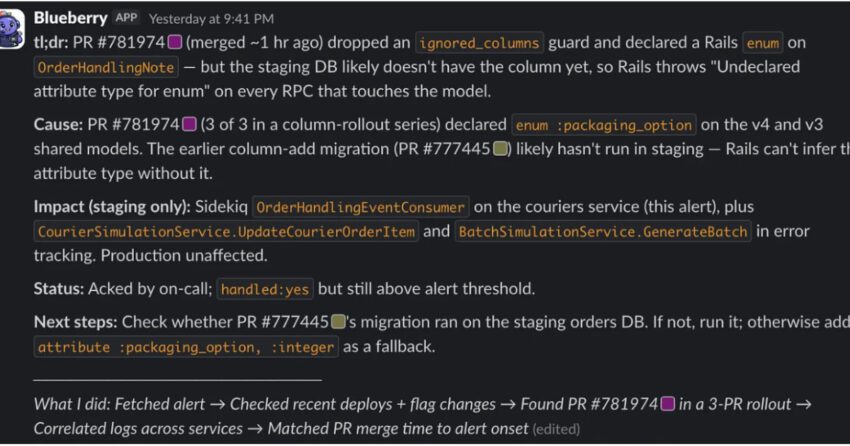
Blueberry is integrated into Slack-based incident workflows, which means engineers can continue working in the same channels where incident response is already happening. Instead of moving to a separate console, they receive investigation support in-thread, including gathered context, possible explanations, and supporting evidence pulled from internal systems.
According to Instacart CTO Anirban Kundu, when an alert is triggered, Blueberry launches approximately 10 subagents in parallel and generates a grounded root cause hypothesis directly in the Slack thread where engineers are collaborating. The system typically returns that first pass within about three minutes.
That design reflects a broader pattern in agentic AI systems: using specialized subagents to break a complex task into smaller retrieval and reasoning steps. In Blueberry’s case, those steps are aimed at incident triage and debugging rather than open-ended conversation.
What the system looks at
Instacart said Blueberry connects agents to organization-specific operational knowledge rather than relying only on general-purpose model outputs. The system draws from internal sources such as:
- incident history
- service ownership data
- logs
- deployments
- other debugging signals
- documentation and prior operational context
This grounding is important because incident response depends heavily on local context. A model can suggest plausible causes, but a useful operational assistant needs to know which services are involved, what changed recently, and how similar incidents were handled before.
Performance gains and operational scale
Instacart reported that Blueberry executed approximately 25,000 diagnostic passes in April across more than 270 Slack channels. The company also said that its diagnostic accuracy improved after the system was grounded with more than 14 years of incident history, moving results from the mid-60% range to the high 90% range.
In addition to that accuracy improvement, Instacart reported a 99.9% workflow success rate, more than 58,000 MCP tool dispatches, and support for around 60 team profiles. These figures suggest that Blueberry is being used as a practical internal system rather than a small experiment, with repeated interaction across multiple teams and channels.
The company’s reported usage numbers also show why the workflow design matters. If an assistant is expected to participate in live incident response at scale, it needs to be reliable, fast, and embedded in the communication patterns engineers already follow under pressure.
Why grounding matters in AI for incident response
One of the main challenges in applying AI to production operations is avoiding confident but unsupported answers. Instacart described Blueberry as using a tool-aware approach in which agents retrieve information from connected systems while preserving investigation state. That means the assistant is not simply generating text; it is coordinating retrieval, reasoning, and context management as part of a traceable workflow.
The company also emphasized that engineers remain responsible for diagnosis, mitigation decisions, and remediation. Blueberry supports the investigation, but it does not automatically make production changes. That boundary is significant in operations, where automation errors can quickly turn a service issue into a larger outage.
In other words, Blueberry is intended to be a force multiplier, not an autonomous operator. The assistant gathers context and proposes hypotheses, while the humans on call decide what to do next.
Operational knowledge as a long-term asset
Another key idea behind Blueberry is the preservation of operational knowledge. Incident response teams often solve difficult issues, document what they learned, and then move on. Over time, some of that context gets buried in chat logs, runbooks, or postmortems, making it harder to reuse during future incidents.
By incorporating historical incidents and team-specific context, Blueberry helps make that previous experience available when new problems appear. Instacart’s view is that the value of incident response is not only in fixing the current issue, but also in building a reusable knowledge base that improves the next investigation.
Comments from Instacart leadership
Siby Alappatt, vice-president of engineering at Instacart, said the system has improved on-call troubleshooting and mitigation. He described Blueberry as “a force multiplier in harnessing AI to help transform on-call and help us quickly troubleshoot and mitigate complex issues in production.”
Alan Wong, director of software engineering at Instacart, said Blueberry changes the starting point for engineers by giving them relevant information before deeper analysis begins. Rather than starting from an empty investigation path, engineers can begin with collected context such as logs, deployments, and related system information.
Those comments point to a practical benefit that is easy to understand: less time spent assembling the puzzle, more time spent solving it. In incident response, that difference can matter when every minute of uncertainty affects service reliability and customer experience.
What Instacart’s approach says about AI in operations
Blueberry highlights a broader lesson about AI in infrastructure and reliability work. Model capability alone is not enough. For AI to be useful in production operations, it also needs strong engineering around it: workflow integration, durable state, trustworthy data sources, feedback loops, and clear guardrails about what the system can and cannot do.
Instacart’s implementation also shows the importance of context-specific design. A generic assistant may answer questions, but an incident-response assistant has to understand the structure of services, the history of previous failures, and the collaboration habits of the on-call team. The closer the assistant fits the operational workflow, the more likely it is to save time in real incidents.
That does not eliminate the need for human expertise. It does, however, shift the work toward interpretation and action, which is where engineers are most valuable during an outage. If Blueberry continues to perform at the reported scale and accuracy, it may serve as a useful example of how AI can support site reliability engineering without taking control away from the people accountable for the system.
Source: Original report
Was this helpful?
Explore more: Software Testing Services More AI & Automation Tech News
Last Modified: August 10, 2026 at 4:52 pm
10 views