how easter island s giant statues walked Easter Island’s iconic moai statues, renowned for their monumental size and cultural significance, have long intrigued scholars and visitors alike, particularly regarding their construction and transportation methods.
how easter island s giant statues walked
The Moai of Easter Island: A Cultural Legacy
Easter Island, known as Rapa Nui to its indigenous inhabitants, is a remote volcanic island located in the southeastern Pacific Ocean. It is famous for its giant statues, called moai, which were constructed approximately 800 years ago. These statues, often weighing as much as 92 tons, were typically mounted on stone platforms known as ahu. The moai are not merely artistic expressions; they hold deep cultural and spiritual significance for the Rapa Nui people, representing ancestral figures and serving as a connection to their heritage.
Despite their prominence, the methods used to carve, transport, and erect these statues have been subjects of intense debate among archaeologists and historians. The sheer scale of the moai raises questions about the capabilities of the Stone Age culture that created them. How did a relatively small population manage to produce such monumental works? What techniques did they employ to move these massive structures across the island’s rugged terrain?
The Walking Hypothesis
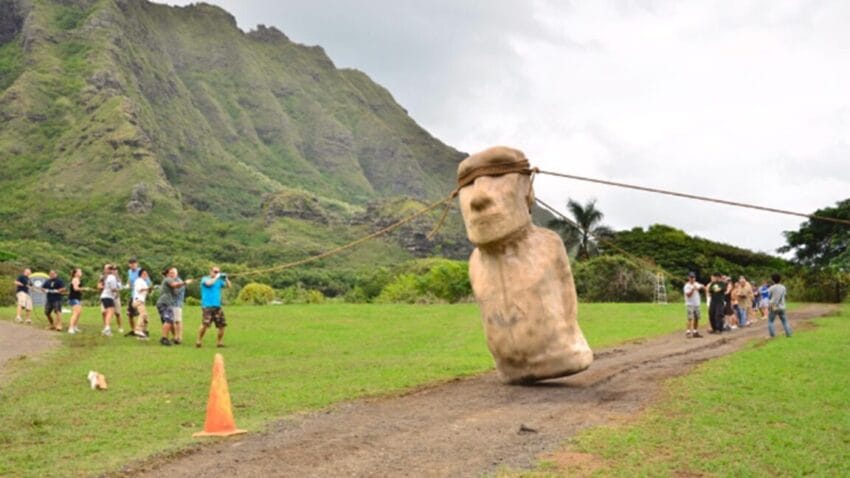
One of the most intriguing theories regarding the transportation of the moai is the “walking hypothesis,” championed by archaeologist Carl Lipo of Binghamton University. This hypothesis posits that the statues were moved in a vertical position, with workers using ropes to “walk” the moai to their final locations. This method would involve a coordinated effort where teams of workers would pull the statue forward while simultaneously rocking it back and forth, allowing it to “walk” across the ground.
Oral Traditions and Historical Context
The idea of the moai “walking” is not merely a modern invention; it is rooted in the oral traditions of the Rapa Nui people. These traditions include songs and stories that recount how the moai were transported from the quarry to their platforms. One such song tells of an ancestor who made the statues walk, suggesting that this concept has been part of the island’s cultural narrative for generations.
Experimental Evidence and Criticism
While the walking hypothesis has garnered attention, it has also faced skepticism. Critics argue that the logistics of moving such massive statues in this manner would be incredibly challenging, if not impossible. However, Lipo and his colleagues have sought to provide fresh evidence to support their claims. In a recent paper published in the Journal of Archaeological Science, Lipo co-authored a study that offers new experimental data and 3D modeling to demonstrate the feasibility of the walking method.
The study involved conducting field tests to recreate the motion of the moai. By employing advanced 3D modeling techniques, the researchers were able to simulate the physics involved in moving the statues. Their findings suggest that the moai could indeed be transported using the walking method, requiring fewer workers than previously assumed.
Historical Context of Easter Island
The arrival of Europeans in the 17th century marked a significant turning point for Easter Island. When Dutch explorer Jacob Roggeveen first landed on the island in 1722, he encountered a population of only a few thousand inhabitants. This was surprising, given the island’s rich cultural heritage and the presence of numerous moai. The prevailing assumption among scholars has been that the island once supported a much larger population, potentially numbering in the tens of thousands.
However, Lipo’s research challenges this assumption. He and his colleague, Terry Hunt of the University of Arizona, conducted experiments in 2012 that demonstrated it was possible to transport a 10-foot, 5-ton moai a few hundred yards with just 18 people and three strong ropes. This finding suggests that the construction and transportation of the moai could have been accomplished with a smaller workforce than previously thought, thereby altering our understanding of the island’s demographic history.
Implications of the Research
The implications of Lipo’s research extend beyond the logistics of moving the moai. Understanding how these statues were transported sheds light on the social organization of the Rapa Nui people. If fewer workers were needed to move the statues, it raises questions about the societal structure and labor dynamics of the island’s inhabitants. Were there specialized roles within the community? How did the Rapa Nui people coordinate such large-scale projects?
Moreover, the research contributes to the broader discourse on the environmental and social challenges faced by the Rapa Nui people. The construction of the moai and the deforestation associated with it have been linked to the island’s ecological decline. As the population grew and resources became scarce, the societal structure may have shifted, leading to conflicts and a decline in the population.
Modern Relevance and Preservation Efforts
Today, Easter Island is a UNESCO World Heritage site, and the moai continue to attract tourists from around the globe. However, the island faces numerous challenges, including environmental degradation and the impacts of climate change. As scholars like Lipo continue to explore the history of the moai, their findings can inform conservation efforts aimed at preserving both the statues and the cultural heritage of the Rapa Nui people.
Efforts to protect the moai and their platforms are critical, as they are not only symbols of the island’s past but also vital components of its cultural identity. The ongoing research into the construction and transportation of the moai highlights the importance of understanding historical practices in the context of modern challenges.
Community Engagement and Education
Engaging the local community in preservation efforts is essential for the future of Easter Island. Educational programs that emphasize the cultural significance of the moai and the history of the Rapa Nui people can foster a sense of pride and responsibility among residents. By involving the community in conservation efforts, there is a greater chance of ensuring the longevity of these monumental statues.
Conclusion
The story of Easter Island’s moai is a testament to human ingenuity and cultural resilience. As researchers like Carl Lipo continue to unravel the mysteries surrounding these statues, we gain valuable insights into the lives of the Rapa Nui people and the challenges they faced. The walking hypothesis, while still debated, opens new avenues for understanding how these monumental works were created and transported.
As we reflect on the significance of the moai, it is crucial to recognize their role in the cultural heritage of Easter Island. The ongoing research not only enriches our understanding of the past but also informs contemporary efforts to preserve this unique island and its remarkable history for future generations.
Source: Original report
Was this helpful?
Explore more: More General Technology Tech News Blog
Last Modified: October 9, 2025 at 8:37 pm
4 views