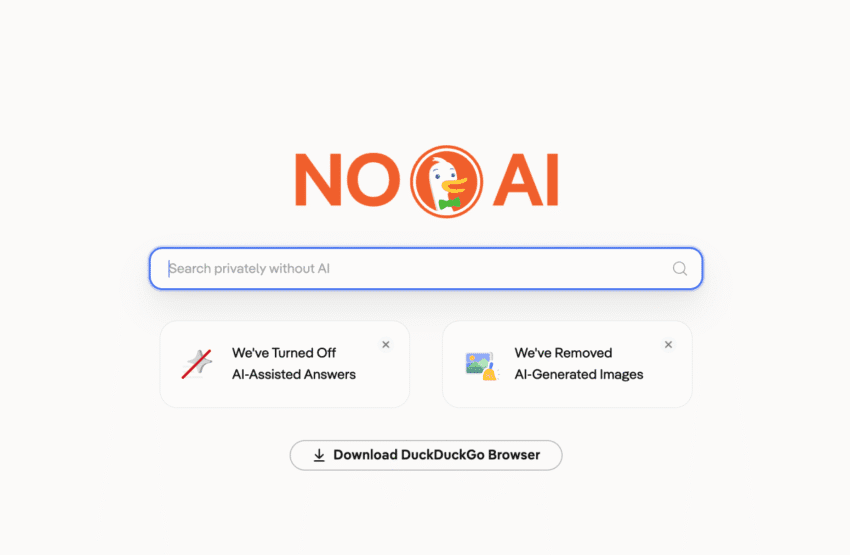
DuckDuckGo is making it easier for users to opt out of AI-powered search results, as the privacy-focused search engine says traffic to its no-AI experience is surging. The company has launched new browser extensions for Chrome and Firefox that let people set noai.duckduckgo.com as their default search engine, sending queries to a version of DuckDuckGo that removes AI-assisted answers, chat prompts and most AI-generated images from results.
A new shortcut to an AI-free search experience
The extensions are designed for users who want a more consistent search experience without AI features showing up by default. Once installed and enabled, they direct users to DuckDuckGo’s AI-free search page. DuckDuckGo says that page does not include AI-assisted answers or chat prompts, and it reduces AI images in search results.
The company said people who already use the DuckDuckGo web browser have their AI settings preserved even if they clear their browser history, which makes the browser itself another way to keep the same search preferences over time.
DuckDuckGo said the new tools are meant to make it simpler to maintain an AI-free setup at a time when that is getting harder to find. The company pointed to Google’s recent AI-first search revamp, announced at its developer conference earlier in May, as a major reason some users may be looking for alternatives.
Traffic is rising after Google’s search changes
DuckDuckGo says interest in its no-AI search page has climbed sharply since Google’s announcement. Last week, the company said web visits to its no-AI search page were up nearly 30% week over week. U.S. app installs were also up 18.1% week over week, while U.S. iOS app installs peaked at 69.9% week-over-week growth.
The company also said traffic reached another milestone on Thursday, May 28, 2026, when visits to its no-AI search page were up threefold and hit a new high-water mark since Google’s search announcement. DuckDuckGo added that the increase is not just appearing in short bursts. According to the company, visits are averaging about 84% above baseline, suggesting a more durable shift in user behavior.
Those numbers came after Google disclosed what may be the most significant change to its search product in more than 25 years. Instead of putting a traditional list of links at the top of results, Google is now favoring AI-generated search overviews. These overviews are becoming more interactive, with the ability to create visualizations, charts, graphs and, in some cases, mini apps when needed. Follow-up questions from AI Overviews can then move users into an AI Mode chat experience.
In that setup, the familiar “10 blue links” that long defined Google search are pushed lower on the page and become more of a secondary option. For users who want a conventional search experience, or who do not want AI to be the default layer between them and search results, that shift has created a clear opening for alternatives.
DuckDuckGo is leaning into anti-AI sentiment, but not rejecting AI entirely
DuckDuckGo’s new extension launch reflects a broader interest in alternative search engines such as Kagi and others, which have benefited from users who are uncomfortable with AI being placed at the center of search. At the same time, DuckDuckGo is careful not to present itself as wholly anti-AI.
The company still offers its own AI chatbot, which can access many popular models. It also has a subscription plan that includes access to the latest models, along with additional tools such as a VPN service, identity theft restoration and personal information removal services.
That distinction matters because DuckDuckGo’s message is not that AI should disappear from search entirely. Rather, it is that users should have a clear choice about whether they want AI features enabled. The new extensions and browser settings are aimed at making that choice easier to control.
What the new extensions do
The new Chrome and Firefox extensions are the most direct way DuckDuckGo is offering to make its no-AI search page the default. The company says the extensions are already available for those two browsers, and that they provide a straightforward route to the noai.duckduckgo.com search experience.
- They let users set noai.duckduckgo.com as the default search engine.
- They direct searches to DuckDuckGo’s AI-free page.
- That page removes AI-assisted answers and chat prompts.
- It also shows fewer AI-generated images in results, according to the company.
DuckDuckGo said its original DuckDuckGo Privacy Essentials extensions for Chrome, Firefox, Edge and Opera will soon be updated as well, adding controls for AI search settings. That means users who already rely on those extensions for privacy-related features may soon get an additional way to manage AI options without switching tools.
Why the timing matters
The timing of DuckDuckGo’s move is closely tied to the broader debate over AI in search. Google’s announcement in May signaled a major change in how the company wants people to interact with search, and that appears to have made some users more aware of the trade-offs involved. For some, the appeal of AI summaries is convenience. For others, the concern is that AI features are becoming unavoidable, even when a person just wants a standard list of links.
DuckDuckGo is positioning itself as a place for that latter group. By emphasizing a no-AI mode and making it easier to access, the company is turning product design into a privacy-and-choice argument. The pitch is not only that users should be protected from data collection, but also that they should be able to opt out of AI-generated layers in the search experience itself.
With visits rising and app installs accelerating, DuckDuckGo appears to be seeing real demand for that message. The company has not said how long the current traffic surge will last, but its latest numbers suggest that the search market may be entering a period of more visible user migration, at least among people unhappy with AI-first defaults.
Source
Source: Original report
Was this helpful?
Explore more: More Big Tech & Platforms Tech News Blog
Last Modified: July 7, 2026 at 9:37 pm
5 views