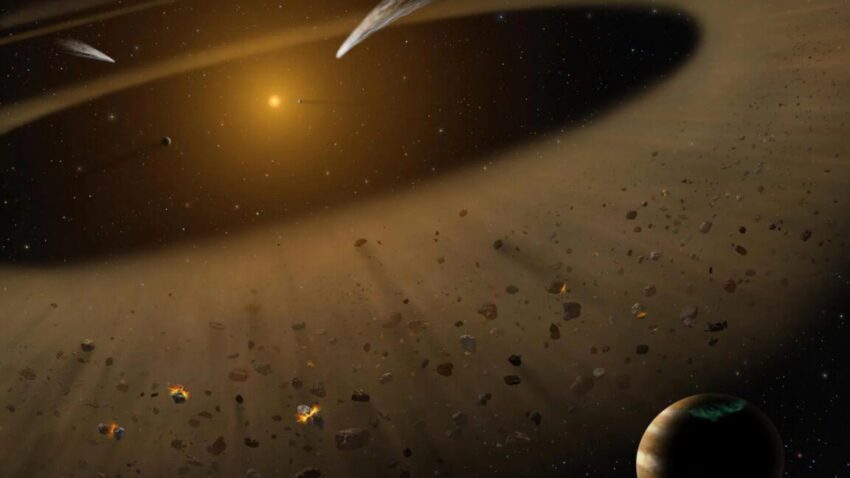
astronomers are filling in the blanks of A new era of exploration is set to unveil the mysteries of the Kuiper Belt, a distant region of our solar system that may harbor secrets about its formation and evolution.
astronomers are filling in the blanks of
The Kuiper Belt: An Overview
Located beyond the orbit of Neptune, the Kuiper Belt is a vast expanse of frozen debris, often described as a cosmic treasure trove. This region, which lies approximately 30 to 50 times farther from the Sun than Earth, is believed to be home to a myriad of ancient relics, dynamic enigmas, and possibly even undiscovered planets. Since its initial discovery in the 1990s, the Kuiper Belt has remained largely enigmatic, presenting both challenges and opportunities for astronomers seeking to understand the early solar system.
Historical Context
The Kuiper Belt was first theorized in the 1950s, but it wasn’t until the discovery of the first Kuiper Belt Object (KBO), 1992 QB1, that the existence of this region was confirmed. This discovery opened a new chapter in planetary science, revealing that our solar system is more complex than previously thought. Over the past three decades, astronomers have cataloged around 4,000 KBOs, which include a variety of celestial bodies such as dwarf planets, icy comets, and remnants from the solar system’s formation.
Current Cataloging Efforts
Despite the impressive number of KBOs already identified, astronomers believe that this is just the tip of the iceberg. The current catalog is expected to grow significantly, potentially increasing tenfold in the coming years. This surge in discoveries is largely attributed to advancements in observational technology and the deployment of next-generation telescopes.
Technological Advancements in Astronomy
The Vera C. Rubin Observatory, located in Chile, is at the forefront of this new wave of astronomical exploration. Its flagship project, the Legacy Survey of Space and Time (LSST), began operations in 2022 and is designed to conduct a comprehensive survey of the night sky. The LSST aims to capture images of the entire visible sky every few nights, allowing astronomers to monitor changes and discover new celestial objects, including KBOs.
The Role of the Vera C. Rubin Observatory
The LSST will utilize a wide-field camera capable of capturing detailed images of the night sky, enabling astronomers to detect faint objects that may have previously gone unnoticed. This capability is crucial for studying the Kuiper Belt, as many KBOs are small and distant, making them difficult to observe with traditional telescopes. The observatory’s ability to monitor the sky over time will also allow researchers to track the orbits and behaviors of these objects, providing valuable insights into their characteristics and origins.
Complementary Observations from the James Webb Space Telescope
In addition to the LSST, the James Webb Space Telescope (JWST) is another powerful tool that will enhance our understanding of the Kuiper Belt. Launched in December 2021, the JWST is designed to observe the universe in infrared wavelengths, allowing it to penetrate dust clouds and observe cooler objects that are often hidden from optical telescopes. This capability is particularly beneficial for studying KBOs, which are primarily composed of ice and rock.
The JWST’s observations will complement those from the LSST, providing a more comprehensive view of the Kuiper Belt. By combining data from both observatories, astronomers hope to gain a clearer understanding of the composition, structure, and dynamics of this distant region.
Potential Discoveries and Their Implications
The anticipated increase in KBO discoveries has significant implications for our understanding of the solar system. Each new object cataloged can provide insights into the conditions and processes that shaped the early solar system. For instance, the composition of KBOs can shed light on the materials that were present during the formation of planets.
Understanding Planetary Formation
The Kuiper Belt is thought to be a remnant of the primordial material that formed the solar system. By studying KBOs, scientists can gather clues about the processes that led to the formation of the planets, including Earth. The chemical makeup of these objects may reveal information about the distribution of elements and compounds in the early solar system, helping to refine existing models of planetary formation.
The Search for Hidden Planets
In addition to cataloging known objects, astronomers are also on the lookout for potential hidden planets within the Kuiper Belt. Some researchers theorize that the gravitational influence of undiscovered planets could explain the unusual orbits of certain KBOs. If such planets exist, their discovery would not only reshape our understanding of the Kuiper Belt but also provide insights into the dynamics of the solar system as a whole.
Challenges Ahead
While the future of Kuiper Belt exploration looks promising, challenges remain. The vast distances involved make observations difficult, and the sheer number of objects in this region complicates efforts to catalog them. Additionally, many KBOs are faint and may require advanced imaging techniques to detect.
Data Management and Analysis
The LSST will generate an enormous amount of data, estimated to be around 20 terabytes per night. Managing and analyzing this data will be a significant challenge for astronomers. Advanced algorithms and machine learning techniques will likely play a crucial role in processing the data and identifying new KBOs.
Collaboration Among Astronomers
Collaboration will also be essential in addressing these challenges. Astronomers from around the world will need to work together to share data, insights, and techniques. International partnerships can enhance the efficiency of research efforts and facilitate the sharing of resources, ultimately leading to a more comprehensive understanding of the Kuiper Belt.
Conclusion
The exploration of the Kuiper Belt represents a frontier in our understanding of the solar system. As advanced telescopes like the Vera C. Rubin Observatory and the James Webb Space Telescope come online, astronomers are poised to uncover new KBOs and deepen our understanding of this distant region. The implications of these discoveries could reshape our knowledge of planetary formation, the dynamics of the solar system, and even the potential existence of hidden planets. As we stand on the brink of this new era in astronomy, the mysteries of the Kuiper Belt await revelation.
Source: Original report
Was this helpful?
Explore more: More General Technology Tech News Blog
Last Modified: February 15, 2026 at 12:36 am
26 views