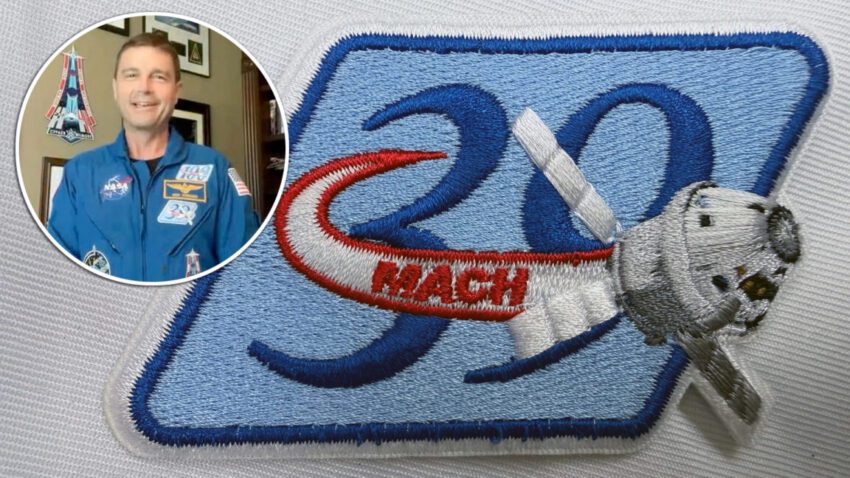
NASA’s Artemis II crew now has a new emblem to match their record-setting return from the Moon: a Mach 39 patch. The insignia marks the speed reached by Commander Reid Wiseman, pilot Victor Glover, and mission specialists Christina Koch and Jeremy Hansen of the Canadian Space Agency as they came home aboard Orion Integrity after a 10-day flight in early April.
A fast journey that made history
The Artemis II crew traveled farther from Earth than any humans have gone, reaching 52,756 miles (406,771 km) away before heading back. On reentry, they accelerated to about 24,664 mph (39,693 kph). That makes them the fastest people alive and places them among the fastest humans ever to travel in a crewed vehicle.
Only three other people in history have gone faster: Apollo 10 astronauts Thomas Stafford, John Young, and Eugene Cernan, who set the crewed-speed record on May 26, 1969 at 24,791 mph (39,897 kph). Cernan died in 2017, Young in 2018, and Stafford in 2024.
Why Mach 39, not Mach 32?
At a post-flight press conference at NASA’s Johnson Space Center in Houston on April 16, six days after landing, Glover said the crew saw “38.89” on the displays and noted that “it depends on how you measure that number.” He added: “It is actually challenging how you measure from space.”
Mach is a relative measure of speed compared with the local speed of sound, so the number changes with altitude, temperature, and air density. At sea level, 24,664 mph would correspond to about Mach 32. But at the point where Artemis II reached peak velocity, the atmosphere was thinner and colder, which pushed the measured value higher.
The patch arrives weeks later
Glover also hinted that the crew would need a new emblem. “There will be a new [Mach patch] coming out when we figure it out,” he said.
Three weeks later, including time for NASA’s embroidered patch supplier A-B Emblem in Weaverville, North Carolina, to make it, the Mach 39 patch appeared publicly on Friday, June 5. Wiseman showed it in a social media video, though he did not call attention to the patch itself. On his NASA blue flight suit, it sits on his left chest below his name tag and near his “100 Days” insignia.
The new patch replaces Wiseman’s Mach 25 patch, a design inspired by the original emblem created four decades ago for the space shuttle era.
How the Mach patch tradition began
Former astronaut Dan Brandenstein, who with Jim Buchli created the original Mach 25 patch, said the idea grew out of a post-STS-1 conversation in 1981. He recalled that McDonnell Douglas had given F-4 fighter pilots “Mach 2 Club” patches after they broke Mach 2, and that the astronauts began thinking about a similar honor for shuttle crews.
Because the space shuttle reached Mach 25 on reentry, Brandenstein and Buchli designed a patch around that milestone. The emblem featured a dark blue “25” on a light blue rectangle tilted slightly forward, with a shuttle orbiter gliding past and leaving a white contrail marked “MACH” in red.
Brandenstein said the patch was always intended as a badge of honor. “We had it made and gave one to John and Crip [STS-1 crewmates John Young and Bob Crippen], and then it became history. Everybody got one after they flew,” he said.
Variants for different spacecraft and milestones
The Artemis II version follows the same basic design, but with the number updated and the shuttle orbiter replaced by Orion, complete with its solar wings deployed from the European Service Module.
The Mach 25 patch has been adapted several times over the years. In 2009, the STS-125 crew of Atlantis realized their higher-orbit reentry would be slightly faster than most shuttle missions, so they wore Mach 26 patches after landing.
Two years later, Mike Fincke became the first astronaut photographed wearing a “MAXA 25” patch, which replaced the shuttle with a Russian Soyuz spacecraft. Similar Soyuz versions kept the English word “MACH” rather than using the Russian “MAXA.”
In 2019, A-B Emblem proposed additional versions for SpaceX Dragon and Boeing Starliner crews, each showing the respective spacecraft. In 2020, Doug Hurley was seen wearing a Dragon patch, along with a shuttle Mach 25 patch, after becoming one of the first two people to launch on SpaceX’s spacecraft.
From speed to endurance
The same patch culture has also evolved beyond velocity. Since 2004, astronauts have received “100 Days” patches to mark time spent on the International Space Station, with the shuttle replaced by the station and “MACH” changed to “DAYS.” Later versions were created for 200, 300, and 500 days, and on December 5, 2025, Fincke presented Roscosmos cosmonaut Sergey Ryzhikov with a 600 Days patch.
For Artemis II, the Mach 39 emblem adds a new chapter to that tradition. It is both a commemoration of a record-breaking flight and a nod to a custom that has followed human spaceflight for more than four decades.
Source: Original report
Was this helpful?
Explore more: More Hardware & Devices Tech News Blog
Last Modified: July 7, 2026 at 9:35 pm
16 views