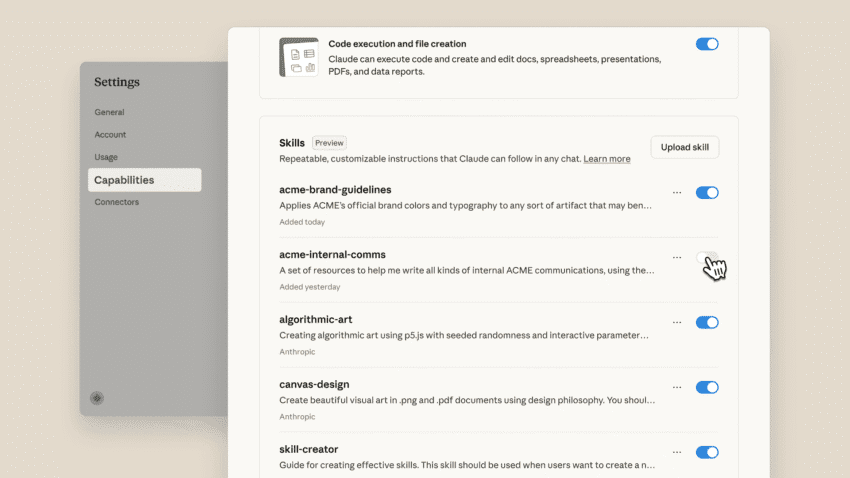
anthropic turns to skills to make claude Anthropic has introduced a new feature called Skills for Claude, aimed at enhancing the utility of its AI agent for professional tasks.
anthropic turns to skills to make claude
Understanding Skills for Claude
AI agents have evolved significantly over the years, transitioning from mere concepts to experimental tools and now to practical applications that cater to both consumers and professionals. Anthropic’s recent announcement regarding Skills for Claude marks a pivotal step in this evolution. This feature comprises a collection of “folders” that include instructions, scripts, and resources designed to enhance Claude’s capabilities for specific work tasks. According to a company release, these tasks can range from managing Excel spreadsheets to adhering to an organization’s brand guidelines.
One of the standout features of Skills is its customizability. Users can create their own Skills tailored to their specific job requirements, allowing for a more personalized experience. These Skills can be utilized across various platforms, including Claude.ai, Claude Code, Anthropic’s API, and the Claude Agent SDK. Notably, companies like Box, Rakuten, and Canva have already begun integrating this tool into their workflows, highlighting its practical applications in real-world scenarios.
The Purpose Behind Skills
The primary aim of Skills is to enhance Claude’s performance as an AI agent in professional settings. By utilizing Skills, users can reduce the time spent crafting the perfect prompt or recalling past context when attempting to complete a task. This feature is available to Pro, Max, Team, and Enterprise users, making it accessible to a wide range of professionals.
Insights from Anthropic
Brad Abrams, a product lead at Anthropic, provided further insight into the motivation behind the Skills feature. He stated, “The thing that’s interesting to me about Skills is basically about agents.” This perspective underscores the notion that Skills serve as a mechanism for organizations to train Claude to perform effectively within their specific contexts. Abrams emphasized that the focus is not on meeting arbitrary benchmarks; rather, it is about enabling Claude to execute tasks that are relevant to individual companies.
To illustrate the functionality of Skills, Abrams shared a personal experience using Claude’s PowerPoint Skill. He tasked Claude with creating a presentation on the market performance of Haiku 4.5. The result was a set of well-formatted slides that were easy to digest, showcasing Claude’s ability to deliver professional-quality outputs.
The Competitive Landscape
The introduction of Skills for Claude comes at a time when several major players in the AI space are racing to develop more effective AI agents. Companies such as OpenAI, Google, and Microsoft have been investing substantial resources into creating tools that can deliver practical benefits to users. Executives from these organizations frequently discuss the potential of agentic AI during earnings calls, signaling a strong commitment to advancing this technology.
Despite these efforts, progress in the field has often been incremental. Companies have been focused on releasing new feature updates or iterations of existing agents. For instance, Anthropic previously introduced a feature called Computer Use, while OpenAI has rolled out various iterations, including Operator, Deep Research, and ChatGPT Agent, which effectively combine multiple functionalities into a single offering.
Recent Developments from OpenAI
Anthropic’s announcement also follows a recent unveiling by OpenAI at its annual DevDay event. During this event, OpenAI introduced AgentKit, a suite of tools designed to assist developers in transitioning agents from prototype to production. This initiative targets both large enterprises and individual developers, reflecting a broad interest in making AI agents more accessible and functional.
One notable example presented during the event involved Albertsons, a grocery chain operating over 2,000 stores across the United States. OpenAI demonstrated how a custom agent could utilize specific data to devise a plan aimed at boosting ice cream sales in stores where sales had dropped by more than 30 percent. This case exemplifies the practical applications of AI agents in real-world business scenarios.
Implications for Businesses
The introduction of Skills for Claude and similar tools from competitors like OpenAI has significant implications for businesses across various sectors. As organizations increasingly adopt AI agents, the demand for customizable and efficient solutions will likely grow. Skills for Claude allows companies to tailor the AI’s capabilities to their unique needs, potentially leading to improved productivity and operational efficiency.
Moreover, the ability to create custom Skills means that organizations can leverage Claude’s capabilities in ways that align closely with their specific goals and challenges. This level of customization could lead to more effective task execution, as employees will no longer need to spend excessive time on training the AI or refining prompts. Instead, they can focus on strategic initiatives that drive business growth.
Stakeholder Reactions
The introduction of Skills for Claude has garnered attention from various stakeholders in the tech industry. Early adopters, such as Box and Canva, have expressed enthusiasm about the potential of this feature to streamline their workflows. By integrating Skills into their operations, these companies hope to enhance their productivity and improve the quality of their outputs.
Industry analysts have also weighed in on the significance of this development. Many believe that Skills for Claude represents a shift in how AI agents are perceived and utilized in the workplace. Rather than being seen as mere tools for automation, AI agents are increasingly viewed as collaborative partners that can enhance human capabilities.
Future Prospects
Looking ahead, the introduction of Skills for Claude may set a precedent for future developments in the AI agent landscape. As more companies recognize the value of customizable AI solutions, we may see a surge in demand for similar features across various platforms. This trend could drive innovation and competition among AI developers, ultimately benefiting end users.
Furthermore, as organizations continue to explore the potential of AI agents, there may be a growing emphasis on ethical considerations and responsible AI usage. Ensuring that AI agents operate transparently and align with organizational values will be crucial as these technologies become more integrated into everyday business practices.
Conclusion
Anthropic’s introduction of Skills for Claude marks a significant advancement in the realm of AI agents, offering businesses a customizable solution that enhances productivity and task execution. As companies like OpenAI and Anthropic continue to innovate in this space, the future of AI agents looks promising. The ability to tailor AI capabilities to specific organizational needs could redefine how businesses approach their workflows, ultimately leading to more efficient and effective operations.
Source: Original report
Was this helpful?
Explore more: AI Automation Services More AI & Automation Tech News
Last Modified: October 16, 2025 at 9:36 pm
11 views